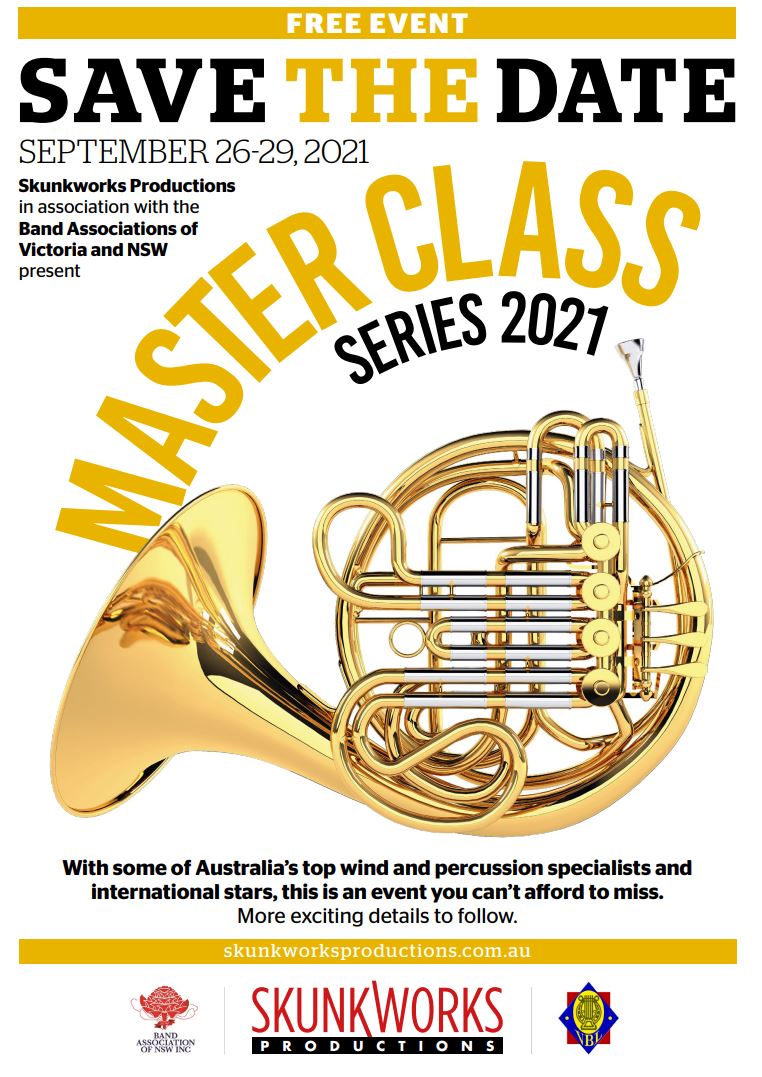
Team Brassbanned is proud to be able to support Skunkworks Productions, the Victorian Bands League and the Band Association of NSW in braodcasting a series of masterclasses over September 26 - September 30.
These masterclasses are completely free, and cover instrumental playing through to workshops on community music making, child safety policy and VCE/HSC solos.
For those that would like to take part in the interactive masterclasses, head along to the Skunkworks website. If you would just like to watch the non-interactive broadcast, then you can watch here on brassbanned.com and sometimes also on Facebook.
The full schedule of masterclasses can be seen here.

Today we will be live with:
Tenor Horn Masterclass with Sheona White at 5:30pm (Melbourne time)
Cornet Masterclass with Tom Hutchinson at 7:30pm (Melbourne time)
Transcript
Auto-generated from the live stream, expect the occasional robot mishearing.
That’s something we might have to look into doing any other questions it seems being a maintenance affection is very difficult yes we we do train a lot rob started doing this job about four years ago and he’s he’s doing he’s can do most things independently now but there’s still things that uh that he hasn’t done yet um i still have there are still things that i haven’t done yet actually this is this job you keep learning and i reckon pretty much every week we’ll see we’ll see new jobs coming in that we’ve never seen before and that’s part of the fun of this job as
Well you have to be very creative sometimes in coming up with ways to repair things that you’ve never seen broken we actually and the 3d printer comes in handy with that as well at the moment we’ve we can make molds or we can print to put instruments in to help to hold them or help them repair things in different ways than we’ve done before so we like keep to keep learning that way and developing new ways of doing things maintenance of brass and wet ministries why should we look after and why should maintain our instruments a lot of people don’t realize you have to actually
We often get people in with an instrument that doesn’t work anymore and they have no idea i don’t understand what’s happened and then we look at the instruments and it’s really worn or it’s often it’s very and then we tell people that it just needs a service and people are very surprised to hear often that an instrument needs a service but just like any other product i guess that has moving parts especially and any other thing that you put in your mouth and blow bacteria into it needs to be cleaned and the moving parts need to be lubricated and make sure that everything works the
Way it should work but the cleaning especially is a very important part of what what we do which we do a lot more cleaning than i ever expected before i started doing this pretty much every instrument that comes needs a clean before we do anything else it um so we so we do a lot of cleaning cleaning is sort of what you can do at home as well especially if you play brass instrument would be this is a little bit easier rice and strings you can clean yourself and i’ll talk a bit about that later um so there what we see the mostly is that
Three main reasons why your instrument will stop working or not work as well as it should or not live not last as long as it as it and two of those are very easy to prevent with just regular maintenance of the instrument so the main thing we see like i just talked about is dirt instruments need to be cleaned to work well there’s if they um if there’s any dirt build up on the inside and i’ll show you some photos later on really to groce you out and try to get you to look at your instruments um dirt can cause blockages it can it can
Create rotting pads leather for example or skin on other pads that will just rot away and cause leaks pads can get sticky valves can get sticky and slides can stop moving so so dirt is that is the i would say the cause of most of the things that we fix here um another reason to to keep your instrument clean is your own health we see many instruments that especially the mouthpieces can be quite dirty and some even have molds on the mold or dirt bacteria and the bacteria and the mold especially is quite bad for you so to put a mouthpiece that looks like that
In your mouth it can it actually makes people sick so another reason to look after instrument is your own health as well and the instrument will move if it’s clean or the parts will move better and it’ll just play better the second reason why we my instruments will stop playing and we’ll come into the workshop is lack of an instrument with like any anything with moving parts like your car needs oil and just like that instruments all the moving parts on an instrument also need to be lubricated if you if you don’t do that they’ll just wear all the parts the metal parts are rubbing
Against each other and they wear much quicker you get lost motion keys start to move or valves will trumpet files for example if you use them dry too much and they’ll start to to wear down and leak air and just your instrument will wear down much quicker and not play as well and the third reason that we see instruments is probably one you can you can’t do as much as about about but it’s but a lot of instruments come in here because they’ve been damaged so there’s just damage and damage can be which you should definitely come in to see it don’t try to fix
Damage yourself which dads often like to do but we we try to uh keep that away from from uh from instruments especially if they have a garage full of tools we’ve seen actually a lot of damage done by dads as well they’re natural enemy number one of instruments teachers come so accidental damage is coming that that’s that can happen that’s nothing you can do about it unfortunately it happens just like you break some dishes when you when you wash the dishes um and the other damage that can occur to instruments is wear and tear and then that brings me back to the lubrication um yeah
If you make sure you put grease and oil in the right spots yourself that’ll that can prevent a lot of damage as well um other damage that we see quite often actually is people putting their instrument in the and then closing the lid of the case and forgetting about the fact that they didn’t lock the case and then they pick it up and the lid opens and the instruments just flings over the floor there was one case of that even that happened i remember when i worked at billy hyde in blackburn a customer i think it was a saxophone the customer brought in a saxophone
For a service and they we service it they came to pick it up picked up the instrument put it on the counter and opened the case just to have a look at and then close the case but without locking it up properly paid the invoice and we’re about to leave picked up the case but the ca the saxophone just fell on the floor right in front of them and it i it got damaged quite badly actually they had to leave it book it in again and we it went back in the repair queue to faster repair but we’ve got a i’ve got a one of
The very strict rules i’ve got in the workshop to prevent things like that is to either when you put your instrument in your case either leave the lid open or if you do close the case make sure you put at least one latch closed close one latch or pull the zip if you’ve got a case with the zip on it pull the zip around the corner so that your case can’t just fling open when you pick it up it’s sort of a i think you have to get used to because it’s i really had to teach myself to do that and remind myself all the
Time but i get shivers now when i see a case sit on the bench here somewhere with with the lid closed but without the zip or the latch close it just makes me feel sick even seeing because i’ve seen it happen too often so try to try to um teach yourself that just leave if you put your instrument in that’s fine in the case without locking it up but just leave the lid of the case open so it can’t happen and speaking of putting an instrument in the case to prevent this i’m always confused a bit not 100 sure what to advise people like that
Like people ask me should i put my can i leave my instrument sitting out on the stand when i don’t play it and there are two way two things that happen with that it’s great to leave it out on a stand when you’re at home because it’s much easier to pick up your instrument again and and have a have a quick play or have a practice so it’s great to see the instrument sitting there the downside of it is that it gets dirty much quicker and especially if you play woodland instrument and you don’t take your mouthpiece and you read off and dry the instrument
Out on the inside after you stop playing it you do it gets dirty much quicker and you can you do run the risk of molten dirt building up inside the mouthpiece especially if you leave your mouthpiece and your read connected as well so i think it’s a great idea to leave it out because you do play more and especially kids sometimes the the hassle of taking it out of the instrument and putting your instrument together is too much um to to start practicing um but make sure that you at least take your mouthpiece off your instrument and wipe it out and take the read off
Clean in between practice sessions it’s just it’s better for the instrument and definitely for your health as well sorry daniel there’s a couple of questions in the um so for young students that maybe not practice as much how often do you recommend oiling the valves i’ll talk a bit about that later as well because there are different types of oil that you can use and some last a bit longer than others i can talk about that now actually so this is more specific to brussels springs obviously um you can buy uh petroleum-based and synthetic oils and other lubricants as well not just valve oil the
The petronium-based oils are a bit more old-fashioned that’s what has been around forever you’ve got the um they’re usually a bit cheaper as well and the problem with those ones or problems they work fine and some instruments actually work better but the problem with them is that they evaporate much quicker and they also wash away they don’t stick to the valves as well synthetic oils and other lubricants so if you use a petronium based oil like we’ve got alkas which is a very popular one for example or there are cheaper ones as well they you have to use you have to usually put a bit
More on it and it also washes away quicker and so with those ones you’ve probably used that even if you don’t blade very often you put it on once a week at least if you use a good synthetic oil you can use you can get several weeks out of out of oil especially if you don’t play it a lot the more you play it the quicker it washes away but in this room that’s not played very much you can with the synthetic oil you probably get two three weeks out of between between putting your oil on and so i do i do recommend buying spending
A little bit money on the on the oil and buy synthetic oil it works better with the instruments it doesn’t smell as much a lot of this a lot of the petroleum-based oils can have that petroleum smell in it which i personally hate it when i pick up an instrument put it on my mouth and i smell i it smells like i’m at the fuel station filling up with gas and so i’d rather not have that smell yeah so i would i would pre i would uh suggest buying synthetic oils synthetic other lubricants they’re a bit more expensive to buy but they’ll last you a
Lot longer uh what other questions are there where may ask where your workshop is located we are in melbourne in hawthorne in the same building like i said before is find music and we uh you can if you’re in the area obviously you can just come come past and drop the instrument off but even at the moment we we take instruments in at the front door we have a um drop off and pick up but a lot of people send send instruments in the mail as well to us which is another option make sure that you pack it up properly though can you explain the
Best way to keep parts lubricated on a saxophone i’ll definitely talk a bit about that in a can you fix a valve that has had a knock yes we can definitely do that it depends a bit usually it’s a valve casing that gets a knock um but sometimes the valve can can be dropped as well and it depends a bit on how bad it is if the valve can be paired to be repaired the valve casing is the easy part to repair usually you see a little ding on the on the outside of the valve casing which stops the valve from moving up and down
But that’s we can definitely repair that and that’s about with the questions now what’s the what’s the best way to store an instrument that doesn’t get used wrap it in plastic and then in the case play it every now and then um instruments if you are it’s so it’s often not easy to predict when you’re not going to play for a while but if you do know that you’re going to put away an instrument for a longer period of time i definitely recommend either cleaning it yourself if it is a brass instrument or give it a service bring it to the technician and tell them
That you are going to store it away for a while and make sure that it gets cleaned because if there is any dirt in any instrument you let it sit for for a long time the bacteria will still keep growing the mold can still develop so if you put it away clean you’ve got a much better chance of of it still being playable when you actually take it when you start using it and it definitely needs to be dry don’t store your instrument under your house you know humid in humid conditions because the case won’t like it but the instrument won’t either and you’re up
For a hefty repair bill and replace it off the case if you do that so keep it stored in a dry spot um preferably another issue we sometimes see is especially with clarinets is little uh larvae that get into the case and eat your paths they actually lava off the carpet beetle and we call them pad bugs but they um they get into your case let me just show you what that looks like actually i’ve got a photo here of that oh no i can’t jamie can i share my screen key it says here that the host is screen sharing can you turn that on
You can you can now great yes there we go so here’s one that’s a pad on the clarinet and it’s got little they’re actually little eggs on the side of the carpet beetle and once they come out of there they’ll start eating your pet the pad in the middle should be but they’ve eaten a whole bit of the pad away and usually what they like to do is take a little nibble out of every pad so that so that the holy spirit needs to be repatted but yeah if they get it that’s the best thing to prevent that is to move your smooth every now
And then um because they don’t like light or and then how to clean spit or water inside an elbow so for all woodwind instruments you can buy a pull through which is a on a long string with a little weight on the other side and you drop the weight into your and then you it comes out the other side you pull the string and the cloth through the instrument to remove all the moisture and water inside if you go to youtube there’s a page for fine music they’ve got a youtube page and they’ve got heaps of videos which that show things like this how to
Use pull through how to oil trumpet valves how to clean the trumpet so if you’ve got questions like this there might be a video there already that shows you how to do it but the pull through is very important on all woodwind strings it’s very important to keep them dry after you play it you do that every time sorry daniel yep can i just bring you back to an earlier question sort of back to the um the valve oil lubrication topic slightly because i’m interested in this because i i use hetman’s boiling mine on sometimes i find that it leaves like a rubbery compound behind
After a while and so someone’s asking brass instruments are their preferred slide and valve oils which are less likely to cause gunk than other problems right gunk is always an interesting one because people use even different people that use the same oil some people will complain about it and some won’t and i i think it’s got something to do with your body chemistry so everyone’s body chemistry is different and what comes out of your mouth obviously depends on your own body chemistry but also on what you eat and what you drink during the day but especially just before you play which i would recommend not
Doing anyway so it’s at some stage that what comes out of your mouth is going to react with the oil that you put on your valves and some people um body chemistry will react differently to different valve oils so admin is a great oil it’s a synthetic it works really well for most people but some people will it’ll react with some people’s gunk yeah or body chemistry and turn into gunk um so what i would always recommend doing is trying a different oil even though admin is great oil there are other oils that are just as good but stick with the synthetic one though um
But try for example the yamaha yamaha makes a good synthetic oil um there’s another brand called la tromba they make an oil called that’s t2 which we actually prefer use it a lot um but it’s it’s often i can’t tell you it’s just like with mouthpieces really it’s sort of a personal preference what the the feel which feel you like but also how it reacts with your own body chemistry so i would recommend trying a different one if that happens awesome thank you i be in shortly do you recommend the use of pad savers for saxophones well here we go for people who don’t know
What a pad saver is i’ve got a photo of it pad savers uh so i just talked about keeping an instrument this is keeping the instrument dry this pad saving particularly is for a saxophone it’s got a slight taper to it but you can also buy them for and other woodman instruments what i would what i would recommend doing is after you play this condensation and other dirt inside your instrument the ideally you would remove all that it needs to be completely dry which would prevent a breeding ground for mold and and bacteria and other things to grow and a pull through is really good
Good for that because you pull the cloth through the instrument and it absorbs all the moisture in there and it actually takes it out of the what the people that make these pad savers say is that you put the pads over in the instrument and leave it in there and just put it in the case and they say that it actually the fibers on the outside will pull the moisture away from the pad i guess the moisture just goes into the pad saver itself but the problem with that is it’s still in your instrument it’s not directly on the pads or the the bore maybe
Um but the moisture and the condensation is actually still in your instrument so it’s still a humid and moist environment where bacteria will still grow it is good for getting some it usually it just works like a brush really so it takes some of the dirt off the inside of your instrument which is um the other problem but yeah if so if you use it i would recommend not keeping it instrumented you can use it as a brush put it in pull it out do that a few times and if you make sure you use a good one because there’s some cheap knock-offs as well
Which don’t actually absorb moisture very well at but if you use this brush don’t keep it inside your instrument after you’ve used it but use it like a pull-through and in that case i think a pull-through is much easier because it’s easier to store much smaller it actually does a better job the other problem with this with with these brushes with the pad savers is that they often leave a lot of fluff inside your instrument and on the outside of the instrument when you pull it out especially the saxophone ones because they are wider at the bottom but when you pull it out it has
To go through a very narrow opening and you pull it out and there’s fluff going everywhere and often those instruments if we if we clean one an instrument with that has been used where passover has been used there’s fluff everywhere on the pads as well which can sometimes even cause i’m not a big fan of them but some people some people use them but i would just recommend not using them not leaving them in this in the the good brand for bad save is actually pad saver pad saver is the brand name of the the ones the people that came out with it originally um
And they the fibers that they’re made that they use are they do actually absorb quite well another thing the only thing that we use pad savers for is to oil the bore of clarinets so i’ve got i’ve got a pack here but these are clarinet pad savers we haven’t used these ones yet here the pads are that we used to to oil the bore of a clarinet it’s a bit dirty but that’s just because it’s full of bore oil so we just put some drops on there and push this through the clarinet a couple of times on the inside when it needs it don’t do
This too often um and that’s a great way to put oil on the inside um of your clone nut or oval the bottom joint of the elbow anyway what’s the best brand for the cloth you said about cleaning the elbow there are quite a few different ones i always like to recommend getting a silk cloth especially with elbows the that you can buy them made of cotton as well but silk um the the the bore of an elbow is so small at the uh that cotton cloth can sometimes get but silk is so thin and and soft that it pulls through much better and it
Also absorbs water very well so try and try and look for a silk uh pull through they’re the best ones how often should we pull bore oil through the clarinet it really depends on how often you play it and what kind of climate you live in how dry the weather is if it’s in your house with what kind of heating you use so it’s really hard to say when i always recommend looking on the inside of your clarinet if the light if the color of the wood is starting to um become a little bit light brown the outside of the clarinet usually stays the same
If the inside of the clone is starting to look a bit light and dry then you can just put some oil on it don’t and don’t put oil on the outside only on the inside and what it does it protects the wood from absorbing too much water and do you suggest polishing cloths for the external flutes yes you can you can just use a carbon fiber carbon fiber a um microfiber cloth to wipe any instrument down wipe your fingerprints off it and they’ll prevent tarnishing on flutes as well to do that but yeah just get any microfiber cloths or yeah and don’t use any polishing
Compact polishing uh things on your on your flute seen that a few times as well it goes everywhere and it’s really hard to get it off i was thinking more silver polishing cloths yeah it’s really hard with flutes i know fleet players love to see their fleets really shiny and one thing you can do is get some i don’t have any idea we sell these as well they’re oh it’s in the wrong it’s a mirror image but anyway it’s a silver protection strips there’s it’s a little strip that you keep keeping your case a bit of paper especially treated paper sorry i should turn my
Phone off that absorbs the chemicals in the air that cause tarnishing of instruments so keep this in your flute you have to replace it once every six months you put a new strip in uh just keep it in your case and it well it helps prevent tarnishing it doesn’t completely stop it but it does slow down a lot and on top of that you can and just wiping fingerprints off it as well will help prevent tarnishing on all the instruments that are silver getting lots of questions here let’s look at another one is someone if someone is careful to brush their teeth before they play
How often i sell them do they need to clean their trumpet cleaning all brass instruments is something you can you can really do it’s a bit hard on french orange because of the rotary veils any other brass instrument and again there’s if you go to the find music online uh youtube page there’s videos for all for most brass instruments how to clean them there’s definitely one for trumpet and one for trombone and if the trumpet is very similar to to the um like if you play tuba or euphonium it’s the same as as um as a trumpet clean so look at those videos if you’re
Interested in doing it yourself manufacturers actually recommend cleaning taking a brass instrument apart completely and cleaning and washing your water twice every once every two months it’ll you’ll if anyone has ever read the instruction manual that comes with your instrument which i don’t think uh they are often taken out of the plastic bag even but it’ll say in your instruction manual they’ll say once every two months i think that’s probably a bit overkill but if you i always recommend people doing it in the school holidays because it’s an easy thing to remember and most people have some time and once you’ve done it once or
Twice it you should be able to clean a trumpet maybe in an hour or so it doesn’t take that much time once you’ve done it a few and if you do clean your instrument regularly you will never have to have it by a professional technician if you keep on top of the dirt build up on the you don’t have to have it cleaned professionally obviously you bring it in when there’s damage or other things go wrong with it but but if nothing else happens to it and you keep it clean you look after your brass instruments are quite easy with woodwind it’s a bit harder
Because you can’t actually put your harness rinse in a bath with soapy water unfortunately actually don’t do that i’ve seen that happen as well someone came in with a flute that they thought they gave a bath but if you put a woodman instrument in a um even if it’s a plastic instrument or a brass instrument like a saxophone the pads that are in your instrument are made of there’s a felt disc inside those pads and that disc is either covered with leather or some some skin uh to make the seal but but the water will just go through that seal and get into the level
Into the felt and the felt will swell up like knuckling up like nothing else and the pads won’t seal anymore and um they’ll all have to be replaced unfortunately when that happens because you can’t even if you let that dry out again which will eventually the the felt will never go back to its original shape it’ll swell up so don’t wash your your wood veneer strings please there are other ways the best the best way to look after your woodburn instrument is to keep it as dry possible um and speaking of which looking so looking after uh woodwinds rinse um so what i’ve talked about
That already make sure you dry it out every time after you play it wash your mouthpiece like once a month or something or look keep an eye on your mouthpiece just give it a wash with a bit of dishwashing liquid under with in cold and you can get little brushes as well to to go through through your mouthpiece but it’s just regular regular hygiene really to do that and it’s so easy to do that especially your mouth to clean your mouth there’s no excuse in my books for not washing your mouthpiece every now and then and we just see too often that people still don’t
Do that either i’ll show you what can happen if you really in extreme cases or not washing your mouthpiece and this some people might want to look away for this if you’ve you’re you don’t like dirt very much for this is obviously a picture of a mouthpiece with a reed that hasn’t been taken off for a very long time um but you can see the mold on the inside there and and the dirt in the mouthpiece and these people were playing it like that they actually put that in their mouth and i i can’t believe that that they didn’t get sick from that here’s another
One probably been sitting unused for a while so it’s all dried up but just as bad and this is very easy to prevent by just giving your mouthpiece a little wash with cold water and a bit of soap every now and then stop that again yes that is disgusting that’s what i was hoping people would think so just wash your mouthpiece another way another thing to do is just look at your instrument don’t be afraid for with brass instruments to pull the slide out and look inside the slide see what what or if anything if what lives in there same with other instruments look through
The inside of your clarinet or look into the bell of your saxophone and see if it’s clean at the bottom of the of the bend of the saxophone most dirt um in instruments obviously because most of the earth comes out will come out of your mouth so the closer the part to your mouth is the more dirty it will get so mouthpieces are always cocked the worst and then on trump or on brass instruments it’s usually the lead part that gets dirty um or the neck on saxophones or the head joint on a flute the vocal on a bassoon it’s all the parts that are
Close to your mouth and after that it’s usually the lowest part or the first bow on an instrument so the bottom bend on a saxophone for example or the tune you slide on a trumpet it’s exactly there where the where the condensation builds up and dirt also gets sort of gets washed you so those parts you should keep an eye out for and and like i said before just have a look at it see if it’s clean or don’t be afraid to if you’re afraid to look inside your instrument then you probably need to clean it uh any tips for safely removing stuck brass lights
Would be appreciated the best thing to once they’re stuck it can get really hard even if you bring it into the workshop if we sometimes slides are so stuck that we actually have to cut them into pieces and solder them back together again to be able to remove them so the best way is to prevent stock slides which which the best way to prevent them from getting stuck is just to move them every now then but once even every time you play really or once a week just pull your slides down just to pull them out of the way but just move all your slides
A little bit if you feel that they’re dry or dirty either give it a clean or put some new grease on it use some good good core good slide grease and core grease for for woodman make sure you don’t use vaseline or lip balm or other products that are not actually made to be put on slides a lot of people some people swear by vaseline but it’s actually vaseline over time dries out and they can become really hard and and gunky and actually glue your your slide in instead of lubricating it and again the best the best slide grease that i have found is a
Synthetic slide grease which just doesn’t dry up as much and also the weather doesn’t affect it so temperature a lot of grease in vaseline included when it gets warm it’ll get really liquid and soft and especially if your slide is not if your slide is a bit loose already anyway it can actually start moving while you play and synthetic slide grease is just they are much more temperature stable we use a latromba grease here which is a core grease but also slide grease you can use it for both and it works really well for slides that fit properly if you slide a bit loose already
You you could try something that’s a bit thicker than that but it’s a great slight grease and core grease as well that um you put it on and it just stays there it doesn’t it doesn’t wear off as quickly and it doesn’t evaporate like other slide greases sometimes do uh i just use a slight grease that came with my friend shawn yep usually that’s and what is slide grease slide grease is on on all brass instruments i’ve got slides that you can pull in and out so the slides the tuning slide and every valve has got to slide as well um and they need to
They need to have some grease on it too to make sure that they move smoothly but also to prevent other from getting into the slides and that will get them stuck yes i think you aim you for explaining that as well good old axle grease would be temperature stable i suppose yeah you could use that so just a slide it’s on a trumpet so this is a slide that needs to move often these tuning slides and especially at the moment because no one’s playing in a band you don’t need to tune up to anyone but still just move your slide in and out every now
And then to prevent it from getting stuck i i always just recommend use the product that’s made to do this a lot of people and i have to admit that i used to do the same i just used to get i used to get some motor oil to put especially on the third slide when i used to play trumpet because it makes it nice and smooth and the third slide you don’t want slight grease on it because you need to be able to move it easily but now just buy the stuff just get the stuff that’s made for it it’s it’s much safer to do
That and and people have been doing research and testing on these products so they are safe for your instrument and say for you as well because that’s the other problem with you you do put your mouth on the your mouth on these on your instrument so you want products that are not poisonous if you ever get them in your mouth but there are lots of other greases and oils that would make your instrument keep you would make your instrument work but it doesn’t always mean it’s the best product to use how to lubricate parts of my saxophone yes someone else asked a question similar to
That um let’s talk about that a bit on all woodpending instruments parts all the keys are held on with and obviously the screws are metal and the keys are metal and they they rub on each other so they need to be to keep the mechanism quiet not making it too much noise and also to keep it lubricated so it doesn’t wear it needs to be it needs to have some oil and grease on it now when you have your instrument service your technician will take the whole thing apart and put oil and grease where it needs to be and which is actually inside the mechanism
I’ve seen quite a lot of videos on youtube of people showing showing you how to lubricate your instrument yourself which there’s nothing really against it but i often if it’ll actually work i can show you so as an example i’ve got a clarinet joint here so these people they tell you you just move your keys and you can see that it hinges over here that’s the hinge tube and then there’s a post there and there’s a post there and the key moves between it so all you do is put a little drop where the key the hinge tube hits the post you put a little
Bit of drop a little drop of oil with your oil bottle with a like this with a little needle on it you put a little a little drop of oil right there and right there and you go over your whole instrument and do the same now on that looks reasonable to do that but the problem show it this way so when i actually take this key apart um sorry i have to take these other keys off first i’ll show it on this key that’s easier so i’ve got this is a similar setup here really this key it’s got a post there and a post there
And there’s the when you move the key this tube will rotate so they say put a little drop of oil there and there you’ve lubricated that key but if i take the key off there’s actually a very long screw inside there so this is what we call a hinge rod there’s a very long screw that goes through the post and then into this tube and screws on the other side of the post just putting a tiny drop of oil on both those sides it’s not going to really hurt anything but i don’t think it’s going to do anything either because you need you need oil
All the way all covering the whole rod and inside the whole tube so when we take an instrument apart and put it back we’ll actually have the key like this put a little bit of a little drop of oil inside the tube there and then work the screw in up and down spread the oil in there and the whole mechanism on the inside is lubricated so that’s one way of doing it or one way of holding a key on an instrument the other one on a clarinet will find a few but i’ll give you one example on the bottom here is if we can show
It better so this long key here also has a post here and it’s hitting there you could put a bit of drop of oil there when i take this this key apart it doesn’t actually have a hinged tube or hinge rod this point it works with a pivot screw so instead of the long rod what comes out is a little screw i can just show it a little screw with a point on it a pivot point that goes in the end of of the key so lubricating a screw like this with a drop of oil will probably work better because you’ve got a bigger change
Of the oil actually getting into that point but still if you’re making if you’ve got a nice instrument with a tight mechanism i think what happens most of the time when you put the drop of oil on top of the key there it’ll run down run down all the way down the post onto your body and i don’t really believe that the oil actually gets where you want it to go what can happen actually if you do that too often and a bit too let me see where i can find that i just want to show you one photo if you do that too often
The oil will just go all over the body of your instrument no i can’t find the photo sorry and the oil will actually get stuck or spread over all the instruments and attract a lot of dirt and get dust and rubbish and other it just makes your instrument very dirty and oily and slippery if you put too much on so like i said oiling oiling the keys on a on a on a wooden instrument you can do it yourself but you have to be careful with where you put it and how much you put on and i don’t i’m not sure if there’s a lot
Of benefit to it to be honest if your technician uses a good lubricant a good oil it should be enough to do it once every few years or once every year during the service when it’s all apart anyway we put the oil in the right spot so i i’m not someone who would recommend you oiling lubricating your own instrument sorry as i keep saying the wrong word so when i talk about oiling an instrument i’m i should i mean actually oiling the bore of an instrument i should say lubricating so lubricating the mechanism of your woodman instrument i don’t feel it has a lot of
Benefit to be honest the rule seems to be that oil ends up everywhere except where you need it yes that’s what happens when you don’t take it apart so the only way to really lubricate it properly is to take the oils from the part which i unless you’re very confident and have done it before um you could get yourself into trouble there as well so i wouldn’t recommend that either so look if you’ve got a wooden instrument a grenade instrument keep an eye on the inside of your of the bore and oil the bore of your instrument if it needs to you can do that
Yourself lubricating the key work i don’t see your benefit i often find many flute students seem to have problems with their f key not working ceiling and i often have to send the flutes to you is there any quick fix for all of this um the quick fix is probably to send it to me and i’ll fix it and usually if that’s the only problem i won’t even charge for things like that because it is it is a quite an easy thing to fix um but that’s because we’ve got the right tools and the right diagnostic tools especially um to see what is actually causing
It so which i’ve showed you i’ve shown you two different screws already on a on a on woodman instruments pivot screws like the little screw i showed you before with the point on it called the pivot screw that holds the key down and then the hinge rod is another way to hold keys on underneath on a saxophone or other woodwind instrument the third kind of screw that you find on wood veneer strength is called an adjustment screw now adjustment screws adjustment screws are very easy to play with and some instruments especially elbows for some manufacturers seem to think it’s a good idea to even give
You a screwdriver to fiddle around with the adjustment screws adjustment screws are great that they’re there but you really need to know what you’re doing if you want to start playing around with them um so on a clarinet for example there’s one adjustment screw which is on the key that i just took off so it’s at the top the top joint is the clarinet i’m just holding the key now but it’s the a flat or g sharpie on the side it’s got a little adjustment screw at the top there which is there to remove some lost motion in that key most of the time adjustment
Screws are there to regulate the mechanism and to make sure that if two or more keys have to close at the same time that they close exactly at the same time when they need to the f key on a flute is an example of that so we’ve got a flute here i don’t know if you can see all of this in a mirror image as well but it’s really confusing me and so the f key is here and you can see that when i press the f key down three keys actually closed at the same and what often happens if the f key doesn’t work
Is that one of those keys closes before the other one which causes what the other one uh to stay open and leak air um so without actually explaining too much because it’s it’s it’ll get very technical and very but on top on top of these keys you can right next to my nail there there’s a tiny little which is an adjustment screw there’s another one in there there’s one on the top here there’s another one on the top there the flutes have definitely got more adjustment screws than clarinet’s plan clarinet’s only a one or two sometimes sweets will have something like six when you look
At an elbow you’re probably talking about between between eight and fifteen adjustment screws depending on what kind of what kind of elbow it is a professional so i would my professional recommendation would be to stay away from those adjustment screws unless you are sure that you know what you’re doing what happens when you turn one of the screws and you have diagnosed the exact problem and know which screw to turn to fix that then sure go ahead um but i often find that people say ah i’ve tightened the screw and now my fleet really doesn’t work anymore and again it’s it’s very easy for us
To fix it so i often don’t even charge for things like that but adjustment screws can be a bit of a on the others on the other hand sometimes people say oh this screw just keeps coming out keeps coming unscrewing itself can you fix it for me and often that happen that doesn’t happen with sometimes that happens with adjustment screws but most of the time they’re just talking about hinge rods or pivot screws for example for some reason on the fleet the b flat key key that you play with your thumb in the side here next to my finger is the hinge rod that holds
That key down i’ll take it out for you so you can see what actually is inside there so you can see when you press the key it on this tube here and if i take that screw out it’s just like the clarinet key that i showed before it’s got a long rod in it with the thread at the end and for some reason i think it’s made because it’s got two separate keys on it on that one rod and it’s quite a short screw for some reason on flips it often happens that this screw just unscrews yourself and it starts sticking out like it’ll look
Like come on clip the shakes it’ll look like this the screw is sticking out and it’s quite sharp often as well and it’s annoying and the more you play it the more it unscrew itself and the key could actually fall off eventually if you see a screw like this and you’ve got a small screwdriver you can safely just screw it often people just screw it in with their nail but you can’t actually tighten it properly with your nails so it’ll just keep happening so if you’ve got a small screwdriver just tighten it and tighten it properly and it won’t come out again it’s something you
Can easily do and but again if you’re not sure if it’s an adjustment screw or a hinge screw or a pivot screw and you don’t want to starting it come to us or go to your local technician and i’m sure they’ll be happy to screw it back in for you but that’s something you can easily do yourself just make sure that you don’t actually adjustment screws like i’ve seen like i’ve seen before the difference i’ve been thinking about how to explain the difference between them but adjustment screws do not hold keys to get on the instrument so for example the little adjustment screw here it’s
Sitting on top of this key and it doesn’t actually hold the key on the instrument same with this one here it’s just a little screw that pushes this part of the key work but it doesn’t hold the key on the where if you look here there’s a the screw that’s inside a that holds the key on the instrument this if i unscrew this you’ll get a little pivot screw will come out of it that hole that holds this key on the pivot screws and hinge rods so the screws that hold these the keys on the instrument if they come loose you can usually safely tighten
Them and they’ll it’ll fix your problem sometimes if you over tighten the pivot screw it can lock up your key but just unback it up a little bit and it’ll work again so those screws you can actually tighten yourself if you want buy a cheap little um what asks you is there any more questions do you think synthetic pads on a piccolo are inferior pros and cons of synthetic pads that’s a very good question um i love synthetic pads but they do have their place i love them on student instruments not so much on professional even intermediate i’d be hesitating to use them the advantage
Of synthetic pads is that they are so traditional pads if we just talk skin pads or piccolo traditional pickle pads or flute pads or clarinet pads and i’ll actually show you what so traditional pads look like this it’s a little it’s a clarinet pad and you can see the bottom the bottom of it’s got the brand on it but it’s a little cardboard disc that sits at the bottom of the pad on top of that i’ll actually cut them on top of the i think so if i cut the skin open you can see all the parts of the of the pads it’s maybe a
Bit hard to see on internet i’ve got a light here actually yeah oh there we go thank you so i’ve got so they’re three parts of your pad there’s the bottom part which i showed you before it’s got the brand on it and it’s just a cardboard it’s hard to see again you can see that it’s quite thick although some thinner pads have got less thick cardboard the cardboard makes the thickness of the pad most of the time on top of that cardboard is a little disc a felt disc the felt disc felt can be different thicknesses and hardness as well sometimes especially on professional
Instruments the felt can be quite hard um it gives a better seal and a much firmer feel to the instrument this one is sort of an intermediate felt uh it’s for or these ones we use on a lot of different instruments but it’s a little felt disc and to hold those two things there’s some bladder we call it skin really but it’s not actually skin i’ve cut it open so you can see it but it’s very thin skin type bladder that wraps around those two other parts the felt in the cardboard um and that that skin is actually made the bladder that helps a fish
Um regulator’s buoyancy so they’ve got this bladder inside them that they can blow up and inflate and deflate to go up and down in the water and it’s a very thin i can show you sorry about that the skin itself comes in big sheets looks like this it feels a bit plasticky but it’s actually a fish product so it’s not pads are not are not vegan but so this is what they wrap around wrap around the the pad so it’s all it felt and this biological product obviously over time they’re wear um and and have to be replaced the advantage of synthetic pads is that
They don’t have all those parts they just have a sometimes they’ve got a cardboard bottom but then they’ve got some foam on the top and obviously that plastic here’s one prepared earlier this is a synthetic pad hard to see what it’s made of but it’s got a little bit of cardboard at the and then some foam bit on the top which obviously doesn’t doesn’t wear as much as the other ones as a traditional pair does so the advantage of a synthetic pad is that they last a lot they’re much easier for us to use they’re much easier to install than um than than traditional pads
Um also because they’re a bit softer so they mold if the tonal is not completely flat or it’s got a little dip in it or a little chip usually they cover everything up anyway because they’re quite soft the felt disc gets much especially with heart felt it’s much more important to have make sure that the tonal is completely flat and so you get a good seal but the advantage or disadvantage of them what i don’t like about them especially for professional players is that they’re quite soft and it doesn’t feel very nice under your but having said that again there are some other synthetic pads
Master series they called which are a lot better another advantage for us is that they’re much easier to clean because there’s no felt in there more skin so we can just run them through the ultrasonic cleaner and they’re clean so there’s there’s frozen cons but i i don’t like using them on professional instruments but use them we use them on student instruments quite a lot yamaha puts them on there you’re asking my piccolos i think pearl uses synthetic pads on their student piccolos maybe they used to be skinned but i think now they’re they’re synthetic the other disadvantages of them is that they don’t reflect
They absorb quite a lot of the vibrations the synthetic pads it’s like a foamy cushion so again for students that doesn’t matter so much but if you’re really honing in your sound as a professional player or a an advanced player i should say and you probably don’t want that either you need to have something that reflects a bit more which might even be not might not even be skin pads it might be that you want a cork pad for example which is very much reflective and can really change the sound of your instrument yeah so that’s sort of pros and cons of synthetic bats is
It okay to swap through with a pull through wet with half water and half clean vinegar to sterilize i have never heard of anyone do that and i don’t think i would recommend it if you want to sterilize your instrument at the moment especially that’s a big that’s a big thing of course um i would recommend using this product one sec again just like with the grease and oils buy something that’s made for instruments because you can when using chemical products you can really hurt your instrument and yourself if you use the wrong products but this stuff is called steri spray by super slick it’s
Just a spray and it’s been tested on his instruments browsing with minnesotans it doesn’t hurt them it’s a very gentle there’s no alcohol in it’s fragrance free no rinse you just spray it on your instrument and it disinfects it uh i usually we use this all the time at the moment after we’ve worked or before and after we work on instruments we sterilize them with the spray and we let them sit for a day or two as well just to in a sort of a quarantined so to make it make sure that it’s safe for us and for for us to work on it and
For people the owner to play on it again after we’ve worked on it so that’s a really good good spray to disinfect your instrument i don’t especially if you’ve got a wooden instrument i wouldn’t pull a wet swap through your instrument anyway but even with the plastic instrument i wouldn’t recommend this no how do you clean and dry the last section of pipe leading to the bell of the trumpet just to pull through on brass and students we don’t actually use pull throughs you can buy a thing called a i think it’s called spitball correct me if i’m wrong it’s a little foam foam thing
That you blow through your instrument which you can use to clean out the insulin the inside of the instrument um they sort of work but it depends what kind of dirt is inside there the best thing is just to clean it to wash it actually take it apart and give it a bath a few times a year and for that section the last section of your bell of your trumpet you can buy brushes that go in there the bell itself like i said before dirt builds up mostly the closer the closer the part is to your mouth more dirt will be there in the bell
Itself often we don’t see much dirt there by then um it’s all being caught in the lead pipe or in the valves itself and usually rinsing that with a bit of soapy water will be enough but you can get some brushes there’s some long flexible brushes that go through there if you make sure that one side is a bit bigger than the other on that flexible um it’ll clean out the bowl from your belt as well is linseed oil okay to use on a wooden clarinet yep some people use that um you can just buy bor oil as well and like to use a synthetic
Bore oil we use the trombone boy oil it just lasts it sits on your in on the wood much better it actually gets absorbed a bit as well but linseed is alright as well for um for clarinets don’t don’t use olive oil please ever on any instrument olive oil dries up hard it actually doesn’t it’s not absorbed by wood it sits on top of the wood uh it’s it’s uh i’ve seen photos and videos of people putting olive oil on their valves if you let that sit for a while it dries up speaking of gluggy that’s really gloggy and it’s if that sits for long
Enough it’s almost nearly impossible to take the valve out after that what’s the difference between rotor oil and valve oil good question too there are especially when you look at the hedman range they’ve got it mapped out really well they’ve got lots of oils and um and greases and other oils and greases the difference between those oils mostly is the how thick they are if you’ve got two parts rubbing together that with that with that with hardly any clearance between them you need a very thin oil because if you put a thick oil there it’ll slow down the movement a lot and if you have
Two parts moving around or on top of each other they’ve got a lot of movement a lot of clearance sorry you need something that is a bit thicker to to fill that space and actually make the mechanism more stable as well so with a valve oil usually people talk about a piston valve oil a piston valve has got a very big surface that touches another surface so and there’s not a lot of clearance in there either so you need and that’s called the bearings the bearing service is a service that actually touches and and rubs on each other with a piston valve that’s the whole
Person pretty much the whole piston moves inside the casing with not much clearance so you need quite a thin oil there although there are different grades of oil for piston valves even depending on how much clearance is in there and how old your trumpet is how much how worn it is you might want to use a thinner or a thicker with rotor oil we usually talk about rotary valves and rotary valves are very different from piston valves because they actually only have two bearing services i don’t have a rotary valve here at the moment but the rotary valve has got although i’ve got some photos
So we’re still going to go to photos i’ll do that soon to some grossing out photos there’s there’ll be a piston valve there so the two ends of the piston oh sorry a rotary valve i’m going to give views now here’s one so this is a trombone rotary valve but when you look at the top this spindle and on if you look at a traditional rotary valve like on a french one for example there’ll be something similar on the bottom as well and these two things are the called the bearing services this is where actually is the contact between the casing um and the spindle
Here that’s where the most of the friction is and usually there’s so there’s not much surface and a little bit more clearance so you need a slightly thicker oil for rotary valves where on the on the valve itself that is not actually a bearing surface on a rotary valve it’s on the outside here i think you can see my cursor move but i’m i’m pointing at the outside of the rotor that that part we call the ceiling surface that needs to seal the air in so usually that just happens by condensation that builds up in there but sometimes you can put some oil on there
As well if you can get to it that’s usually the high part i’ll just quickly go through these the rest of these photos as well so this this is just a um a router that we took out that’s got a bit of calcification on it from and it looks very dry you can see that as well there’s no lubrication on there at all and it gets yeah this build up of dirt happens because because of the dirt obviously but also because of the lack of lubrication lubricating oil can also wash away some of the dirt here’s a nice trumpet valve i told you we were
Going to groce you out so normally there there should be a stem on the top of that piston this is so the um for non-travel players the trumpet the bottom part of this is the valve itself and then on the top part that’s actually come off because it’s completely rotted it should be another stem and that’s where the little button sits on that you put your finger on but this has just not been cleaned for way too long a second slide of a trumpet brass players are disgusting it’s minty fresh we call this yes daniel we agree with you here we’ve got a photo taken
Of a faraway galaxy but it’s actually the inside of a trumpet lead pipe so this is what i was talking about before don’t be afraid to look inside your instrument it’s hard to see into your lead pipe when the instrument is together but once you pull the tuning slide out of it on the trumpet and you hold it up against the light you can actually look through your leadpad quite easily and you can see what’s inside there if it looks like this don’t play it again but have it washed clean at first here’s just a brush cleaning out a mouthpiece another one that’s yeah you
Don’t want that stuff inside your mouthpiece because remember you put your mouth on that and it’s just full of bacteria here we’ve got another rotary valve of a tube i think i’m a mature player but i’m saying them super players are even more disgusting than the average brass player this has been i reckon this one hadn’t been cleaned for a very very very long and probably this person would eat just before they play or drink lots of soft drinks before they play and that helps with the development of this other minty fresh gunk i guess someone asked earlier daniel on the when you’re showing the
Trombone rotary valve what the green stuff was is that copper leaching out of the the green stuff can be just um but sometimes it’s a reaction with the copper in the instrument as well yeah i’ll talk a little bit i don’t have much time left but maybe we should do some questions first actually other questions um but another thing that i’ll show you some features of is something called red people always talk about talk about that a lot and i’m nervous about it but often don’t actually know what it is and i’ve got some photos of that as well red rod is something that’s really
You don’t want to get that and some lead pipe like this i’m sure that if if i look at this lead pipe on the outside there’ll be red rod all over because this is what causes it do it on the inside brass is actually made of copper and zinc together um and everyone has some acid in their breath or in their mouth and certain foods make it worse it’s just like your teeth they will um the enamel on your teeth will corrode away from from sugars and bacteria and other things if you don’t brush your teeth properly if you leave your instrument dirty the zinc
Will actually be dissolved out of the out of the brass and this and which makes the copper a copper is a very soft metal and it leaves the copper behind which can then over time sorry i’ll show you some photos of red rot so i’d leave the copper behind and it’ll eventually rot through the copper as well but to see that when the zinc is removed from the brass it leaves a very soft copper behind and it’s it’s a process that’s non-reversible once you’ve got it you’ve got it the only thing you can do is really keep it clean once you realize you’ve got red
Rot make sure that it’s not leaking and keep your instrument super clean and it won’t get worse that way um some red rot photos where did i have here we go so this is the inside of a piston valve one of the ports where you can see that it looks like rust actually but it that’s this is what and it can create little holes in the in the brass this was a second slide that had a dent in it but once we when we tried to push the dent out of it it turned out that the the red rod was so advanced um that there
Was just copper left there and we just pushed right through it with dental so we have to replace this slide here is uh the side of a lead pipe over i think it’s probably a trumpet but you can see here very clearly what redford looks like and what you should look out for in your instrument especially on the lead pipe and the tuning slides of all your brass instruments but i have also seen it on saxophone x and you can recognize it by this sort of reddish spot with a little darker spot in the middle sometimes it’s hard to see the difference between just the
Lacquer rubbing off which you can see a bit more to the left here i think that spot looks to me like just the lack of worn off it’s not red it’s not round and it doesn’t have a spot in the middle there but some of the other spots on here like this one as well it’s got that dark pinprick in the middle and that’s a telltale of red rot and when you when you look if you would look on the inside at the inside of this lead pipe you’ll see you’ll see lots of dirt exactly in the spots where the red one is on the
Silver instrument it’s usually a bit harder to see and i’ve got another photo of that um but the first telltale of of red rod in a silver bladed leaf pipe is that the silver starts to bubble it’s got little bubbles on it so here the bottom the bottom of this photo you can see that it’s advanced a bit further already the bubbles have come off and you can see the brass through it and it’ll be the same as with the lacquered one except you can’t it’s usually not a nice um because the silver sort of the silver is not affected as much as the the
Brass is so but yeah if you but the silver will start to bubble on the red rock but it’s usually harder to spot on a silver plated instrument than on a brass and there’s another nice this valve is rotary valve or that thia valve has been cleaned but it’s um yeah you can see all the this is made of aluminium it’s just all all right now we’re getting close to the end of it i’ll just quickly look through the questions is there anything else i’m going to close my ass now yeah you’re probably glad you did it other people probably thought they should have done
So too is it normal or okay if the cleaning rod pops the crown of the end of the fleet it’s not really because that means that the um the cork so we’ve got a flute hedge on here i don’t know if you can see inside but when you look inside at the end there you can see a metal plate and that metal plate will be about about this space here is filled with a cork it looks like a uh working on a flute so you just push the for you so we can see show what’s in so this is actually inside this way this is
Inside your flute about here and then you can see there’s a bit of threaded rod here which is what the head the head crown screws onto so that’s the head crown that he just unscrewed you can see sticking out a rod so that’s on the inside like that the the cork is there just to seal the end of your head joint if the cork is so loose that it comes out when you put a cleaning cloth on this side and you push the whole thing out it means that your cork’s too loose and it’ll be probably leaking air when you play it and it’s time
To have that cork at the cork replaced so you take it to your technician and it’s either it’s part of a service or um they can just do that just just replace the cork as well if there’s nothing else wrong with your but that’s a that’s a good question if the coil comes out it’s too loose and the other thing is that it needs to be positioned in a certain spot it needs to be in a certain spot you’ve got on your your cleaning cleaning rod at the end of your cleaning rod there should be a little ridge so when you put your you can
Use that it’s a it tells you where the cork should be positioned so when you put this in the end of your it’ll hit the cork at some stage when you look through the tunnel which is hard to see in the video i think but that little mark on the stick should be right in the middle of the tunnel in the center of the tunnel if it’s not then you should move your cork in and out of it by by turning the the crown obviously and pushing it in further or tightening it and it’ll pull it out but it’s quite important that the for the
Tuning of your between your octaves on your instrument it’s quite important that that um that the cork is in the right spot and if it moves too quickly too easily it’s not going to stay there should we be tightening the screw on the crown or not touching it oh that’s yeah that’s what i just answered so check if it’s in the right spot um and that it doesn’t move too easily and then just screw the crown in the spot that it stays there and don’t touch it afterwards last call for questions guys i need to wrap it up in the next minute or two thank
You very much you’re welcome any tips for cleaning the end of the flute of the uh headjoint of a fleet my cleaning rod aren’t able to clean it well so when you talk about the end i assume you mean the sides inside inside here you can i would use your your stick but when you when you get a cloth or a hanky or whatever you use put it through the loop it through to put it through there but then make sure you wind it over the and and turn it like that so that you get a bit of a lump on the end and maybe
It depends how thick your your cloth is as well but maybe fold it over a couple of times and try to get a bit of a lump at the end this is still not because it’s the stick is i can feel the stick really hard to the end here but make sure you’ve got a bit of a buffer on the top here and put it in and turn it around a few times and that should make it work well if you but you need to get a bit of a lump at the end of there too to get you’re right that’s a hot spot to
Clean you can if you’re careful you can also the head joint a bit but make sure that you um don’t get water in inside there under your crown keep that shoe brass instruments everywhere we like it they don’t have to be some instruments are made without and lacquer will wear off eventually some like last longer than others but um just from touching it it’s going to wear re-lacquering an instrument is quite expensive actually the lacquering itself is not that much but to to clean all the brass um take scratches out take dents out polish everything there’s a lot of work so usually it’s not worth
It and and also because there’s no insulin manufacturing industry in australia no brass instrument in the manufacturing industry there’s no there’s no company that actually does re-like ring on instruments properly so most of the time when that’s done there’s a few people that do it a few but it’s it’s not cheap so yeah i usually say don’t worry about i just took a look at my valve style for clean nothing red but little bits of lumpy build up yes sounds like it sounds very clean i have the quite some old rust rinse that smell really really bad that was stored in the damn basement i
Bought them in detail i put them in the sun to dry they still stink somehow a lot of the smell of those old instruments actually comes out of the the case those old cases usually have felt inside them and that it’s like old things usually do smell a bit there are some sprays that you can buy to spray inside the case just trying to think the name of it that takes smell out of febreze yeah that’s right there’s a product called febreze don’t spray it on your instrument do not spray it on your instrument glen20 there’s another one yep nail odor you can try that
As well make sure you don’t put it on your instrument just spray the case with it and let it sit in the sun i like that’s a good idea too the sun can actually um especially on a warm day the sun can get rid of some of the smells as well the instrument again it’s it’s usually the brass itself doesn’t keep those smells in it but they’ll be felt in pads and other things that can absorb smells and will smell until you actually take them out and replace them with new parts and yeah we probably time to it is that time to uh stop unfortunately
Thank you so much um that just adding another dimension to this masterclass can i just say again if any any un unanswered questions really feel free to contact us go to minecraftrepair.com you can find our email there or uh like i said the live chat is there as we’ll we’ll be very happy to answer all of your questions excellent daniel and on behalf of skunkworks we’d like to thank you and windcraft for being a major supporter of this this whole week and us in general and find music um if everyone wants to unmute and just yell at daniel justin thanks daniel thank you thank you
Well done thanks daniel thanks daniel i’ll see you in hawthorne soon nice thanks tom and thanks skunk works as well for this this week well done thank you we’ll speak soon danielle i hate talking to blank black screens with just names on them i think people sometimes forget the fact that we uh got into this teaching thing to teach human beings yeah yeah definitely oh yeah so i’ve just put you on the screen so you’re you’re kind of half half so we don’t have to flick between screens awesome um i’m sure you guys have done and what i will do is actually encourage people to
Turn their bloody videos on because it’s back on now because you’re oh we’re all teachers would you meant blah blah blah stop you justin so it’s officially running out over the internet at the moment so let’s watch out hello internet okay so you got four minutes so um yeah so you can just turn yourselves off for now um and then we’ll and then we will get started in four minutes okay lovely thank you no problem okay pen do you want to go inside nina radio so masterclass series 2021 is brought to you by skunk works productions in partnership with the band association of new south
Wales and the victorian bands league uh in conjunction with create new south wales our principal sponsor is windcraft repairs and our other sponsors uh fine music yamaha geneva leonard and bessen this conversation this conversation this session is a conversation for hse and vce students and teachers and we’re really pleased that our two panelists have been able to take the time out of their busy holidays and are hoping you guys are having a decent holiday um to help us navigate these tricky times so karen karen blanche on the left of your screen she’s been working in high school music education for 22 years don’t look a
Day over 30 karen thank you that’s very kind she has worked through hsc helping students reach her potential in both theory and practical she’s involved in several in services for stage six including being asked to facilitate ca spa performance which is clearly something new south wales specific facilitate pilot marking for the southern region ceo and experiencing marking hsc which is a high school certificate high school certificate yes i did it i should know that goodness gracious me and james lefeve he is for more than 15 years james has been sharing his passion and enthusiasm for music education with students and colleagues across the independent catholic
And state school systems around following seven years as our lady of sign college director of bands and arts learning leader james now proudly serves as the head of music at the victorian college of the arts secondary school because in his leadership chain strives to empower support and challenge others to live their best and they are both here today to help us within this conversation um you are being we’re recording this and live streaming just so that other people can have the benefit of this conversation um because we really do sometimes need to just chat about things and talk things through so over to you guys
If you can if you’ve got questions put them in the chat um i’m assuming most people are here are adults so i don’t think i need to tell people they need to behave um and you know and maybe that you’ll be asked questions so yeah okay over to you thanks so much uh for the introduction uh philippa i might ask um you know if everyone is comfortable and you want to join in this conversation maybe um if we could if you’re happy to have your cameras on it certainly feels much nicer to be presenting to some friendly faces as opposed to back black screens with
Some words in there so feel free to join us and at this point i’d like to acknowledge that i’m presenting from the the warranty lands um and pay my respects to their elders past and present um and the those uh custodians of the land on the where you are joining us from right now um so this is a relatively loose sort of thing and karen and i were just chatting um before that you know kind of like the governments couldn’t of new south wales and victoria couldn’t take more uh extreme kind of different approaches to what they’re having in managing the the covert situation um
That’s definitely flowed into education because we’re just lamenting about the fact that karen you’re booked to be an assessor for um the hsc performance exams and then all of a sudden they’re not having external performance exams um and that’s all happening internally and i was really intrigued to hear that most of that’s already happened down here south of the border uh next weekend we start with externally assessed vce exams with you know kids and accompanists and bands going to different schools or all over the land with lots of hand washing i’m sure going on um but i just it was it’s just most uh most
Entertaining and interesting i guess with that in mind we’re probably not going to talk about the performance exams too much um if there’s anyone in victoria that wants to kind of ask some questions about that i’m happy to uh chime in with my uh two bob’s worth and whatnot but um i think it’s probably best if we sort of focus a little bit more on the the written paper which is the common ground uh those uh north of the murray and the south and so we’ll probably center most of our um conversation around there but uh as with all things of this nature we definitely
Know that there’s a great brains trust um in the music education of fraternity and um with that we definitely encourage this to be a conversation um ask questions but also if you’ve got suggestions or tips or advice please uh definitely uh put those forward because um you know karen and i have been doing what we do for a little while but at the same time i’m sure that there’s some great experience in the room that we’d certainly love to capture um i’ll just uh also preface just a little bit that um i am uh on the board for the music education alliance victoria for those
In new south wales that’s the rhythmio equivalent um that’s the coming together of education organizations to work alongside uh government and policy makers to try and advocate for what we’re calling for is a full and nuanced return to music education um which is similar to what rhythmia have done as well um so yeah just with that in mind if there are specific questions about um what’s happening in victoria with the exams and specifications and those sorts of things um i’m happy to try and shed a little bit of light from what we know uh so far um so um i wanted to ask karen because
I’m gonna be i know very little about the hsc because i’ve always had my hands full we’re trying to keep up with the vce uh down here in victoria what’s what’s the end of your paper actually look like well the majority of students in new south wales undertake the music course one and that is based around the concepts pitch duration dynamics expressive techniques structure texture and so forth and it’s actually listening to music and analyzing the music in relation to those concepts and creating some sort of answer so the question might be based around you know describe what elements of pitch have been used in
A piece of music um through to the more complex um you know why do you think a composer has used the duration duration um dynamics tone color that sort of thing um to create mood in a piece of music um so that’s that’s the one that you know thousands of students in new south wales every year um less or so students doing uh music too um and i’m not big with music too it’s not a course that i’ve taught um so there’s probably actually people on the panel who know more about music too than i do and does music two have like you know your
Theory and your transcription and oral component is that what that is yes music so music one is more of the oral component whereas music two has yeah your um research background your score reading um as well as an oral component as well so yeah a bit more theory based a bit more amyb style theory four-part harmony writing and so forth yeah excellent and welcome because i don’t know i’ll return surf uh vc down here for music performance um it’s got uh what we call the section a which is like what you described this sort of a analysis um and so that’s where in music performance
We’re looking at it very much through the things that the performer has control of so less about the melody and the rhythm and the texture and those sorts of things and actually more about the uh what you might call the expressive elements so um articulation dynamic tone color those those sorts of things that’s an interesting sort of distinction that um i think sometimes gets a little lost in in vce land we start talking about the melody and the rhythm of this which you can do but you know as with everything make sure you read the question um and the question i guarantee you victoria won’t
Be discuss the use of melody because that’s not in our study design or in our curriculum um and then after that yeah we’re writing scales and we’re listening to intervals and and naming them and here’s a rhythm write it down and uh here’s four melodies which one did i play and all that kind of stuff like the the real uh conventional traditional sounds like maybe music two approach um so that’s uh something that everybody’s required to do so given that the uh sort of analysis section seems to be a little bit more of the common ground um let’s let’s focus there and if there’s any
Questions a long way just a reminder pop them in the chat um so when you’re working with your students in let’s say i assume that tone color or timbre is something that you’re asking the students to respond to what sort of things are you looking for um we try and develop a really good word bank with the kids on descriptive so that they uh i suppose this is very much probably the only thing within the questions which is language based and having them having a good grasp on the language um of description so we’re looking for individual tone colors and individual descriptive language um for
Instruments but then also looking for groups of instruments so if you’ve got a standard string quartet what sort of tone color would you be looking for there or your combinations of groups orchestras bands um jazz bands and so forth and looking at the differences between the descriptive language with tone color do you guys get rock and roll bands in the the listening response so i assume yeah yeah cool good just checking it’s um yeah excellent and i guess um you know for us uh i’d probably be suggesting that um not only do we want to be able to kind of describe the the tone colors
That we’re hearing the timbres that we’re hearing i always use two words for that by the way there’s a little pro tip at least two words to describe tone color um but we’re also looking at you know how that tone color is created or how or what affects that so i think um you know being able to say you know that you know that the flute is aspirate well that’s great um that’s a really really good start but you know being able to explain that the flute is asteroid because it’s playing in the upper register it’s soft volume those sorts of things so things like
You know the register and and techniques of the instrument such as pizzicato flutter tuning or soul point or tambourine rolls or whatever instrument is even like the sustain pedal on a piano i think you affects the the color of the sound um you know even brass instruments whether they’re using mutes or stopping in the horns um in their the rock and roll realm if there’s effects pedals and um those sorts of things are electronic and then we always try to encourage the students to consider the physical construction of the instrument so you know the difference between a glockenspiel and a xylophone they can play the
Same same uh melody but the difference between metal bars and wooden bars and then let alone the mallet they can really create a um a different uh color in the sound and that’s i think the sort of nuance that examiners south of the border are looking for um and it’s always interesting as well like i think sometimes students get a little confused um or struggle at times about mention discussing some of these things which appear to draw in different elements like i it’s sort of weird to discuss tone color existing solely by itself because there’s other things that influence it like for example articulation the
Way that an instrument is articulated whether it’s like a forceful accent or if there’s some vibrato or maybe even something like slap tonguing that’s going to have a really significant impact on the tone color and i find it’s a little bit gray there for students about whether they’re allowed to start talking about articulation in a question that refers solely to tone color and my advice here is that that’s actually a good thing to do and i just think that shows a higher level of insight and detail but you’ve got to make sure that you use the word tone color or timbre um in your response
I think that’s a really important part of it sometimes i think that gets a little i agree completely james one of the first things i say um the students coming into year 11 is that none of the concepts are mutually exclusive they all happen together and interact with each other um so if they are answering a question on tone color for example that you know they don’t be afraid to step outside of that box um and yeah and relate all those other elements together all of the other concepts together yeah so long as you’re still pinning it to tone color if that’s what the question
Asks it’s that matter of uh answering the question that’s asked not the question you want to answer and sometimes they’re a little different um here in victoria one of the things that i find as well that can be a little confusing and i’ve just started with tone color because it’s the first one that popped into my brain um is the um sometimes there’s a bit of confusion between what might be like a character word or a expressive outcome word a mood or an atmosphere type word versus something that’s uh a tone color word and like an example of this might be you know you could
Use the word booming for tone color i like that that’s a good word for tone color but sometimes students will say something like it had an intense tone color to me intense is like a character word or that’s a an emotion word it’s an atmosphere word because if you went up to and here’s the test the uh if you’re sitting in an ensemble rehearse and you look karen could you just play with a more intense tone color or a more intense tambo like if someone asked me that i’d be like um i i could give it a go i’m not real sure exactly what that
Means but um is this what you’re looking wrong um whereas if somebody said hey could you play with a more resonant sound oh yeah i can do that or could you play with a more whispery sound yeah i can do that so i find that sometimes students get a little kind of lost in using character words to describe tone color um tranquils is another one that i’ve seen in the past as well you know the um the flugelhorn had a very tranquil tone color what the hell does that actually sound like like you’ve got to be able to describe what the what the sound of
The instrument actually sounds like um so there’s a there’s a little one um as well did you want to add to that at all no i i you know completely on the dot um i know with uh music one in new south wales um probably less emphasis on those definitions in in the the meanings of the word um where with the marking side of it they’re looking more at the general overall um answer that the student has in a holistic approach in the answer so yes what you’re saying i 100 agree and if the kids can get that because that’s your upper level that’s what
Pushes it yeah your band 5 to your band 6 in in new south wales are those little details um as as a marker when we go in to look at those sorts of answers we’re looking at the holistic and even if they do use a word which we would we would sort of govern really what does that mean um as long as they’re getting across their we you know we’re pretty happy with that but you know you’re completely right that and as i said that’s what takes it from that you know that next level and steps it up in the answers can i ask a
Question cool please um so let’s have some fun oh go ahead yeah i’m right in here um karen’s just started mentioning about marking and that was one question i wanted to ask about but um obviously i think i can see some of the people in this uh meeting are instrumental music teachers and a lot of us prepare the students for their practical exam rather than the obviously like for amy b exams and other things or performances in general we have our mindset of what we need to do but obviously there’s a whole heap of marking criteria for the hsc or the vce for the prac
That we wouldn’t necessarily be teaching in a normal private music lesson or you know or for ensemble preparation uh obviously because this is a master series by both the band association new south wales and bbl says lots of community band people so uh can you talk to them maybe about what what sort of things you’re looking for in the performances rather than the written paper as such i’ll let you go first james um because yours are yours are still coming up whereas ours have been so i’ll let you go first that’s right we’ve still got ours um so uh basically it boils down to um
I think what’s happening in a one-to-one or a group music lesson i think you are actually teaching um you know 100 of what’s actually assessed in vce because the vce performance criteria of which are 10 they’re really quite broad and are actually just assessing the student’s ability to present a um a musical performance um and look i can quickly run run through what those ten um because i conveniently opened up the document in front of me which is and of course it doesn’t actually have the ten criteria in it where i thought it was which is a great all right i’m gonna go find that
Later um it’s available somewhere on the v car website which is like a round or the best of times um so yeah criteria one is you’re looking at complying with the task do you play the right pieces and the length of time and all that kind of stuff um we’re also looking uh for for things like the the musicality um being able to present an informed interpretation one of the ones that has a a really great dichotomy is uh one of the criteria has been able to present informed historically informed interpretation then the next criteria next to that is being able to present an original
Interpretation uh and that’s always a great one to kind of rub up against each other and go well you need to sound like you’re playing baroque music but you need to do it in a fresh way which isn’t actually the intention there of course the intention is that uh you actually have listened broadly to a range of performances and taken the bits that you like to be able to present um a historically informed interpretation because of course music is cumulative everything that we’re doing is building on what has been there before uh so when you’re in your private lessons you’re probably spending time on scales
And uh preparing technical works and those kind of things that’s absolutely assessed not necessarily in the performance exam in outcome 2 for vce it’s definitely can be part of what you’re preparing there but all of that work of course flows on to being able to present accurate musical performances which is another one of the criteria so uh i’m not sure if that necessarily answered your question justin but karen yeah wells are very very similar um marking criterias for practical work um so we look at the technical skills that are used by the fluency and disability intonation as well as the stylistic understanding the use of
Dynamics expressive um personal expression as well as the expressive elements within the piece and then the awareness of the solo player or the ensemble and the role of the player in that ensemble is also sort of a an element as well so very much on the same lines as you james with that side of things so whilst as you said we’re not specifically marking a a scale and not um yeah not looking at an ab amy b style where you know play me a um major arpeggio in thirds whatever um in inversion sorry um yeah but all those elements do come through in the marking
Um but i think from experience as a marker more successful are not necessarily the most accurate um it’s the the combination of all of the elements it’s it’s being able to really show your awareness within the ensemble even if it’s a backing track i know these days i know victoria hasn’t got any restrictions but last year’s hsc that kids had they weren’t allowed to use um as like a band as a company it had to be a solo or backing track sorry i just got distracted with the chat i’ll come back to that in a moment so being able to engage in that backing track
And being sort of at one with the backing track really knowing it as well as being able to demonstrate the technical fluency and interpretation and i think stylistic interpretation is such a strong point and element within performance um so i mean you can you could be playing a jazz piece and fall over a few of the but if you’ve got that stylistic interpretation and you understand the improvisation of it you know yeah you’re so much better off yeah in vce there’s one criteria that really focuses on accuracy there’s another one that focuses you know kind of on but the clarity i like i guess and
There’s a there’s another two or three for perhaps even actually that really focus on the performance of music and that interpretation and the style so yeah i think it’s similar down here and i mean that’s why we listen to music isn’t it uh to really get a buzz off that um the the style and the interpretation i think we can all think that um the tender performances maybe they haven’t been a hundred percent accurate and we’re probably grateful that they worked that’s right yeah you know you’ve got a question i’ve got a question there in the chat um just to sort of expand out a
Little bit on personal expression so from our point of view as ma when we’re in their marking we’re looking for the use of expressive and using them in the correct way obviously but also in an individual sense so making that choice of of where to put your trills making the choice of where to put the vocal inflection um and the seventh the sensitivity to the within that uh expression so this stylistic incorporation of being i suppose is what we really look at um and how do you how do you go about teaching that karen a lot of i mean that’s a lot i think a
Lot of innate ability to some extent um students particularly singers i think pick it up a lot from what they’re exposed to um yeah i’ll probably actually say exposure is a really big thing and being able to listen to a piece of music and analyze being able to say why a student likes it or doesn’t like it and then being able to incorporate that into their own work i think is a big part of it um i know with guitarists who want to put bends on every second note um and then they listen to a piece and suddenly the bends they realize that they’ve been
Overworked and overdone or they’re going up too high and not going to the correct note and they suddenly then pull back and go okay sometimes more is less less is more um um what they’re exposed to and trying to give them a broad exposure is very important and i think from the point of view of an instrumental teacher that’s a really significant uh role to actually be able to hit students to a whole gamut of recordings of the music that they’re looking to uh to recreate and interpret and one of my favorite exercises to do with students is actually to to get the music out
Ideally the score depending on how big it is and you actually have a different colored pencil for each recording and you listen to each of the recordings and you actually mark in what’s going to happen or what the performers did so you actually you know in in green you might be uh marking down what pablo cassell does um on a bark’s first suite and then you have a purple pencil then you’re going to write in what roster povich does and being able to listen to these these different masters that actually notate you know where are they slurring are they playing four semicolons in the bow
Are they paying two um where are they using rubato where are they using crescendo diminuendo those sorts of things and being able to do that so the kid actually has this wonderful piece of paper that has three different versions of the same thing and then they can actually choose well i’m going to be roster povich here i’m going to be casal here and i’ll be mar at the end because he always does great endings um so i think that that can be a really really worthwhile um task to undertake i think one of the things i find in having vcu music for a number of
Years working closely with instrument mental music teachers is really really really but at the same time i’m also an instrumental teacher myself and understand that there is just never enough time there is just never enough time ever um thinking that those sorts of activities you know you might be thinking oh well that’s that’s eating into my lesson time that’s eating into my lesson stuff that’s an investment of your lesson time and you might not sit down in the lesson and listen to the recording and get them to marketing at that point that’s a homework task but the opportunity to engage with the instrument specialist of
The instrumental music teacher is i think is super super valuable um and i think sometimes we sort of think that you know we’ve got to get through all but we need to remember that when it’s working properly there’s 80 percent of the time maybe 90 of the time that this student is making music we’re not there um in an ideal world maybe 95 of the time uh we’re not actually there so being able to set them up for um success and being able to you know invest in those things where they go away and do them and checking backing in a lesson i think is
Really valuable yeah i i agree james and i think um there’s probably not enough conversation between classroom teacher and the instrumental tutor i know there’s been times where i’ve tried um sometimes fruitlessly get in contact with a tutor who’s you know one of my students tutors just to sort of say or this is you know this is what we’re doing in class and it would be awesome if you know you could sort of follow that through in in the instrumental lesson as well um i’m at a school currently where we don’t have any tutors um at the school so all of the kids have their
Own private shooters um and that that conversation is yeah really hard when when they’re not there in the you know the room next door that you have a conversation with so if you’re um if you’re an instrumental tutor then please i think you know classroom teachers would love to have um interaction with you with even just by email every now and again touching base absolutely 100 at the same time like i know you know you’re teaching the student and you have x number of minutes that you’re on the clock for the casual nature of it um i’ve certainly had instances where you know instrumental teachers
Have not overly keen to really engage with or support that that vce or you know hsc equivalent but just one thing with that i find that can be really useful is just having an information pack um that you email out to all of the the instrumental teachers those that you might have on staff but also those that uh have teachers outside of the school as well um just with key assessment dates um links to what each assessment might um and being able to get that information ideally that goes out um you know the end of the year before because really if we’ve got a student
Go through year 12 music we probably want them to start be thinking about it in november the year before and start planning programs and those sorts of things so yeah is there any other questions at this stage that want to direct where we’re going with this thing i might jump in again i’ve got another and i it’s more of a zoom out over and have a look at the whole actually more the covert situation i know last year um obviously covert broke out in march at the end of term one and the year 12s it was really disappointing and everyone was all upset and we
You know you mentioned that group in um victoria we have rhythmia sort of formed and all the singing teachers and the instrumental teachers and the advocacy groups all came together trying to get music back in schools because you know blowing instruments was banned and there was all sorts of kerfuffle about what to restrict and what to allow but they got through the year maybe year 12 didn’t even get to um see their teacher i mean there’s so much zoom lessons and everything and that we sort of felt really disappointed for them but we’ve now gone another entire year so in fact all of stage six
Year 11 and 12 this year’s group has done their music in this really um disruptive you know environment and you may not have even seen the kid at school or heard them play or you know so i’m just if you’ve seen notice any difference in the quality of the standard of the work that they’re about to present or i know we’ve done our prac in new south wales and we might be doing it soon in victoria but was there a noticeable difference in the because the kids have been isolated for two years or locked in their homes and you know or talked to that point
Thanks um in new south wales this year the practical element has been marked in schools by the teachers and there has been a lot of leeway as to how schools run that and organize it i’m in the catholic system and so we have tried to be a little bit more universal within our school but new south wales board of studies have basically given principles a little bit of leeway in how they run and organize this event um so i know a lot of teachers were very keen to have their students do the proper performance um and bringing closure giving the kids a sense of was
Really really important which is great but there’s also um a lot of elements that were obviously disrupted because of that so not being able to have a backing band there was some mandates where they weren’t even able to have any accompaniment at all had to all be backing track um so this in in new south wales this meant that the department of education had to send out marking packs to all year 12 teachers um where they were given the benchmarks of you know this is what an 18 looks like this is what a 16 looks like and the teachers allocated the marks as they felt
Fit but the teachers were also guided to make a judgment because they know the they think they had been affected um now i helped a couple of friends out with some trial marking um took a bit of time going through with them saying well you know you can see this student if they have missed 80 of their private lessons with their um you know these little technical errors they wouldn’t be happening so we were able to work out you know this is where they are now but this student would have been up here had cover not affected their studies um and on the on the
Flip side though there was other students where we looked at their their technical difficulties anything even with you know ten times more private lessons face to face with the classroom teacher and practicing every afternoon those elements that they’ve not got or the issues that they are presenting they still would be there in the hsc and so they were the ones that we didn’t you know adjust the marks as much but that’s how new south wales has run theirs this year um with those with the teacher being able to adjust those marks based on what they thought was fair um i know nessa is now talking
That they about i’m not employed by nessa i have no idea how nissa plan on moderating um any of the marks presented by the schools i do think last year’s cohort were also moderated um and i don’t think from what i saw i don’t think any students ended up worse off so whilst everyone sort of does panic a little bit about this idea of moderation um from what i’ve seen in in the past nesa has done the best for the students and none of the students i believe last year were worse off so hopefully that will go again for this year i think one of
The biggest um factors over the last two years and and justin here is a really good point in the fact that these year 12s have actually spent their entire year 11 and 12 in some level of affected by covert um and it it’s really sad um at the same time there’s a there are some amazing triumph stories of kids that like we’ve got a student who lives in who had to go back to taiwan and they’ve actually been able to fully participate in um well the vast majority of our curriculum from taiwan which i think that’s pretty amazing and she’s always the first one on
The call and a smile on her face and there’s there’s some really beautiful stories coming through it as well but um it’s uh i reckon it’s really tough going for the kids and i think mental health has really suffered in a lot of students uh for us in lockdown number six we’ve really seen the cracks start to show and talking to colleagues as well you can really start to see the cracks are showing not only for the students but for families as well and i’m gonna put my hand up and say teachers do oh my goodness he’s teaching online thing it’s hard uh anyway um
Interestingly though it’s been a bit of a mixed bag some students have been really affected other students have actually sounded like they’ve done four years worth of work in six months and they come back and they sound incredible now i don’t know if that’s just because i haven’t heard live music in that long then i’m like oh live music just give it to me it’s amazing all of it i’ll have it all or if i think some students have actually really benefited from the extra time and the extra space in their um you know kind of in their energy being able to spend more time
On the instrument or listen to more recordings or uh developing in different ways i definitely noticed there’s a there is a higher level of independence amongst the students which is refreshing because that’s not always the case uh so there have been some positives for sure hi james it’s granular here um hi granny hi i’ll just pop on my i just uh i’ve just been in the chat um just about i’ve found particularly my older students whether they’re doing bc or not um just recording themselves with backing tracks and often kids really only get with the piano you know quite close to their exams whether they’re
Amy b or anything like that and i have found i’ve got as many backing tracks as i could or got accompanist to record things and then giving them the you know the tempo they want um as much as possible and then they’ve actually gone home and looked at the piano part and listened to that and then added in their part and sent me a like they would record like a page of it for me and i would give them feedback and and stuff like that i found that incredibly beneficial it was particularly for the kids who are really keen and and some of my younger
Ones as well you know i found them to be incredibly motivated to actually have a task you know while they’re online um and they’ve got so much more time a lot of the kids i teach are boys and they do a lot of sport and so suddenly they’ve got all this time and i’ve just found that absolutely a fantastic sort of um way of approaching um getting them to do some tasks each week even if it’s three scales or four scales or whatever um just technically being able to hear them better than actually when we hear them online and maybe talking through the lesson a
Little bit more and you know give them a few exercises physically in the lessons um as well as you know i mean i’m going off tangent here but yeah just the the piano parts often are the hardest things to put together and getting that ensemble um sorted out and then when they do play live they’re able they know what’s going on and then they can have that flexibility to move the time around particularly in pieces you know by sensor or schumann um pieces by stamets and and you know a lot of the more traditional classical composers it’s much easier to put together um but anyway
That’s just some thoughts um that’s something that’s worked really well for me i think that’s actually been really one of one of the things that i’ve been reflecting on um probably over the last 12 months really is what are the things you’re going to keep like what are the things that you’re going to keep doing even when face-to-face lessons are able to to start up again what are you um and i’ve always used a lot of recording in my teaching um i i used to have a wonderful arrangement where i was teaching uh eight saxophone players all at the same time which is really great
Fun um and through that um would always set a recording task each week and the kids would come in oh my god i had to record this thing like 80 times before i got one that i was happy to play for the class like that’s brilliant because that’s probably 79 more times you practice that that you otherwise wouldn’t have so i think there’s some really great um you know use of technology coming through and that was one thing that we were very clear on at victorian college without secondary school we have a number of staff who have been teaching in the tertiary sector for a
Number of years and the whole run in a zoom lesson where the sound’s problematic and you know particularly things like piano where you’ve got so many notes all happening at the same time god knows what’s actually going on in there you can’t really hear well and no matter what settings you change it’s still really difficult um we encouraged a lot of our staff to actually provide feedback on and a large number of our staff have used that as the the principal method for delivering their lessons online as opposed to having a zoom you know traditional lesson um with the issues and whatnot and so that’s
Actually been quite um a revelation it’s also meant that even in times where we weren’t in lockdown if a teacher’s going on tour with an orchestra for a couple of weeks or something normally they wouldn’t be able to have a lesson or we would have to get a deaf teacher in well in that instance we’ve actually thought that the the preserving that relationship with their teacher is more valuable than having a couple weeks off or more valuable than getting somebody else in to have a listening purpose so we’ve actually said hey when you’re on tour and can you run a lesson or get them to
Put a recording in and send that in and provide some feedback um on that and and send it back um i think the recording of accompaniments is really fantastic and that’s been super useful for students um sometimes it worries me a little bit because whenever there’s a recording the students are learning to be reactive to what’s going on rather than one of the things that we try to assess in music performance which is actually being able to as a soloist lead um or develop that sense of collaboration as well um but hey we’re going to do what we’re going to do in these times and
For some reason toyota works really well uh for other repertoire um you know as you mentioned i probably might steer clear of and just point them in the direction of some great recordings to listen to um just getting back to justin’s questions i definitely noticed that students ensemble skills are not have not developed to the same level that we would expect over the last two years um and now that we’re back rehearsing ahead of their um final examination you can just hear that you can just see that they don’t have the experience to deal with things but it goes wrong some students are less experienced
With dealing with things when they go wrong some students have not developed the high-level listening collaboration responding to each other skills um some students have been a bit slacking learning their notes and they’re so freaking out about what their thing is that they’re just completely shut off to everybody else um so we’ve definitely noticed that um you know despite the fact that students individual skills on their instrument might have improved quite well because they haven’t had more time on the instrument um when it comes to putting together an ensemble situation um i think you can some of that inexperience of not having been able to
Do it for the last couple of years probably shows up a little more um and it was interesting what you’re saying about you know the um oh by the way you have my email now uh when we finished can you email me that pack that said who’s an 18 and what’s a 16 and 14. i need to see that that sounds intriguing um so uh hook me up with that one but i am i saw a uk study that um suggested that uh in general the students individual teachers or their students local teachers are far too generous um and everybody gets a pluses because we
All have that personal relationship with the student um and when it came to moderating in the uk they had to drag a whole bunch of people down a lot um because the teachers were overly which is very very interesting and just something i’ll touch on just just out of interest for those people in new south wales uh who may not be aware of this and maybe some victorians as well um department of the victorian curriculum assessment authority the vcwa have elected not to change any of the exam specifications which means that the students still have to do exactly what they were meant to do in
2019 as if covert didn’t exist and then they’ve got this process that they implement after the exams to try and level it all out and go oh well you know covert affected you more than this person though therefore you will do this and you get that and we’ll look at your other exam results and write me a statement about how covert affected you and i have no idea what out the algorithm for calculating those adjustments to marx is going to look like it sounds super complex but it was nice to hear that people in new south wales are also required to take out their crucial
Ball and try and predict what grade a student would have got had covert not been a thing um that’s something that we’re all about to go through here in victoria and it’s a bit of a um how long’s a piece of string kind of thing and you’ll excuse me if i’m a little bit um what’s the word facetious about uh that particular process i think it comes because i don’t really understand exactly how it works i know what we have to do but i had no idea what sort of uh impact that’s gonna have on students marks uh i noticed uh there was a little
While ago there was just a little comment i think it came from catherine on the chat i said i love this this is great i find sometimes classroom teachers give vague feedback to students of just one two or three sentences leaving them and being confused example you need to use more personal oh come on cathy of course you need to use more personal expression go ahead and do that would you please it’s one of the principles of feedback isn’t it the feedback has to be uh you know specific and timely and actionable um so uh yeah no i definitely uh feel your pain with that
Kathy i think sometimes though as well you uh you know i’ve been guilty of using those very broad statements when i don’t know what i’m talking about um you know being a classroom music i find particularly at a place like vcass where the students are working at such an expert level at such a young age they probably know more about what they’re doing than i do um i know how it’s assessed and can provide feedback on that in a vce kind of context um but you know these kids have been playing the music of haydn for um you know kind of ten years already i’m
A saxophone player i don’t really ever play one piece of haydn i know i need to do more okay um but you know that’s not necessarily my area of expertise so um on behalf of all uh music teachers who write vag statements because we don’t know what we’re talking about uh sorry kathy um we’ve got a question there maybe kathy can feel this one this is from marco um it’s just about what you think people and we can do to keep motivated during these sorts of times um is it kind of short term goals long medium term goals long-term goals um and i think my
Uh i think marco is actually a student um can you give us a thumbs up marco if you’re actually a student he’s actually a year 12 student um so yeah what would you what would you recommend for kids to keep motivated i think um from my perspective in the classroom um the thing that’s been most valuable over the last 10 12 weeks is actually being in contact with the kids so when i’ve got a student who is maybe it’s motivation maybe it’s time maybe it’s just the work isn’t detailed enough for them they can’t really work out what i’m asking um it’s really important that
The students talk to me um the ones who sit there and just let it fly by are the ones who are going to when it comes to the written exam whereas the ones who send me that email and say struggling this week can’t get the motivation staying in bed till 10 o’clock at 10 a.m in the morning what do you want me to do or what can i do um and just having those i’ve had one student um our zoom protocols with the sydney catholic education office is that we can’t have one-on-one zoom so we have to have it with a parent in the room
Um or another teacher and so i’ve had a couple of senior students who we’ve just gotten on zoom with and just talked um made the connections given ideas on on how to get out of bed before 10 a.m and what sort of things that they could be looking at to to keep them on track and one of one of the things i was going to share with new south wales people leading into exams written exams is an amazing website and i have no idea who put it um it’s you put it in the chat karen we’ll make sure we can get that out to everybody
Yeah i will just copy and paste that now it has years and years of of past papers and it’s all grouped nicely and you can search for a certain type of question so you know you’re having troubles doing a compare and contrast question you can search for compare and contrast answers it’s got examples of good answers as well as the links to the actual tracks it’s really a life-saving resource that i use endlessly with my seniors in the as most hsc students in new south wales would know also if you go to the nesa they have all of the i’ll put this link in as
Well i’ll put the music one link in because it’s the most common but yeah they have all of these past exam papers that you can go to and have a look at may not really keep you up to up and going with motivation but it can keep you on track with where you’re going with your oral tasks and you’re listening and give you some good feedback but when it comes to motivation i really think it’s the personal connections it’s being in contact with your friends being in contact with your teachers and talking through any issues you have because that’s one thing not being in the
Classroom every day with your friends and your teacher that is affected the most i think yeah that’s really really good points there um so james adaptability is such an important part of performing well students generally develop this with rehearsing and performance experience and in these cases anyone found ways to implicitly teach adaptability do you mean implicitly or explicitly that’s insane i think it comes down to experience and i think that creating opportunities for um students to risk being awesome is really really important and pushing the boundaries so uh some some kind of tangible things that i think you can do to provide experience is getting
The students to play in different spaces i used to always make students rehearse in the school gymnasium and then rehearse in the smallest crappie sounding practice room that we had um uh you know playing outside and for different audiences in different arrangements with good pianos bad pianos all sorts of different things um one of the things my teacher used to make me do in preparation for an exam was go and put on your worst read and play your and see how you go and if you can survive it playing on your worst most crappy read then you know when it comes time for the exam
And you’ve got your best read on you’ll be fine and learning how to to deal with those different scenarios being able to present performance in a range of settings as often as possible is really valuable i mean at vcas we’re lucky we have weekly performance seminars for all of our students so by the time it comes to exam they’re just used to getting up and doing it because they just do it so often um and that’s really valuable i think sometimes that’s the benefit of recording something as well is when the red light’s flashing there’s a bit more pressure on you to um you know
Get things correct as well i think also encouraging your students and getting back to this um that that whole notion of risk being awesome asking them to ham it up to the point that’s unmusical go too far okay so we’ve got these contrasting articulation that we want to bring out i want you to go like to the unmusical level where the shorts are so ridiculously short the accents are so ridiculously heavy uh your dynamic contrast goes from uh 1 twenty six um and go too far with it because it’s not until you go too far i think that you realize where how far you can
Push um so he really encouraging students to go above and beyond and outside um what is maybe musical and being able to deal with that play it too fast what’s it feel like when you play it too fast oh wow i really found that i rushed the semiquavers yeah you’re not helping yourself mate slow down you know spend more time with the metronome play it slowly i think playing things under tempo is really really quite valuable um as well so i think that all comes from putting yourself in a variety of situations in which to develop the experience to to handle things when they go
Wrong i think in addition to that james when um students as new south wales have been out of the classroom for 12 weeks um even just doing visualization exercises in exactly what you’ve just talked about then visualize yourself playing this piece of music in the in the school gymnasium with the whole school watching visualize yourself playing it in a small room with one person um that’s still such a powerful tool the visualization and um in in the preparation for exams and so forth i used to get the principal into the last rehearsal or like a program run by they you know they may or may
Not be particularly uh uh astute in the realm of music um but ten they tend to scare the hell out of the kids anyway uh and that’s probably what they’re gonna feel when they walk into the exam room uh with these two or three experts um i’ve also had students say you know i don’t get nervous for the exam i’m never going to see these people again whereas performing for somebody that they know is like the most terrifying thing for me it was exam situations i could play in front of ten thousand people uh with a band that i’ve never sat in with before and
Fine we’ll work it out but yeah put me in front of an assessment panel where i’m meant to be doing xyz and it has to be done this way uh this still does i think scare the daylights ahead of me um so karen another i thought was um how do how do students maximize their rehearsal time with their accompanist given that it’s actually been minimized and some kids will only get one or two rehearsals with an in-person accompanist so you can start that discussion yeah i think coming back to that recording um conversation we had is is where that fits in in new south wales
Anyway when we were we still are um in many places we restricted to five kilometer travel i had students contacting me saying how am i going to meet with my companies was you know what your company knows how the piece goes um get them to make a recording for you then you know work work from the recording when we can get together at the school we get we you know polish things out um but for us because i mean there’s so many problems kids have tried you know i tried doing a zoom lesson with my accompaniments and putting it together on zoom but there’s always
That delay and um so forth so yeah i always came back to the recording side of things um make a recording do the best you can with the but even in in new south wales there was allowances made in the criteria of playing a piece of music which was supposed to be with a backing of some sort to then having it become a solo performance um there was leeway there in that marking guideline so not i know probably more disappointing for the kids not being able to play it with their jazz band and so forth but um from a marketing point of view not as
Drastic as what they felt it was karen i was just going to say um i’ve just written something in there about there are lots of stedfords and competitions around that have specific sections for vce students and there’s been quite a few things on with um video the video thing that they can do and i found that i haven’t had many kids this year do bce but i’ve had just doing grade seven and grade eight and they’ve just put you know even younger kids as well just putting in a video of themselves um with the piano compliment there as well so um and that’s been fantastic
You know because they’ve got a performance up and they’ve listened to it and i don’t like that so i’ll do it again and um that’s been a fantastic really beneficial thing for my kids very things from from me on rehearsals just really quickly um first off have a plan um it i banged my head against the wall that how many uh people walk into a rehearsal room with really not a clear plan on what they’re going to do had the plan ahead of time be talking to the companies about okay here’s the program order this is the order that we’re going to run things through
Um i’m pretty comfortable with this this is going to take a bit of work in the ensemble so let’s start with that if we get time for you know actually have a plan for your rehearsal you wouldn’t walk into a lesson without an at least half an idea at least a sticky note with three points written on it about what you’re going to do do at least the same for your rehearsal with your accompanist and record the rehearsal so that you can listen back to that and know what you need to look at the next rehearsal um and you know we’re really encouraging all of
Our students um you know on sometimes we have a pretty big chamber program at big has to be recording your rehearsals now so that you can listen back to that and reflect and problem solve before you get there so that was yeah thanks james that i was going to the other question is am i muted no no no you’re going i’m sorry it was just saying certainly not it’s a really important thing that like i teach at a really low socio and economic school and if nothing covert has shown us the digital divide um and how our poorer kids really are at such a disadvantage
So in both states is there somewhere where it doesn’t matter how how you’re placed in in everything they can get all the resources they need at least for the written paper um is there is there somewhere that kids can go or teachers can go to make to lead kids to the right place i’m not quite sure i’m on your wavelength there philip about if you’re talking about looking at past papers so that they know what they’re coming up with yeah so like like i think you’re talking before um there’s one website you said so and like in victoria is there one place that is like
The fountain of all knowledge so it doesn’t matter how what your school’s like even if there’s two kids doing vc music and the maths teachers supervising you while he teaches whatever he’s teaching that you can go and you can be self-directed oh there you go um james just put something in there as well but is there something a little bit more organized that is certainly not the font of all knowledge no but is this something that’s what i mean is there something a bit more organic james it someone like some altruistic person is just put something together to help and answer questions and those sorts
Of kids that don’t get all the opportunities of the kids at the you know they’re really good private schools yeah there is um there’s a few really great resources that i’d certainly suggest unfortunately i think they’re all you need to access online but um you know maybe you can do it off the phone or whatnot um and you know print these days is kind of expensive um the the two of the places i would definitely go to um is uh deborah smith music and debra smith’s facebook group um which might not be great for kids but maybe parents can love you or what not and
There’s um even her website has a bunch of free resources heaps and heaps and heaps and heaps um and it’s very generous of debra to make those available to everybody so i think it’s the other one is a website by jenny gillan called listening beyond hearing she also has a facebook page associated with as well um and jenny shares quite a bit of free resources things that are particularly helpful like um your sample exam responses um which is something basically don’t share and they have examiners reports which vary in their level of usefulness but listening beyond hearing with jenny gillan and deborah smith music have
A heap of free resources it doesn’t have everything all in one place and both of educators really focus on the written of vc music so yeah that’s probably the best place to start i think do you have any suggestions karen apart from what you were saying before um i’m not aware of any i know for teachers who wants help some help and support there’s some great facebook groups out there the australian music teachers facebook page um is a great source um for instrumental and classroom teachers um as for any other sort of websites i’m not aware of any that i’ve come across that’s um the
Past papers is what i primarily use there right so um there’s no more questions in in the chat here so let’s should we open it up for people to have a bit of a chat about things um so kathy i’ve been looking at you have you got anything you’d like oh yes off you go sorry i had just one thing that i wanted to circle back and it’s for our friend is marco still here yeah marco is a a year 12 student from daniel and he plays saxophone and piano um and he’s really really i knew i liked him yeah he’s uh he yeah he’s
A really conscientious kid and he works really hard that’s good well it just doesn’t sound like he needs any help with motivation um we have definitely noticed that vcass that motivation has waned this last term like year 12 is hard enough term three is hard enough as year 12 and life looks pretty grim at the best of times let alone when you don’t get to go to band and jam out with your mates and and hang and play basketball or whatever else you do um so here’s what i’ve been telling my students um routine is really really important and actually planning your time i think
Is really really important um taking care of yourself getting exercise eating well like it’s so boring but it’s so important um so taking care of yourself is really really important but i think also splitting up the work um you know sitting down to try and do two hours of practice in one chunk works for some people um but i i at various times i really struggle with that so doing a little bit in the and then a longer session in the afternoon um i think is a really really valuable way to keep the monotony out and just with that trying to spice it up and
Find different ways to do things whether it’s practicing on your instrument so i had a a lesson with a great saxophone player actually jb ollis and he had these kind of like here are the six things that you need to practice every day but under each of those six things it was like well here’s 10 different ways that you can practice that same and that was great because it didn’t mean that i had to do the same thing every day like you need to do a certain amount of same thing every day but you’re still practicing those skills but you’re doing it in different ways
That were interesting and novel um so if you’re working on a you know a particular scale or whatnot build it up from a slow tempo with your metronome for sure but then improvise a melody on it or play a song in that key just to it working in a different way so can you play happy birthday in all 12 keys um if not there’s your homework marco um so but also finding different ways to to actually study for these um things and one of the things i might send this through to you philippa you know to be able to share afterwards is i’ve gone through
And i’ve actually um every question from the last decade worth of vce music papers and put it in one document it’s really really helpful because it it really just boils down to one question that we all get asked in vcu music in the analysis portion which is discuss the use of whatever element they name and how it creates character that’s it that’s the whole thing um so you can take that question and go okay today i’m going to do tone color and you go and you analyze take color tomorrow i’m going to do another element dynamics um and you just listen to a recording that
You love um or you choose to get something um turn on the radio start analyzing what you hear on the radio um you know classic fm particularly is going to be useful coming exam time um listening to no but maybe not as health will come exam time perhaps that’s a good thing discuss um being able to do things in different ways the other thing i find is there’s a lot of research that says that you should set up a like at the moment have a workspace and that’s where you do work separate from your relaxed space i absolutely advocate for that entirely but the other
Day i went and sat on my back deck and i worked on my back deck and it was sunny it happens in melbourne from time to time i felt like a different human being i was really happy doing work that i was doing just being out amongst the bird sounds and and whatnot so um yeah you don’t want to be studying in bed because there’s a place for rest you know you don’t want to be studying on the couch because the couch is a place for chill but maybe there is sitting at the other end of the dining table just to create a different perspective
Can sometimes be enough just to keep things a little fresh um for you and i would definitely suggest plan your time what i find tends to happen is that the music exam is often the la close to the last exam in victoria and what happens is people kind of plan their lead up to english and then they don’t have to get through their maths and then they have to get through their bio and then their psych exam and then i’ll use whatever time i’ve got left for music doesn’t work like that you can’t cram for a music exam it has to be a little bit
Often so plan to be doing a little bit of music every day all the way through no matter how soon your biology exam is there’s some really good points so i’m putting a document together with all the links so if anyone’s got links or websites if you put them in the chat i’ll cut and paste them into a document um and then i’ll make sure it gets sent out to everybody through the um through this class email so chuck things in the chat just so we can make sure everyone’s got as much as much stuff on hand as possible um did you say you had
Another one james and i can’t remember yeah they’re stored on my school google drive which means i don’t think i can actually share it so i’ll make a pdf coffee and send it to you yeah that’d be great um so there so let’s open up let’s open up the panel and open up new lot and have some questions we’re in jump in again um i just wanted to follow what james said that music’s not from the last exam in victoria for the last couple of years music the written’s been the first one every year for a couple years it’s actually the one before english because
They have the oral component at the start so they do that and then you do your music written and then english is in the afternoon so that’s just a little quirky difference there between music victoria hmm that is and we’ve already done our practice we do them at the end of term three so okay um so kathy you’ve been sitting there um um you know listening intently have you got any comments or anything like that you’d like to say not specifically um but i’m very i’m still very interested in this concept of personal expression and how one teaches that to a student this i had
A particular student who got this one-line sentence you need to have more personal expression in your and she interpreted as meaning that she needed to move her body around more as she was playing her flute that was a very difficult one to to sort of explain and deal with and i’m sure that’s not what the teacher intended but that’s how she took it because when you move your body around too much when you’re playing the flute it affects the embouchure and the tone quality so we had to sort of have some some careful discussions there but apart from that no i don’t have any other
Questions i think i’m sorry because personal expression i think comes from so many other areas that’s why it’s really hard to sort of pinpoint um a lot of the time personal expression could be up to the phrasing of the piece of music and just the the nuance in the attack on notes or the decay on the notes those little nuances give it their own little touch um so yeah for for a singer as i said the new the um inflection a singer would put on um would one of the main personal elements of personal expression that i’d be looking for but um yeah phrasing and
The shape of the the the lines that they’re playing um is also yeah personal expression such a broad broad area to sort of pinpoint i guess i’ve always sort of thought of those things as separate concepts not necessarily coming under an umbrella of personal expression i think the problem only one of the problematic words there is personal expression like what does the personal bit mean like there’s expressive there’s interestingly i’ve taught some really reserved people and their existence in our world really comes through their music yes like they can be um what other people might perceive as being reserved or safe or stiff um there
Might not be a whole lot of um verve in their music making in a way that’s who they are as people there’s not verve when you talk to them they’re actually you know so quiet and reserved and that really shows in the music and that can be a hard thing to break down because that’s like a that’s a personality thing that’s not a music making thing that’s just that means um well arguably so right um but i think um yeah being able to share with them a different range of music um and highlight sometimes you need to go down to specifics like that and go
I want you to make it sound like this person like listen to that phrase and i just want you to copy that okay other people will perceive that as personal expression um i want you to copy this and do it this way and do it this way and it’s interesting because some students you can kind of come in with that global thing and go all right i want you to make it dance more or i want you to make it more raunchy and they go and off they go but there’s a lot of people who aren’t able to do that if they haven’t listened broadly
Um and you know i’ve taught students with a diagnosis of autism spectrum disorder and the way that they process things is just entirely different and i’ve had a student that was brilliant at copying things but if you ask them to say you know could you play can you make it sound a bit more lively a bit more but if you played them something bouncy they would do it straight away so it’s it’s i think that’s a little different i can see karina’s got her hand up waiting very patiently yeah just remember to unmute myself thank you both so much so far um okay this uh
It’s this is more about your experiences with past students um two different systems my daughter’s in the sydney system she’s in year 10 um but i’m sure you’ve both had um hang on over start my video or i’m sure you’ve both had students who were interested um i mean they were using their music hsc music study or vcu music studies as the launch pad to auditioning for um and then starting their music degrees and i’m particularly interested in the crossover between interstates between the states in spite of covered for example kids who are interested in applying to several conservatoriums armed with an hsc in music
Or a vce i as i said it’s possibly more from the universities and how their admissions uh would view that and then the audition panels etc but is it generally successful for kids to sort of cross states with different armed with different uh year 12 qualifications oh can i answer that can i answer that because here’s a really here’s the good news and possibly the bad news depending on who you talk to uh there is no prerequisite to gain access to a music university or a music course in a university in victoria that i’m aware of that requires you to have undertaken music studies in
High it just doesn’t matter as far as i’m aware in new south wales like you to have done music for senior years but the majority of the entrance is based upon your audition and at 25 in english in victoria yep and the audition in victoria for example melbourne uni that’s that’s uh pretty pretty up there as well what do you mean by up there oh um as a major component of uh an offer it’s the component yep yep okay okay so your audition and a 25 in english is pretty much what it takes but being from schedule my daughter wouldn’t be getting a 25 in
Vce english she’d be getting the hsc that’s equivalents fine it’s and that’s more of it that’s a university yeah it’s not a music course entrance um and so the universe melbourne uni or monash uni or uh box hill tafe or whatever would be across the whatever grading equivalent for an hsc would be well good same language music music yes in new south wales i i think you brought it up the other day and i was going to comment but i didn’t um she was trying to do a degree in music so she was doing music too but often now at even at a big private
Schools in sydney the um the trend is to make those instrumental you know the ones who want to go to the con and do bmas performance to do the music one course because they can get a better mark so if you need the you need the number to get into to tertiary you don’t need the course so so some of the big private schools in sydney where all the good kids you know they’re all in year nine or ten they’ve all done their el mas on piano they’re actually being funneled into music one rather than the music two course because it doesn’t you just need
It you can get a better result in the other club course you’ll get a higher eta yeah and then you do your audition okay yeah and if you’ve got people on the same sort of level with an audition panel and they can’t make a decision then they go backwards and look at what they got in their hc music and so forth and yeah i i agree with justin that has pretty much what’s happening in sydney is you know there’s less emphasis on music too um i’ve had some students who’ve gone on to study music the university has asked them to do a little bit of
A bridging course because they didn’t do music too they needed music one um but generally kids particularly who have amy b behind them or private tuition behind them um even if they do music one it doesn’t affect their entry into university it’s all on audition if i just may pop in here one little exception i know from personal experience is the con high in sydney they don’t teach music one they only teach music to an extension yes of course but that’s the conservatorium and that’s all those teachers are specialists that’s what the con high is set up for to teach that course all the other
Schools there’s thousands of schools in new zealand the others would play for the other courses yes of course so do we have any other questions or and concern and even if they’re dumb questions because there’s no such thing as dumb questions because i think a lot of the time people assume other people have knowledge about things and then people are afraid to ask the questions because they think it’s a dumb question there’s no dumb questions and things are so complicated sometimes and things are made to be very complicated sometimes it’s sometimes it’s nice just for someone to say what’s this how does this work and
Then some have someone who actually knows what they’re talking about there’s a first actually tell you the answer so if you’ve got any questions have a have a please feel free to open up uh turn on your microphone and have a chat um and if you don’t there’s no more questions maybe james and kerry can karen sorry kerry karen can give us like they’re one thing they’re one thing that you really want kids to focus on this so any more questions or we’ll hand it over to james and karen to make a comment i just have one little question um i’m just wondering um is
The course going to be the same over the next few years or will it be changing i’ve heard the vce may be changing the next couple of years or not no it is massive changes huge changes yeah 2023 vce music is going to look really different um music investigation is gone um which will leave us with only music performance but music performance will be split into a at the moment it’s called repertoire and contemporary that won’t be the way it stayed it’s going to be you know note based on notation based off notation if you like um so basically you know to put a very
Coldly string core tests and rock and roll bands um they will actually they’re different courses there will be overlapping the content they’re designed to be able to deliver in the same classroom despite the fact that their exams at the end of the year will be different and the assessment structure is different year unit one and two currently there is music performance unit one and two and styles of composition one and two there will only be one music uh unit one and two for typically taken at year 11’s which is called general music and then there will be a general music course at year 12 and
Style and composition will also have the unit 3 4 and that general course is really catered to maybe those people who haven’t come through a formal music background um so that’s where you’re going to have you know electronic artists and metal guitars probably a little bit more uh everybody has to engage with digital audio workstations dws which is kind of cool bit more technology in there um is it a bigger performance um like the portion of you know how it’s 50 of the mark at the moment is that it’s going to be like a performance that they’re going to do at the end of the
Year still or is that going to be different for music performance um whether that’s a classic repertoire or contemporary there will still be a 50 music performance exam however that i understand the current draft has reduced the time limit from 25 minutes to 20 minutes wow okay okay thanks for that james appreciate that thank you that’s okay there’s information on the vcar website with a uh draft um of what that looks like however they’ve received quite a bit of feedback because there are some pretty drastic changes um and my understanding is the next iteration will hopefully provide a little more the one other thing is
That you can’t do solo anymore everybody has to play with somebody else at some stage uh which is kind of cool so your piano players and your classical guitarists have to at least do a duet with somebody it can be a staff member um but no more are there people playing in the room by themselves and that’s the experience of vc music they have to make music with other people so in that last recital in that last 20 minute recital they’d have to do a piece with someone else in that recital for the 20 minutes that’s right wow they could do they could do the
Whole thing as a group like you could do the whole thing as a string quartet if you want um or you could do like you know three works as a string quartet and then something unaccompanied or you could do a something flashy technically brilliant and then you know something folky with a double bass player um like it’s actually kind of opening things up quite a bit more one of the problems will be the crossover between you know you might have a saxophone player uh that is going to go and play i mentioned haydn before that’s in my mind but then is also wanting to demonstrate
Diversity and do some improvising on a blues or something like that they’re not really going to have a a place where they can do both of those anymore whereas currently they can um so it is in some way sort of narrowing the parameters yeah things less but karen you can work for some that won’t work for others um sorry karen have you got any final words about hsc and this year and any tips and tricks in a you know in a little vignette of wisdom i’m not sure i mean as our performance is already done down here where our focus is pretty much on the
On the oral um i think possibly with with the way that our schools have been running um over the past one of the biggest things i think students can work on from for our exam is the timed response um because everything happens within yeah a minute of applying so you hear a piece of music you’ve got 30 seconds to write about it then you’re gonna hear it again and you’ve only got a minute to write about it and practicing those timed responses i think in this situation that we’ve been in is going to be vital for our students to do the best they can with
That written exam but um i think this year last year you know it’s such tough times at the moment just get through it enjoy it kick back and you know what what happens happens um there’s you know it’s it’s a really unprecedented time and i know nessa is going to look after things um as i did last year with a little bit of moderation yeah so exactly you just gotta kind of throw it out to the universe and just trust it’s gonna be okay yeah yeah yeah james have you got a any final tips or tricks i guess it’s maybe not a tip or or
A enjoy when you are able to make music with other people at the moment enjoy listening to some music i think sometimes in our busy lives we forget to go back and sit and just enjoy listening to music um remember that this is one thing in your life and it doesn’t define you it’s a grade or an exam um and that’s somebody’s opinion on a particular day that goes through the mince grinder of assessment and comes out with a number that number isn’t you that number is a thing um sure it might open unlock some doors but there’s more than one way to get to
Wherever it is that you want to go um and it doesn’t define you my hope is that everybody can walk off stage after their performance or walk out of the exam room you know kind of proud that they’ve done the best they could have in what is a pretty rubbish situation um and that you you feel good about what it is that you have actually managed to and i guess the the other thing i would say is that um you know year 12 is a pretty massive milestone but i really hope everybody finds avenues to be musical after year 12. um you know it breaks
Music teacher’s heart when they say oh yeah i’ve finished with you know music at the end of year 12 or you know i’ve never once heard anybody say gee i’m glad i quit playing clarinet that my channel could just be the company that i keep but don’t want to make music can i just say james there are plans of foot to fix that but we had a bush fire and we had a bloody plague so skunkworks have a plan and we can take it to sydney too so don’t you worry there if we can get our plan off the ground that is one big thing
We are going to be addressing is getting kids transitioning from high school into university into the big wide world of community music um and on that note can i thank you two for taking time out of your holidays to chat to us um i think to reassure us um and to give us the wealth of your knowledge um it’s you we’re all in our silos and we’re all freaking out and it’s really good to have people just chatting and telling us all the things that we need to hear basically and to let our kids know that they’re going to be okay and that’s really the
Most important thing um tonight we have a vce recital night it’s kind of we don’t know who’s going to turn up so any if you’ve got any year 12 students who just want to have a crack at just playing um as long as their internet’s working uh just one piece they introduce it and all the rest of it um so if they just log on um god only knows probably going to midnight but we’ll do whatever we need to do so if you’ve got some students get them to register for the class and turn up um and maybe we can even uh let’s think about
Moderating comments because some people get a bit weird with comments um but anyway so log in thank you all for coming thank you to james and karen and hopefully we’ll keep these things going and we’re going to keep working with our community to get us through this and make sure at the other side of the plague we do have music still going on you know in our communities so thank you very much thank yeah a pleasure and um yeah have a great afternoon and our ufo workshop new phoning workshop is coming up later as well bye everyone thanks james thanks karen thank you bye thank
You i’m i’m from belgium and i’m living in switzerland now um why do i live in switzerland because i met my wife years ago um and then we had to to uh uh we had to decide where we’re gonna live so it was either belgium or switzerland then with my job i can travel and and play from wherever so it was a little bit easier to come and live here but it’s actually great because um because there’s so many brass bands out here especially in the area where i live so there’s lots to do in terms of teaching conducting so i i played euphonium i
Teach over here in the in the local conservatoire and i conduct uh two village bands as well so i know a little bit of of conducting if is of interest for for some people if they have got questions about this uh it’s a little bit strange over over zoom so there’s a little bit less interaction between you guys but uh um keep in touch with the chat and then uh ask away um sorry can i just can i just jump in there for a second i did forget to mention guys glenn is happy for people to play for him so if you’d like to play
Please just put that in the chat and i’ll let him yeah thanks and also um i will be playing uh some of the exercises when i when i’m talking about them so um you guys are muted so i will show the exercises with the uh screen share uh thing on here so feel free to uh if you have the possibility to to play along uh and to do the exercises maybe that way you’ve got more um questions or you want to know something particular about the exercise and then you you can ask as well but it’s it’s you can sure play play along with this
You don’t just have to sit there and listen to me uh talking or playing so usually there’s uh i i as a euphonium player or a brass player we we’re always in a bit of a weird position it’s not very natural especially corner is a little more natural because it’s uh symmetrical but the with euphonium we’ve got our left hand a little bit over the euphonium and then we’ve got shoulder problems so um and back problems because it’s quite heavy so um i usually do a little warm-up for my upper body as well before i start to play uh and it might be very helpful
If you’ve got a weekend of rehearsals or um uh or or you plan to do a long uh a long um practice session it might help everything of your playing um i i work on this a lot with my students as well about posture um and and all those things so i’ll talk a little bit more about it so normally if i were to do a real master class reveal we would do some uh some upper body exercises but i won’t bother you with this now but it’s very basic so it’s just rolling your shoulders backwards forwards um moving your upper body when your knees
Stay in front just a little bit like this this hi guys i think we’re all seeing the same thing here bear with us um and i hope fingers crossed he’ll come back so anyone know any jokes um well there you go here is a shameless plug um if you want to actually hear hear some some music in exactly one hour and 50 minutes time we’ll we’ll be hosting a vce solo night which is um people zooming in and playing their repertoire for the vce hsc recitals which should be awesome give me two seconds i’ll just check up with glenn see what’s happening i think i’m
Back hi glenn welcome back hi i’m sorry my open i’m how does this work can you see and hear me again yes we can right yep okay i’m i’m sorry i’m in uh in my basement so sometimes the internet is a bit funny so um yeah i was saying um warming up my upper body it’s also a good way of just being relaxed when you play i also do this before concerts before uh um so it’s very basic stuff uh not very difficult but we’ll we’ll move on for this now um afterwards what what else what i also do is of course breathing exercises there’s
Um there’s a lot of breathing exercises so we can put a metronome on uh 60 beats per minute and then breathe in for four breathe out all those exercises that uh everybody does but i recently came across um a very good one and i want to show you guys this so i’m gonna share my screen um and just put just a short uh fragment of the uh of the video let me just search for this uh i don’t know if you guys are familiar with the wim hof method um but he’s uh he’s a dutch and he he’s got his own method he’s it’s got
To do with eyes uh going into ice baths and everything but his breathing exercises are actually really really so i’ll share my screen yeah so i think now you can see my and this is the start so this one i do in the morning and it’s actually very good it takes up 11 minutes which is not too long we’re not going to do everything now but it’s just to show you guys what it’s about and this is just um hi guys welcome so what’s gonna what’s going to happen is you can see a light over here and he’s going to breathe in breathe out breathe
In breathe out in a certain rhythm there’s another video of him explaining how to breathe which is very useful as well but um what we use what how i breathe is your throat as open as possible so i think about yawning when i’m when i’m playing i will show you after when i start to play as well um but here there’s no playing involved you can do this sitting down or laying down or whatever position is comfortable for you guys you’re going to breathe in breathe out just follow the rhythm of his he’s going to he’s going to talk the guy and there’s going to
Be a light on here as well which is like a metronome um breathing breathe out there’s mainly three sessions and in between the sessions we’re going to hold our uh stay completely empty uh i think it’s one minute and then afterwards one minute and a half without breathing so you’ve br you you you breathe it in 30 times so you’ve got so much oxygen oxygen in your body that you actually don’t need the oxygen anymore so your body doesn’t need it so why why do i do this exercise because it’s really good to get your stress level down also before playing before a concert just
Lay down somewhere uh in in the uh the dressing room and you do this exercise and your heart beats will go down why because there’s no oxygen in our lungs so our heart doesn’t have to has to uh it doesn’t have to pump the oxygen through our body so we’re just gonna um so this is the start i’ll just show you guys quickly relax to the deepest lie down sit down whatever it takes are you ready here we go round number one breathe in breathe out breathe in breathe out just go with the flow of the breath into the belly into the chest and let
Go like so what he says here is actually really important so we go into the belly and then afterwards into the chest so i’ll just stop this for a second so i’m on on big screen again so i can show you guys last time i moved my laptop i was frozen so let’s hope it’s not like that anymore the goal is everybody every teacher says to breathe in with so we we often do i’ll show you there but when our lungs they’re in here so it’s important to not lift your uh your shoulders yeah where everybody every teacher is is 100 does it 100 agree
With this so we’re not going to do a play like this because we’re too but we use we often forget how to breathe with our lungs so we we do this and we use half of our capacity lung so what you can do is you breathe with your stomach first and then afterwards you think about lifting your rib cage like this so you move your chest upwards without your shoulders and that’s quite important what he says here so in through our belly our lungs or and then out and it’s going to be it’s going to come back when i start to play so i’ll just
Uh go back to the video just keep on going i’ll show you guys one round between inhalation and exhalation five more let’s give it all we got as empty as possible all right one minute breath hold from now on in this moment let the body do what the body is capable of doing be aware of your heartbeat slow it down and just be in this moment let that relaxation spread down to your toes into your fingertips to the base of your neck and head if you’re gonna pass out you can breathe in here you are almost there do you want to prolong your breath hold
Pause the video now and continue when you feel the urge to breathe recovery breath in five four one broom take a deep breath in and hold for 15 seconds and we’re gonna hold in when we’re completely full exhale in three one i’m gonna breathe out round number two and then it starts again straight away yeah so um then it’s going to start again um with with another round and it’s three first time you breathe in breathe out breathing breathe out you’re gonna stay completely empty and you can feel that your fingers are and your toes they start to tingle a little bit because there’s no
Oxygen in there anymore but your your mind and your brain and your body just goes into survival mode and you actually don’t that much air and it really gets your heart rate down which is very good if you’re uh if you’re stressed um so you’re uh you you get your uh your heart rate down and you you stay uh easy so the first time it’s gonna be difficult and then afterwards you can practice i think the the second round and the third round are two minutes of staying completely empty and when i first started doing this i thought oh it’s uh it’s not going to
Be possible but actually after a couple of days you get used to this and now i can see people on social media he’s got an app an application on iphone as well and you can uh hold you it’s calculating your uh your time there’s people that go like three four five minutes even without breathing um and i i think it really helps our lung and especially our stress so it’s a good exercise you can watch all these videos on youtube he’s got a lot and he explains how to do it um uh properly um and then afterwards he goes and does exercises or he goes
Into an ice bath and he controls everything with his breath which is quite useful for us brass players because breathing is and air is everything we need to to communicate with our audience and to play um so it’s very interesting i just wanted to show you guys this when we’re gonna uh start to play of course we’re not gonna do breathing like this so we have to hold our breath we’re gonna breathe in and then afterwards we’re gonna control the outcome of our breath so therefore i’ve got another exercise which we’re going to do a little bit later with our instrument um so we’re going
To breathe in and then just to really control the outcome of our breath i told you guys about yawning why do i because everything is as open as possible the goal of breathing is to get as much air in in a very short space of with as less noise as possible yeah so we don’t want to hear on recordings or if you’re in your audience you don’t want to hear all those uh swimming noises so why that’s why i think about yawning when you yawn i think it’s it’s quite it’s uh in the evening it’s it’s in the morning for me so i’m still yawning
So it’s gonna become very natural but if you yawn like this you can feel that everything’s open your throat is completely open and there’s almost no no noise and we also lift our rib cage a little bit because we’re going to lift our head when doing this this is also what i do when i play so some of you might have seen me play live or on videos or some of you don’t i’ll show you i’ll show you now so i take my instrument and when i’m going to breathe i’m going to lift my instrument upwards to make to give all signs to my brain
To do everything right that’s the the thing everything we do in our warm-up in our routine it has to become a habit so our brain has to say okay he’s yawning now everything’s open or he’s lifting up his instrument so we’re going to lift up our rib cage and we’re going to breathe stomach first and then rib cage so everything we do now i i’m quite repetitive when i talk but it’s to get everything uh to get really getting the message across so what i do when i play i do a really yawn movement with my with my head with my with my mouth so
I i always keep contact with my bottom lip and i relax my upper lip i lift my upper lip and i breathe like this i often get questions of people that see me play um why does he do this it’s just again a signal to my brain to say he’s yawning everything’s open and another advantage of this is um you where do we where do we feel it when we when we get uh tired it’s our top lip because often there’s too much pressure even though we say don’t push there’s going to be pressure especially when we whilst playing concerts or competitions because there’s a
Little bit more stress so we go and push a little bit more so with doing this kind of breathing my upper lip relaxes and i i get less so it goes it has got a couple of advantages rather if if you breathe like this there are people that it’s convenience for for some people and people do this they keep the top lip so they do the opposite they keep the top lip on her on the mouthpiece and they go it’s possible too because the the movement is the same your your jaw is open you’re gonna yawn so your throat is going to be completely but
Personally i’m not a fan because you keep the contact there and everything every everything you keep the pressure so you will keep you will be more tired you get more tired of doing this so therefore i always breathe like this just to to tell you why i do this and maybe you can try this at home and um and see if it’s convenient for you guys as well or try it in a band rehearsal sometimes and i think you’ll notice that everything’s going to be very open another way to open your throats is you take your mouthpiece you put it the other way around in
Your mouth and you breathe like this the aperture there is quite open so our throat is going to be open as well so think about this when you when you start to to play to get this as open as possible yeah so that’s uh that’s about it for breathing i’ll come back to the breathing when we’ve warmed up a little bit these are a little uh tips and tricks from what what i do um breathing wise now after my breathing when my breathing is fine i feel fine my upper body is great um what are we gonna do then just um without playing still well
It took half an hour now but normally it takes like five minutes uh to do all of this because i’m not talking in between yeah so don’t worry you don’t have to an hour and a half to do this whole routine normally i’m going to breathe in again we want to create a habit so we’re going think about yawning we’re going to make the yawn movement when i’m going to breathe out i just let very loose my lips like this we want to get as much blood going through our lips as possible to to really start to feel all the little muscles and put some
Uh inject them with blood gonna do like this when everything’s quite loose what i’m doing then is i’m gonna breathe in i’m not using my tongue yet at the start of my warm-up i don’t use my uh one there’s only one reason i i feel when we use our tongue to attack we’re gonna close everything what we want what we want is a nice that’s what every brass player wants so therefore we need aperture if these are my lips we can’t play like that because it’s gonna sound very we want it quite big and the contact with the mouthpiece is gonna make the vibrations and
Not the actual lips uh on each other so therefore i don’t use my tongue i’m just gonna breathe out and tighten my muscles like this like this yeah so i keep a certain amount of opening there not to to do this yeah now i’m going to breathe in and try to hold this as long as possible to really control the breath control control the airflow and also control the the muscles so what we’re going to do what you want is to bite a little bit with your mouth these have to be very strong in order to play quite flexible i’ll show you guys more in
A little bit but um so you’re going to breathe in like this i do this a couple of times and i just it’s it’s not important when you start to vibrate or there’s no no certain rule i’m gonna blow out and then the sound has to has to come out this it’s just whenever your muscles are starting to vibrate and afterwards when i get this right i uh both exercises together so we’re gonna start with i call it the horse or the and we’re going into the other one with the glissando so our jaw or on our chin is very important that it to get
Our support really on our bottom lip afterwards when we do it on our it’s important not to have a glissando we have to have a glissando it’s important not to have a break in between like this try and get it as smooth as possible so you go it’s quite difficult in in the beginning but i’m sure you will get used to it and especially when using the mouth corners strengthening them it’s going to be easier to make the transition between both of them and then afterwards we’re going to do the same on our mouth piece so there’s lots of theories about should we play on
Our mouthpiece or not um i’ve seen a video on on youtube by a christian lindbergh a famous uh trombone great trombone player conductor and and composer um and he says he never does anything on his mouthpiece because he feels like i said before we’re gonna close everything to get this buzz i don’t think um i i find it very useful to do it because i actually think that sometimes especially as euphonium players or tuba um or brass plays with with sex horns like cornets flugel which try and open the sound too much and then it goes all very woolly big sound but not not very
Detailed or or centered so this actually helps us to center the sound and all you have to know and realize is that the way we play on our mouthpiece is just to train it’s very it’s a good way to train our muscles as well so we don’t play the same way so if i do this i still have a quite big opening there because you can hear a lot of air i don’t know how it comes across through the microphone but you can hear a lot of air in the sound so it’s not really a buzz a small as long as you give a lot
Of air and you hear and you keep your pressure on your bottom lip it’s fine because you can hear the air coming through the sound and it’s the air that’s going to produce our actual sound afterwards or that’s going to transpose the sound in in in the instrument so uh long story short sorry um we’re gonna do i i always take my mouthpiece with two fingers so i can see i tell this to my students so i can see what’s happening there so you can see in front of a mirror what’s happening here what you want is again bottom lip support so your chin is
Like if you whistle when you whistle you’ve got the exact good embouchure the perfect embosser and then if you whistle and you put it on your or your mouth then you see that your chin is straight straight down so you can really we can push on our bottom lip it’s strong and it doesn’t stop the vibrations so i’ll demonstrate so you go very strong if we do the same on the top it just stops the vibrations that’s why i talk about bottom lip support so we put our mouthpiece nice on our bottom lip and we keep our mouth corners to the like you would whistle
But with the with the buzzing sound so again we’re going to breathe in and try and hold this as long as possible so you go yeah try and knowledge it as long as as possible just as an exercise to get the airflow going afterwards we can also control that we don’t push on our top lip so we lift or we take off the mouthpiece from our top lip but we keep the support on our bottom lip like this if you stay on the same sound same pitch it means that you quite strong if we take it off and we go down means that we have
To muscle up a little bit more on our mouth corners it shows even better when we go up so we do a glissando upwards and on the top note we can lift just be careful by doing this that there’s no tension in our neck sometimes we see this yeah it’s important that when we start uh to go a little bit higher that we really think about i always compare this with spaghetti yeah so everybody loves spaghetti and you take a spaghetti out of your belly button as far as possible so you keep pushing right on your belly to get to keep the pressure there and
Not not in your neck so if we do this and you think about this we’re going to do this again if you’ve got your mouthpiece and you think about the spaghetti out of your belly button so there’s no no tension there and when we go down we think the opposite so you lift your mouthpiece a little bit downwards because the airflow actually goes down i’ll talk about airflow in a second so you go by doing this you move your jaw forward i don’t know if you can see it but i move my jaw a little bit forward to keep the tension or the pressure on
My bottom lip so i’ll show you from profile by doing this a few adjustments with my i’m starting to talk and think about the direction of the air so when we went up i do like this because the air has to go downwards into the ins into the mouthpiece if we stay up we never go we never go up and our tongue the inside of our mouth is actually more important than we think people don’t talk about it um often enough i i find um it’s only a couple of years ago that somebody talked about the the actual interior and it helped me a lot
Um our tongue if you whistle you’ve got the right we whistle different pitches and you can feel the tongue change the back of our tongue goes up a little bit when we go up when you sing oh goes up as well this is to give the direction of the air so when we do the same when we play the airflow goes down so it always goes the opposite direction when we go up airflow airflow goes down when we go down the airflow goes up so our tongue gets lower in on the inside of our mouth and the airflow goes up i’ll demonstrate this as well
Whilst playing for flexibility exercises so you go this is a good example of how the airflow goes and the pressure of our lip and our jaw movement everything we did on our mouthpiece is the same for those um for those sounds we’ll do an easier one uh in a second but um so that’s uh for our mouthpiece afterwards we also can so i still didn’t use my tongue for my mouthpiece yeah and i i’m not going to use my tongue when i do my low notes or my uh my long tones or my instruments either is going to be the same principle so you’re going
To breathe in start to give air and start to see where the vibration so you can hear air coming through the instrument first and then i engage my lips and then the vibration starts so what i do afterwards so um that’s it i think for a mouthpiece i might come back to it a little bit later if if needed or if i uh want to explain something more but that’s that’s a little short routine which normally takes two to three minutes to do um on our mouthpiece to really get everything going uh about air vibrations the feel of the mouthpiece on our lips and then
We can go on to the instrument let’s try this so i’ll explain again so you’re going to breathe in think about yawning i hammer on this because it’s really important to be relaxed when you breathe in and we’re going to see where the sound starts and it’s going to be a very very open sound when you start like this you’re gonna do a crescendo and then diminuendo and we’re gonna fade out not closing the lips but just stopping with air again like this and then there’s air again so we don’t shut down the the sound or our lips i do this chromatically upwards so i’ll
Start again on c and then i go to c things like this um it’s it’s also a relaxation exercise again because we just enjoy taking air in breathing out listening to a nice sound so it’s quite uh it’s like a little therapy playing long notes i find um i don’t do them every day so my warm-up changes every day um i’ve got a couple of routines uh which i rotate why do i do this to not fall into bad habits or and to stay focused to stay focused when i’m doing this so my my my training is gonna be uh transmitted to a habit like
I said um before so if by doing the same thing every day again every day again every day again we get it’s like like work you do the same if you were to work in a in a in a factory uh and for example you have to twist i know it’s all machinery but in the past you have to twist caps on bottles every day you get really tired of it and it you do it without your brain so it’s really important that we keep our brain whilst doing our routine so there’s no bad habits or or bad or false things that that fall into
Our routine so keep very focused so i’ll show you guys another of long tone exercise which i wrote um during the first lockdown in march two years ago now warm up so can you see the pdf at the moment we have your folder view ah all right i’ll do this again yeah i think can you see the pdf now that’s good thank you great yeah so um it’s a little you start on g now we’re gonna start with our tongue so what what’s gonna happen with our tongue uh i’ll stop this just to explain what’s gonna happen with our tongue when we when we uh
When we attack so i talked about not at first but now we’re going to attack to get more precision on here tongue is behind our top lip and we also we put some pressure on there the air is behind the tongue also with a little bit of pressure and we’re going to think of of releasing the air rather than attacking we’re going to think about releasing the tongue duh and you already say before starting just release it so that’s how you how you’re going to attack now so i’ll go back to the exercise here we are so we go down with help of our valves
For the e we go c and then we’ve got the the fifth or with the lip slur it’s quite easy and very relaxed as well so start with tongue the valve is going to help us to with the direction of the air so if i do the second one because we push more valves in we need more air because the instrument is going to be longer yeah it’s like or if you play the trombone when you use your slide your instrument is a lot longer so you need more air and it’s even even more important because you blow straight into the uh slide don’t you
So we need more air it’s going to help us afterwards to get the slur right with lots of air then we go to f i see some people with instruments again feel free to play along yeah so this is the first first one another possibility for for this exercise is the next one i’ve written and it’s exactly the same but we’re going to put semiquavers at the back why do we put semiquavers at the back to keep the airflow and during these semiquavers we we try and not stop the air so it’s not i’m gonna do two examples the first one is the wrong one
I stop the air it’s going to be too the goal is to think crescendo till the last note that’s why i’ve got the slur for the first semi quaver to give air over the beat so we go and so on so it’s the exact same but with semiquavers at the back to keep the airflow so the slur over to this first semiquaver of the group is to continue the airflow so these are a couple of my um warm-up first first warm-up exercises so it’s gonna be the first few notes that i play on a day um of course afterwards i’ll start with with with some
More advanced stuff but it’s really important to set your sound the sound you want so you’re going to think about your position jaw forward bottom lip support yawning when we and a nice sound you’re going to listen for the nicest sound possible but with with some core in it anyway so if if you find that the sound is too big try again on your mouthpiece do it like this and then you go back to your instrument there you go and you’ll see that it’s a lot more so this might be a second day and then the third day i might do another one which i’m
Gonna show you again uh where’s this it’s a trumpet and how i do this is i first played on my mouthpiece so i’ve got the intonation right mouthpiece practice is good for intonation because if you’re right there you’re most likely to do it well on the instrument as well so we go from g i take just to control the first note i go then what i do then is something new i incorporate a flutter in my practice don’t worry the microphone isn’t that it’s it’s it’s normal so i flutter roll my tongue behind my upper teeth to get this exercise why do i do this
Because there’s so much more air that goes through the instruments whilst doing this and then afterwards as a third exercise i played normal as written you will feel you have got a lot more projection in your sound your sound will carry on a lot further and i like these exercises because they go quite gentle they go up so the first one is still a then the second one goes then we go up again till d e then what i like to do is the one with the octave same principle so it’s a lot longer so we have to control our breath even more let’s try
Maybe the first one for people that want to always control the intonation first note breathe in by yawning i didn’t do my breathing exercise yet today so i didn’t get right at the end but try and get to the back end of the uh the exercise again think about your tongue position so we go when we play the g our tongue is up and a little bit to the front and our pressure goes off of our top lip yeah now we flutter and then normal what i forgot to say is we’re going to do the opposite then written so we start and i always do
A diminuendo up just to work on the flexibility and not on pushing through and then again crescendo downwards so the opposite as written why to get to make the jaw movement downwards as well so and then the last note is quite open as i think this is the last exercise i’ve got on the pdf but you can make it up and you can go even higher so it goes you make it up um is this is this exercise too high for your uh for what you you want to do to warm up i don’t think so because we’ve already done some lip exercises so you
Start the horse like this then so our lips are warmed up it’s just getting the contact right when we start with the chikovich and of course we go so we’ve done some long notes and then afterwards you build up but in maybe 15 minutes you’ve already touched the high g which is quite and and then you will feel it’s it won’t have taken a lot of effort so you play with less efforts you’re already warmed up quite nice over the um and you’ve worked on your airflow so these are a couple of exercises that i do to start yeah then afterwards what do i do
Um i’ve talked about we’ll do a breathing exercise afterwards position there air flow uh tongue position so now we’re gonna do a little bit more of tongue position and coordination coordination so that really are that we’re very focused that our fingers our tongue move on the same at the same time and then afterwards the airflow keeps continuing so i’ve um another one which is i think yeah this there’s two but i’ll yeah i’ll i’ll show you this one um scales are very important too to not go too high i’ve written half the scale down again and then we go up with the arpeggio to do
The uh the octave so you start slow and also practice all um because you will keep track of of your improvement so it motivates well as well so maybe one you start this on 60 beats per minute the next day you go 72 your routine not not as the same exercise then but um it’s it’s very good for your to keep track of things so you stay motivated and you see the progression you make yourself keep the airflow so don’t don’t play i compare this i’ve already said this maybe but i often compare this with you open up your your water tap in the that’s
Your airflow and then with your finger you go through the water but the the actual water keeps flowing it’s the same so we we give air the air keeps coming out and our tongue is the same principle as our finger it just interferes with it but it’s never going to stop so when when you play this too short you will stop your airflow so think longer also diminuendo up crescendo down stain for the arpeggio then i forgot to write down an e flat there but it should be e this is one and then the other one is actually even better for your coordination this is
Just for staccato this is for coordination we go down half a tone up through tone two tones half half a tone and then the arpeggio so slowly it makes and i’ve written down uh correctly how i do how how i want them the crescendo diminuendo so it goes it’s a very good exercise and then afterwards you go quicker let’s take another one maybe b flats so it’s uh you can make up exercises yourself um maybe even um something that you’ve seen in a band piece uh or a solo that you’re practicing a little lick that’s quite difficult and you you transpose it all the time
So so you’re working on and you’re inventing uh your own exercises which is always very good because you’re again more aware of you’re doing which is quite important um so that’s that’s for um articulation or um what i do in my in my routine after my warm-up um so very often they asked they asked me what’s your how long do you warm up it’s a question i can’t really answer because um your warm-up and your routine when when do you draw the line line between warm-up and routine i think maybe warm-up or the long-terms and you’re breathing and your body exercise and your your mind
That you’re um uh calm and relaxed when you play that you’re very aware of everything what you’re doing and then afterwards when you start to go into more technical bits it might be your routine do you need your routine before playing a band practice some people do some people don’t i don’t think so if you if if you do your routine and it’s really uh in you in your head and and you’re really used to it then you your warm-up you can have your warm-up and go to your band practice or your piano rehearsal for competition or or whatever you want i think it’s really
Important to do your warm-up all the time and then afterwards your routine is to get better but you don’t need or you shouldn’t need your routine to go to your band practice uh to be warmed up for your band practice if that’s if that makes sense so but it’s it’s a very thin line warm-up routine but i think now we’re already in in the routine you just have to draw the line for yourself and be aware of that line so when i was a student i i played a lot because i had a lot more time than now um and my warm-up and my routine
It was all very vague so i would go into college college and uh practice in the morning um for two three hours and did i play pieces then no i just did exercises and then afterwards afterwards if i had a concert on a weekend on a saturday i felt like i needed maybe the uh um the the the whole routine so the two hour practice before the concerts just so everything feels fresh but i think if i lost a lot of time there i think if you’re more aware of what what you’re doing how you’re warming up and everything um i think you don’t you
Don’t need it and you’re warmed up quickly and sometimes we have those days that um you don’t need it because everything feels good um i often have this when i uh when i went for a run because my breathing is so so open after running taking a shower and then i start to play and everything’s open so i actually don’t need that much of a warm up because everything feels comfortable because you’re you’re playing a lot on which is very good so um yeah warm-up routine thin line um just it’s maybe a uh something to think about and something to to draw a line for
For yourself and try and and try some stuff out some new stuff out um and then you can see whatever works best for you what i do afterwards in my routine is i go into urban practice or flexibility practice um or high range i haven’t talked about high range yet so let’s let’s talk about it a little bit now before we go to the q a or if people want to play something for me um don’t don’t forget there is a possibility for this so you don’t have to listen to me talking all the time so a high high range it’s the same as i
Talked about before what’s really important is that there’s no pressure on our top lip and our direction of the air so what i find a very good exercise is just to go high with arpeggios or flexible so i start i usually start on f sharp why because if i start on c it just takes a lot of time and f sharp is is that range which is quite comfortable and we’re not pushing yet so i i do it over over a couple of octaves so you go diminuendo as soft as possible and then i do a crescendo i breathe in a strong attack and then
A massive and it’s the diminuendo that gets us the strength to keep the same pitch not push it needs air support from my stomach and and these mouth corners and then i go down again then i go up with the same note and i half a tone there’s no pressure then i go down with the next arpeggio i take this arpeggio up and i add half a tone so let’s now do c because it’s less comfortable and i go to e we can incorporate the other exercise which we did on our mouthpiece to control that we don’t push so when we’re on a high note
And we’re gonna do the diminuendo i’m gonna take off the mouthpiece from my top lip i keep the pressure on my bottom lip like this crescendo strong you see so i lift up like this to keep the control there and stay on the same note and prove that we’re not pushing if we were in real i could show you guys putting my euphonium on a table and i would play this exercise and you will see that my euphonium doesn’t i don’t push my euphonium on the table normally if i were to push i push away my euphonium and by thinking about this the euphonium doesn’t
Move it just stays there and it means that we play high without any pressure or without pushing so that’s very important so that that’s how i um practice my high range and it usually comes after practicing some some technical bits in my routine i’ve got a little paper with some topics i wanted to to say so before we go into the q a um i this is a bit the routine i do now i’m gonna i want to talk to you about preparation so preparation goes together with stress where musicians we get on stage especially now is uh i i did a concert over the
Over the summer or your winter and it was the first time in a year and a half that i was on stage again uh so it’s quite uh scary so when you guys get back to it be really prepared uh in what you you’re going to do um but we get in a position again that we’re not used to so we get stressed what happens when we get stressed it’s getting very hot we’re starting to sweat more we have to breathe more our breathing gets a little bit higher a good exercise is just to do a breathing exercise again and get your breathing very low
You can also breathe through your nose so our breathing is lower when we breathe through our nose just to to think about everything what we’ve done in our warm-up to get the habits back again so is breathing is a very good very good trick to get rid of stress but the most important is preparation i when do we get in a position of stress when we’re not prepared how do we i know most of my pieces from memory because maybe i don’t always play from memory i will have the music there but some conductors they make so many gestures that they push our music stand
Over or they hit it or that we play an outdoor concert and there’s some wind and you lose your you use uh the wind blows away your your uh sheet music um so i’m trying to read now wait i know yeah and uh so by knowing it from memory you don’t have to uh think about it so you know everything um and your brain and your fingers they know what they have to do as well so a technical passage if you know it from while sometimes when we read it we’re too slow it’s already gone and i wasn’t watching everything you don’t have to watch
Everything you can just go up that’s this lick i’m gonna play it bomb got more flexibility to look at the conductor when we’re prepared when we know it’s from memory because some conductors do different things on stage than in the band room so you’re you’re uh you’re really with if we know it really well also the mouth position inside mouth position for for certain intervals if if it’s so pushed in our brain that you have to do that it becomes a habit when you see your music you come to that passage you’re going to do it your brain is going to do it even without
Thinking about it um so preparation and and by knowing that your brain is going to do this it takes out a lot of stress and uh i i i once followed like a little course about stress and it was a psychologist that talked about it he worked with sportsmen and and the most interesting thing that he said and and what i thought was was very useful was to accept your stress and why do i say this because he started off with uh saying it’s ridiculous you shouldn’t have any stress it’s it’s stress is crazy why do you have stress so he was a bit a
Bit strange but um of course we do have stress and he he said the only thing he said was i’ve got stress my hand is shaking rather than saying stop stop stop you if you think stop your brain is still going to do it it’s like uh you talk to your kids they’re screaming you don’t you say don’t scream the thing they hear is scream scream so they’re gonna or don’t run of course they’re gonna run because they they like to do things that they don’t we’re exactly the same so i’ve got stress my hand is shaking and instead of saying stop it just says
Oh my be aware of what what’s happening my handshakes and then it stops because you know that it’s shaking you don’t think about it anymore okay it shakes and it stops um that was quite uh quite quite a funny thing he said but i think it really helps so um yeah just be be aware of this are there do you have any advice on achieving good vibrato that’s actually a good question i didn’t talk about vibrato and i’m a i’m a euphonium player uh not talking about vibrato that’s a bit strange so good point there vibrato is something we have to add to make the
Music more interesting so it’s not something that this that’s there all the time so how do you get a good vibrato you first have to look at your to see where we can add vibrato and in which way so i might get an example open circle i get a slow melody i’ve got a folder somewhere with slow melodies where is it if we go to dropbox what should we play that’s a good example this one i like yeah uh it’s even written in because i use this for a student so first of all vibrato needs a lot of air what we do i’ll stop this
Just to show you when we start to play vibrato we go you have to keep pushing the air often what happens is we play we stop the airflow to start uh you have to keep the air support because the nose has to go i’ll write this down so you can see this rather than so i’ve written down two examples the second one is the incorrect way because you will go that’s exaggerated what happens when you don’t give air the airflow should go like the first one so the air stays the same everywhere and we don’t go we want the notes to shake like this there’s
Different ways of doing vibrato head vibrato i use it sometimes on certain notes difficult to show it comes naturally with your jaw like this and in the same time your tongue goes a little bit i like to to combine both of them sometimes we use fast vibrato sometimes we use slow vibrato and then i can show this on this music so it’s written down even so why did i say look at your music to say where you’re going to use vibrato and where not on highlights you can use vibrato straight away on the notes in the build up we’re going to start straight and then
Add a little bit of vibrato so this g is a build up and this b flat is a highlight so we’re going to do vibrato straight away so it’s gonna sound a little bit like this see even on that line online i use vibrato sometimes and sometimes not at often right before a highlight so on that f i’ve marked a tenuto because there’s no vibrato so the impact on the b is a lot more so that’s yeah your use of vibrato is really important some people’s would use a metronome and and try and get your in rhythm it’s dangerous to get in the first habit
Of this to get through this one we’re thinking about the rhythm it should come naturally and gets really with lots of airflow i think that’s uh yeah a good example of of vibrato there also listen to string players they or singers they don’t use singers use vibrato maybe a lot but some string players the really good string they play straight and then vibrato or straight they ed and then a lot of vibrato so um a very good example of this i find is joshua heifetz playing the corn gold concerto you can hear where he wants to add vibrato where he keeps the note straight sometimes
Yeah we’re too afraid of keeping notes straight sometime but then the vibrato has got more impact are there any more uh questions because i keep um but you can uh maybe it’s a good time now we’ve got 10 minutes left or something to to do uh some some interaction or is there anybody that wants to play you can talk oh you like glenn it’s um been awesome here we go here’s another question there you go my student julian eckerman is keen to play bring him on gotta stop yeah you can go ahead i’ll mute myself so you’re you’ve got the whole platform for yourself and
Then we’ll uh i’ll i’ll stop you what are you gonna play for us oh it’s called motto yeah cool okay i’ll stop you there for a moment because otherwise i’ll i’ll forget so when when you go you’ve got this lyrical passage you play very nice and then afterwards you go back in what’s this um do you know what it is no it’s the the horn concerto for uh um french horn concerto for mozart it looks uh it sounds a little bit like this there you were stopping the air so you go i i don’t know the notes but okay just play this for us when
You go down give more air think okay are you using double tonguing or triple uh or single um single single yeah so just keep more air can you do this um without your instrument just like i do now yeah so even even there you go you you cut off the air after every full so what is important when you’ve got semiquavers like this instead of thinking one two three four one two three four it’s three is it one two three one two three one two three one two three you think one one two three one two three and you change the uh the three on
The first one so you have one becomes a three if that makes sense so it’s going to be less one two three one one two three one two three and it’s it’s gonna flow more like a multi team so accentuate a little bit the second note okay just do the first okay good you go on a little bit slower yeah but you think one one two three one two three one two three yeah yeah so it’s a lot clearer it’s a lot clearer it’s better now go to the slow um can you can you play the slow passage again you’ve got some intervals just play
That for me okay good so to to get it a little bit more fluent emphasize on the low notes so you go something like that low notes always and it counts for every every piece low notes always need more and we relax when we go up so it sounds go from there again good there was one um a few bars where you where you slowed down uh it was some arpeggios can you can you go back to to them okay do them slow you’re gonna exaggerate the crescendos so you go what’s the first okay good and think about your jaw tongue goes down and your
Airflow goes up peanut butter peel pop all so the extra the sound is quite big at the bottom try again okay now go quicker peanut butter yeah so slow practice and exaggerating dynamics is key to get it fluent so um when we go down crescendo when we go up diminuendo and really exaggerate so it’s like almost a double piano double forte difference because when we go faster our dynamics do a little bit like this so if we’re already there when we go slow then it’s going to be the same and it’s not going to be fluent so really exaggerate and then and then you you
Will get it right but it’s very good um one thing i i forgot to mention is about posture so i see that you’re very much to the front you go looking for your your instrument it’s the instrument that comes to us yeah so back straight and you hold your instrument a lot with your left arm and it comes to us you stay straight and then our hand just on the fingertops on the valves and it’s very flexible there not not too far like this yeah just on those little cushions that you’ve got and you press them down and there’s no tension in our right arm
At all so our valves work well something like that you go again on that one beat up pop arm and think about moving your wrist just slightly outwards yeah so you’re in a natural hand position yeah so it’s it’s easier um to do it this way let’s move on from where you stopped at the end yeah good very good that’s very good start again from the second note you keep the airflow yeah yeah good very good nice sound at the top as well bravo well done good have you got any questions no yeah good well done so yeah guys slow is the key slow exaggerate
And then position and airflow just keep keep thinking about those things but it’s excellent great stuff glenn um it is time to wrap it up um unfortunately i i certainly don’t don’t want to i’ve enjoyed this class immensely thank you so much um on behalf of of skunk works the victorian bands league association and the new south wales band association we can’t thank you enough um and special thanks to geneva instruments for for for bringing this to us tonight in in um tradition can everyone just unmute and yell at glenn just yell at him go do it thank you thanks thank you very much yeah
Thank you pleasure thanks jamie for organizing this and hope to see you guys very soon just wonderful thank you glenn thank you so much thank you guys thank you and uh vce solo recital in half an hour if you’re interested thank you and good night thank you again glenn you’re welcome thank you