
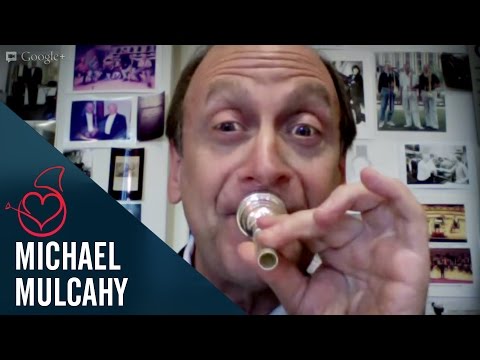
Michael Mulcahy, trombone player and teacher extraordinaire, live from Chicago on Sarah´s Horn Hangouts talking about trombone, buzzing, music and Chicago Symphony Orchestra Legends with a quick visit from Gail Williams… 28.11.2012
Transcript
Auto-generated from the live stream, expect the occasional robot mishearing.
Hi everybody you all out there it’s so great to have Michael M sitting opposite me on the screen and talking to us today and you’ve got a suit on me wow is that especially for us the best for you Sarah just the best we didn’t rehearse this beforehand actually we didn’t so you are in your studio at
Northwestern and what do you see out of the window I’m looking out onto Lake Michigan it’s 3:00 in the afternoon there’s not a cloud in the sky I see blue blue blue and you’ve got someone special behind the camera don’t you I do I have my dear colleague Gail who teaches in the studio next to me in the horn
Studio here’s Gail Williams hi everybody this is so this is so great this is deja vu because of course oh you no this my soup it’s a bit late for lunch isn’t it in Chicago yeah unfortunately yes we’re always late late to rehears late to interview for the people that didn’t see Gail’s interview this is a Deja
Vu because the beginning of Gail’s interview we had Mick on live in her studio so you’re rep you even brought your laptop in today didn’t you just in case just in case yeah we have a cameo deal where we always appear in each other’s Productions someone will have to start paying you for that soon oh there’s plenty of
Doubt here well I want to say thank you to Sarah for providing everyone this opportunity to speak with people I think this is just fantastic and it’s a wonderful education for everyone I agree on that I have to go teach talk to you later okay thank you that’s really sweet of you but remember it’s also Tim in
Melbourne who’s s who’s up at 6:00 this morning to get ready to do all this so speaking of Melbourne how did an Aussie like you get all the way over there to Windy City you don’t have to tell us the whole thing but was this where you dreamed of of of ending up well I I have to be honest with you and tell you my first dream was to go to
London I was a young boy when I decided against all logic to try to be an orchestra musician uh my hero was a Welsh trombonist by the name of Derek James who at that time played in the London philonic he was uh to go to the Royal film monic at the end of his career but I fell in love with his sound and
I had a fantasy it really was a fantasy about going to London I had no idea how that would work um as my career developed if I can be so pretentious as to describe it as a career uh it was really more of a calling a love of Music um I was in Australian orchestes in Tasmania and
Melbourne and decided fairly early in my 20s that I wanted to see the rest of the world and so those travels took me to Germany I was in what was West Germany at that point at the time when there were quite a lot of jobs for trombone players and at a time where there were International competitions was there was there the rule then if
I mean was there the rule that you had to play on a German trombone a Deutsche P was that was varied some orchestras yes the Berlin philonic for sure most of the places didn’t insist upon that the funny thing was I ended up in v in the vest West German radio in Cologne I was there for seven years and
I was the most enthusiastic person about playing the German trombo my colleagues weren’t that into it and we do it in the Chicago Symphony frequently in fact we’re doing it tonight in the Doria golden spinning well we do a lot of German trone here we have glal and Crispers and lechers and Coons and Ty and you name it start you off on that or were you doing it before he became
Chief we were doing it informally and he loved the idea and the orchestra actually bought a set of glazes which were copies of uh Leches and Crispers for the orchestra but between us we’d have for sure 20 25 German trones Among Us yeah we have a lot of instruments um so I was in I was in Germany for for seven years and then
I went back to Australia because I had children and decided that was the place to bring them up and I was teaching at the Cabra School of Music and the Chicago syy came to Australia for Australia’s Bicentennial and I knew the guys I knew Charlie from when he was in the Philadelphia Orchestra and we got together in
Sydney to play quartets and so the the short story is basically we played quartets at the Sydney Opera housee just for fun and they said Frank is retiring and you should audition and so I did I auditioned I came over to Chicago the next year in January and I auditioned live and uh it happened to be my birthday which was to my great
Advantage because they offered me the job which was very generous of them that was it was a nice birthday presid do you have to did you have to audition behind the screen yes it was behind the screen until the finals and in the finals there were two finalists the other finalist was John dutas who’d been at Curtis a beautiful trone player who subsequently went to the
San Francisco Symphony uh he passed away very very prematurely from a diagnosed heart uh disorder uh I think in his 20s um but we were on stage for the finals uh going back toback playing excerpts by ourselves and then backtack excerpts with the section we’re on stage the whole time and I think we were both having yeah we were having fun at that point because we were you know we we were playing with the section and we were enjoying each other’s playing
I believe and um shty us some pretty crazy stuff B traumatic EXs Bolero renish in one breath you name it he came up with some some some spicy stuff but I had the fortune it it wasn’t John’s birthday it was mine so they but you you were F you came from being principal trombone everywhere to being second trombone that’s true that’s true that was that was a whole
I mean from that’s a whole new learning process somehow being a being the supporter in the section yeah there there are two elements to this firstly in the 23 years I’ve been the orchestra I’ve played quite a lot in every chair and at the moment we have a vacancy so I’m doing a lot of first trombone and a little bit of
B trombone I love variety so that suits me a lot the mo but the more important point is that having been first trombone in three orchestras previously I did not really appreciate what the second was doing I was always grateful that they were great players but I didn’t really understand the substance of their job and sitting in the chair
I realized that I could hear everything much better sitting in the middle than on the end and when you’re sitting in the middle agree that’s my job I agree you can hear everything and so to the extent that things are not unanimous sitting on the second chair affects you much more than it affects you sitting on the first chair and so sitting in the middle you’re a bit of a unifier you’re you’re the conduit to the people around you and you can give uh
I think good feedback to both ends of the section and and and I think I think the most important thing people you know talk about having a a rich dense sound to support the first and being able to blend with the low end and being brilliant at the high and all those kinds of things but the main thing is just to bring everyone onto the same page
I would say the second always has to have a faster a higher radar than everyone else I find yes second has to be has to be so in tune with everyone the first has to do his job take care of the solos obviously has to react it’s in a horn section anyway I mean I’m sure it’s no different in a
Trum in a trumbone section but I find that the highest Radars they go to the second home players usually well my my radar had to grow when I started in this job that’s for sure no question about it and what would you say there’s a job free in your Orchestra yeah we have we had an assistant uh an assistant job that person retired and there’s going to be a vacancy filled in the next couple of years and uh so we’re looking forward to getting new blood in the section and uh you wouldn’t you would do that job she asks live on the internet would that
Be something you be would you like to go back to playing only first or are you happy where you are um there’s some discussion about what the new job’s going to be so I’m very happy with my job at the moment because I do have a lot of variety and um depending on what the new job is uh it it may not be more attractive than what
I have or it may be I don’t know we that’s still that’s still being figured out we wanted to hear it here first tell me what you you have I guess if you play if you play second you have a little bit more time on your hands to do all your other things like uh conducting yes I
I once again I like variety so I like to express myself in different ways and I find that orchestra playing is a very important part of my musical life but it’s only a part of it and if I was to be isolated or even marooned in any one area I think I’d be unhappy I need to play
Champion music I need to play recital occasional concertos um and I like to conduct I end up conducting more new music than anything else because that’s where the biggest need is so I I find myself conducting things that are usually more complicated I would love to conduct a GMA and a Moz out or something profound that wasn’t just you don’t you don’t just find yourself conducting you you studied it properly didn’t you or did you was it just studied by the great conductors you had in front of you at at at
Chicago Symphony I would say most most of what I’ve learned has been by observation when I look at the people who who I thought were just beautiful conductors when when you when I think of beautiful techniques High tank has a beautiful technique um Abado has a beautiful uh technique I I like people who say a lot with economy so
I’m not so big into the big shows of emotion and the big body gestures uh I find that the conductors that are most powerful for me are usually understated but very intense and their intention is very clear by their body language the the clarity uh the clarity that they provide I’m I’m not into people that just beat great um conductor has to have a very convincing vision of a piece to convince a uh a very experienced at times jaded
Orchestra profession that that they should adjust their thinking to a new vision and and the great conductors do that the great conductors stand on the podium they definitely have a conviction about what the composer intended and the best conductors give themselves over to the composer and represent the composer and those that do it with humility um and insight have a lot of credibility and the musicians will will go with them a long distance to to um accomplish something there other people who just put their personality their own uh individual personality on the music tend to impose the same um traits on every composer so you’re
Getting a a little bit more of the conductor’s personality than you are the composer’s content here here oh God and we’ve had people people are writing in Darren who’s principal Trumbo in HS I know he just said well said well said Dar Finland yeah greetings to yeah we had a great party with the Finnish uh The Finnish musicians mainly the horn players but
Darren was allowed to crash because he’s nice so um so well well said that how does your Orchestra react when when there’s someone out there waving around who they’re just not interested in I know how my Orchestra reacts but I’m sure yours is probably very similar the music stands go up and uh you just do you and
I are fortunate in that we each play many concerts so the orchestra is very um uh trained to deliver performances sometimes not under ideal conditions the better the conductor is the more notice will be taken uh the the orchestra has its own automatic pilot as does your Orchestra and you know we have what I refer to as our house version of things when it’s necessary just to get the job done as best we can in the circumstances yeah
I know exactly what you’re talking about yeah the great really the great conductors I’m I’m very happy to do something a different way when when when a conductor does something with with real belief with real conviction and um I’ve had you know I had you know one of your old bosses Daniel Baron Bo oh I’ve lost their picture there somehow uh
Daniel Baron bo uh was a very um active uh discusser of all situations and um we had many in-depth uh friendly arguments about how music goes and why it goes and so on and so forth I hope I still have you Sarah ah there’s Tim yeah I think Sarah’s feeds just dropped off but I’m sure okay I hope it’s nothing
I did no probably nothing you said either I’m sure sure I did not disinvite Sarah I did not vote her off the island you didn’t I’ll just reinvite her back in that was scary because I’m technically so novice we’ll see she’ll come she’ll come back soon now is everyone else listening to me yes everyone else is still out there we got about 100 or so while
Sarah is getting back on I’ll mention this CD produced in Australia oh do it is the uh 20th century hit for trombo called Full Circle featuring music of Richard Mills carvine I’m just showing them in your [Music] absence ah B of advertising that’s good yeah this is this is this is the coolest music written for trom bur all
Australian music so check it out full circle and where can they where can they get it where can they buy it can someone put up a link on the chat please of where we can buy it yes um someone can uh go to Eric clay.com that’s KL y Eric clay.com if you’re in America you can buy it from hickeys um it’s around it’s also downloadable on iTunes someone’s just written
Adam Adam from Texas has written own it I love it so obviously it’s rounds and I love Adam um I would like to have that for Christmas please someone out there so that’s what I wish for for Christmas okay I need your address yeah no problem I’m so sorry about that little um that little Fallout here we’re at the digital
Concert Hall office that actually shouldn’t happen the brilliant fille media but um I don’t know anything that can happen online a miracle wasn’t me it was actually you’re you’re doing no it wasn’t you you’re doing really well I must have been Gail helping you okay I’m tell me what who is that heink on the wall behind you who’s that up here up here there yeah that’s heting who else have you got up there um uh
Pierre ising there can you see Pier yeah and there’s up there what’s up what’s up there there’s a Australian BR that’s on the on the there’s Baron Bo there’s Baron Bo with our low brass group we did some Champion mus some low BR chair music concerts with Baron Bo he he conducted DEC pieces for trombones I mean solo pieces and screan uh yeah we did we did a lot of he played harpsicord in some early music and conducted caprico yeah
I’ve done a lot of CH music with boues and yeah perfect I want to see your tie that’s why if you wore a tie I want to see it yeah absolutely um but that’s great you’re conductors have really been really into doing brass I mean the CSO brass come on they are legendary I’m not I’m not flatter it really that’s just the way it is well they they were great for 50 years before
I came to town um that we are very um dependent on the pedagogy of our predecessors can you hear me Sarah I can I can hear you very well okay it was so silent I thought something was wrong no uh most of us studied most of us most of us studied with uh Arnold Jacobs uh Ed kleinhammer
I certainly did I had lessons with with all those old Legends um Bud HTH was still in the orchestra for some 12 years after I joined um and I did some translating for Jacobs for German students that came over to study which was very difficult because he speaks in a very anatomical way when he teaches he’s a very
Jake was a very wordy teacher teer so he would he would go on for ages and you would just be expected to translate uh yes and it was like translating for a doctor oh God when you say what he knew all the all the the the names for all the various parts we use we bre he knew he knew all the stuff all everything that a that an internist knows he knew and he would refer to certain things he he was he was a beautiful teacher he was a beautiful user of the language but it was flowery and that was quite difficult for me to
Translate I bet but he was a huge influence on all of you I mean AB did you like that before you got to Chicago or was it something you sort of changed I had I had worked with many people who’ studied with him before I came to Chicago so I was dealing with those Concepts but they were refined when
I when I came to town uh I made visits to Chicago for two years before I took the audition and uh funnily enough I was I was playing in Berlin a lot with the former uh Berlin radio Symphony now the deutsches symphony orchestra um when Shay was the music director there I’d played with them a lot while
I was still living in Australia and so I would go to Berlin for some concerts or go on tour with them and I would always come via Chicago take some lessons and then go on to Berlin so I used to you know for for for a few there I was um staying with Stefan yisi and so you know we got to parties parties yeah good times very good times yeah they are still good times in
Stefan’s house we still have parties here but but I should I should just um you know share with our listeners that maybe the most important thing that I’ve concluded from the whole Chicago School of teaching is that you have to find the healthiest way to play the instrument you have to find an unforce way that uses a combination of structure where the omuser is um consistently set in a diamond shape
I’ll just do this for a second you can see my Corners are engaged and my chin is flat you want to keep the chin still especially while you’re articulating and when you’re changing notes and you want the tension or the engagement of the omish primarily on the sides not in the middle you want to minimize the amount of pressure and stress and tightness there is on the middle of the
Amish where you want it to vibrate around the aperture but to hold hold this simple structure in place in uh in a in a permanent way for every phrase so you engage the amature at the beginning of the phrase and you don’t relax it until you take a breath the other thing smile and Horn the horns we we we try and do everything to stop to not smile everything is sort of not smile no no smile no people say a pucker you know you have to control the width of your
Amisha so at that point where you can make a diamond shape without stretching the lips then as you go into the high register on the low register didn’t get me a mouthpiece Teddy it’s important that you don’t stretch the omisha wide when you play high you’ll see kids when they if they’re going to for 100 then when thep get when the lips get too thin they can’t vibrate they get very brittle so you have to control the
WID there and it should all be nice and still and economical but the other part of the story which is equally important that is this this structure has to be fueled has to be fed has to be nourished and that in in the same way that you engage the obish at the beginning of the phrase in a singular motion you also set a singular wave of air in motion so that a phrase consists of one wave of air not several spurts not individual spurts of no individual spurts of air for each individual not but you grow you blow in a nice single wave so
I like to think of our our approach to Brass playing being this single wave of air support per phrase the single engagement of omuser it doesn’t it doesn’t relax it adjusts it may adjust in tension as you change notes or change registers um so you have the line of air you have the line of omuser and then the third thing which is equally important is that you establish a cohesive and uninterrupted musical line so if you just think about that everyone parallel lines of air support
Ure engagement and musical line and your job is to find the most efficient way of combining those three parallelisms in order to project a beautiful unforced sound to make the most beautiful sound on every note one note at a time as easily as possible how how can they do that because everyone’s listening to you saying that and it sounds
I mean it’s just like that that is how it should be that brass playing should be such a natural part of what we do it should be breathing in blowing out making a beautiful sound so many people have you know they they breathe they breathe in strange and then they get all tense and then they go and how can how can we get get that how can we get to there what how do you recommend kids to to to practice something like that if you listen to a great player play you will hear beautiful clear pure sound that sounds effortless and the reason it sounds
Effortless is because they’ve found that sweet spot between structure and energy so when you’re doing it right it’s quite close to doing nothing so if you can imagine Teddy give me my Trum for a second if you can imagine that I was going Teddy say hello Ted come down here can thanks for helping us out today you have to be beautiful to get into my studio yeah absolutely so so if um we we’re getting uh uh we’re getting precise about making a beautiful sound so if here
I am doing nothing here I am playing a note nothing nothing nothing [Music] it looks so easy it looks so easy you know the air the air really accomplishes the work if there’s work in brass playing it is air movement but the air is not under so much pressure that when you stop there’s a pop some people if they’re playing high if they’re playing something like this you hear that if you hear that people are creating resistance they’re creating internal pressure you’re not trying to do that you’re simply trying to elevate
Air at the speed that’s appropriate to the pitch so if I’m if I’m if someone says a note Teddy say a note E flat E flat so a normal EF flat I know is about this much air speed if I play a high one I know I have to blow faster and before you play it you have to know the pitch and you have to know that speed through experience you sort of have to and and and and and you know when you’re playing in the high register it’s like putting the bow on the right string obviously when you’re playing
High your lips are skinnier than when you play low if I play a low note that’s my favorite register the lips are very thick and the aperture is very big if I’m playing a higher note the the the the lips are skinny and the hole is small but there’s there’s not tremendous pressure there when you’re playing high you’re blowing through a smaller tube if you can think about these as pipes maybe when you’re playing very low the
Organ Pipe is huge right so the volume of air is huge when you’re playing High the Organ Pipe is very small like a piccolo so so the the air volume is is not huge it’s tiny but you’re just moving it through the pipe rather swiftly but always always ising Force disavow of all Force and and everyone even the most um basic beginner can start off by just playing one note and seeing if it’s clear see if it’s pure and see if it’s unforced it should be beautiful and easy and you can apply that test to everything you play and everything you try to play will
Improve if you can figure out how to make it sound more beautiful more pure and more easy but it takes time you have to be patient yeah it’s song and wind like like the name of Arnold Jacob’s book it’s song and wind it’s actually very close to singing I find if if it’s working well it’s like a natur it’s like a human voice procing it is it is very close to that and
I’ll say something else is a little bit esoteric maybe but give me my mouthpiece again Teddy when I’m when I’m moving air when I’m moving air it’s it’s it’s it’s a relatively gentle thing you don’t want to get forceful about this you’re not trying to blow someone over um you’re just trying to set the air in motion if you tap the mouthpiece on your instrument the instrument will resonate very easily and very clearly so you can see how well the uh instrument amplifies sound but the actual mod motion of air is actually relatively gentle it’s not forceful like for midle be flat
I can say that my physiology here except for making my brass players Diamond my physiology is as relaxed in Whistling as it is in buzzing so this should all be relaxed sometimes people activate too many muscles that their neck muscles and their chest and everything are tight and you hear this no it’s nothing like constipation if anything that you’re doing is reminiscent of something that happens in the bathroom you’re doing it wrong okay it should be more like floating on the
Dead Sea you’re just floating on the top of the water you don’t have to do anything the air is keeping you afloat but the exactly the air is keeping you a float and the the the Chicago boys are really renowned for I told this story before on the when I came to play with you guys um you weren’t on that week it was or maybe no you weren’t it was
M or 2 or it was some huge piece and I was sitting right in front of the the trombones and they took a breath and literally my hair did that I felt like I was being sucked into their into their belts it was the most unbelievable and and that is something that I found in all the places
I play that’s actually quite unique unque to you guys or at least you started it yes but you know to be honest with you if you were to if you were to sit in front of Stefan in your Orchestra you would get your hair would move there too if I if I sit if I sit behind Stefon this is what
I look like um yeah that’s true but no it but home players don’t make we don’t exhale on such a huge a big as big an aperture somehow I don’t know if I find if I was if I was doing this it would disturb the the position of the mouthpiece for me but you guys do feel a lot more a lot quicker somehow
I think there’s a bit of confusion about this the primary the primary points for breathing in on the trombone like the horn are the corners so when you see this kind of breath that’s not as good as this kind of breath yeah yeah I I recommend that people have contact with the mouthpiece as they breathe that they enlarge their corners or expose their
Corners a little bit I actually tell my students to think of Julia Roberts who’s an actress who has a very big mouth and her teeth begin over here somewhere and so think of a channel going in here and a channel going in there the tongue is in the bottom of the mouth I get my students to say oh a
British o because when we say e the tongue is very low and the oral cavity is very big it should be very po and you stretch the corners the difference between the horn and the trombone is that the the trombo mouthpiece covers up more than twice your face so we don’t have quite as much room around the mouthpiece as you do but you can’t breathe through the mouthpiece because the hole is too small you get a little bit through there you get a little bit through your nose but the primary points are in through the corners and the
M the amuser should be more or less set during the breath and at the end of the breath when you go to start the note the alisher must already be engaged so when you start the note there’s no movement it’s stable and it’s ready that’s when splits happen it’s when it’s not set up the whole uh phys physical effort when something’s a little bit off that’s when the splits happens
Sly y the structure has to be in place when you articulate and shouldn’t move there are a whole lot of then now the questions are really flowing in from all our friends how do you practice achieving that state of relax relaxation can you practice that because your body your body I believe and not everyone agrees with this your body should generally be in a state of release as you’re playing not in a state of tightness so the
Sensation that you get when you exhale is a very pleasant relaxing sensation you should sustain that sensation even when you breathe in and as you make sound your body should still be in release the parts of the body that are active during brass playing are limited to the omuser and your air exchange the air exchange should be very effortless and very economical you don’t want to add work or labor to breathing you don’t want to add work or labor to making sound you’re always looking at minimalism so it is a lot like doing nothing you know if you lay on your back on the floor
In your bedroom and you just do very slow breathing feel how your body is in a state of release when it’s not standing up feel how easy it is to move air when you’re laying down and you should copy that when you stand up you should still be in a state of release because it’s about efficient exchange of air it’s not about effortful exchange of air don’t try
I have a saying don’t be a Tommy try hard or as the case may be a Tammy tryhard you know it’s it is a it it is a fairly natural thing to do and it’s if you at these few functions um you can you can learn to make a beautiful pure sound without force and everyone even beginners can copy their teachers and just play single notes and ask themselves does the notes start with a quick clean attack do you get the full sound at at the articulation and is the sound pure is it unforced is it uh is it um devoid of all
Distortion or airiness or Woofy or graininess or any of the other properties you know think of it like drinking water when you drink the most important thing about that water is that it’s pure so you should think about your sound like you think about the water you drink but I find if as a as a girl and and there’s so many more girl brass
PS out there than there were before I mean Gail is a total phenomenal I mean she’s like she’s so tiny and and can play longer and louder than most people I know um I do have to work and I’m not always in that state of relaxation because if I’m sitting next to Stefan Dory as a I have to play just as loud well impossible but as loud and as long as as he does and and my my body has to work twice as hard in a way almost because
I I I I when I exhale um I find I have to force not force is a totally wrong word but it is quite hard work sometimes well that’s why to find out about this this relaxation thing well it it is it is not like you’re doing nothing you are doing something you’re moving air and if you’re playing with
Stefan door uh then you are using a big scale of sound a big range of Dynamics um the difference between Stefan and you is really simply that your lungs may not be you’ve got better hair okay that’s true but uh you may breathe more frequently but both of you will be breathing with Vigor and both of you will be blowing with
Vigor but not with force not with Force no okay that’s why because because when when when you when when you go from via to force when the Air’s under too much pressure the sound gets CSE yeah you you’re no longer playing in a controlled or refined way and even when you’re playing very loud you have to control the sound so um there there is a point at which the air gets too hot and the sound gets rough and okay don’t do that yeah no no we don’t we do not like rough sound um
Charles has been asking a couple of times how do do you use the buzzing moue piece buzzing the mouthpiece is a practice tool and what about free buzzing and burps and I don’t think he means think he yes I I I use free buzzing relatively little um I just have not had the time or the inclination to develop much of it
I just do a little bit to show structure just to reveal that you can play on mouthpiece rims to reveal stuff um I think the burp is fine the resistance is is slightly different I I basically do more just relaxed mouthpiece buzzing and when I say relax mouthpiece buzzing a lot of people try to make the same amount of sound on the mouthpiece as they do on the instrument and that’s a mistake the trombone or brass instruments are very efficient amplifiers the mouthpiece is just a little pipe so it doesn’t amplify sound at all so generally
I recommend that people um um buzz a moderate Dynamic maybe metop piano to metso Forte but don’t try and make a lot of sound and in fact if you’re playing a moderate Dynamic you’ll be practicing the structure of your omisha more certainly than when you’re playing really loud because when you’re playing really loud you’re flooding the mouthpiece with air and it’s possible to make a certain amount of noise without any structure but if you’re playing soft [Music] you you rely on your structure more but if you’re playing very loud
I’ll point away from the screen so it’s not um objection no I I was just about to actually stand up because we having the the national anthem so I was God bless you God bless you and so uh yeah don’t don’t force don’t force on the mouthpiece um actually I think Joe or lesie um Joe lesie influenced me a little bit there in not forcing the volume on the mouthpiece because a lot of people want to play with the big sound so they go you know if you put that on a trombone you could play in a football stadium ridiculous what about burps uh
I I used to mess with that many many years ago it’s not part of my regular teaching I don’t have a strong feeling about it oh okay good that was a question um uh we we are told Richard in Melbourne this is a real trombone question we are told not to use the middle finger to contact the bell in third or fourth position how many how come many great players in fact do this yes and
I’m guilty of that myself and I and I tell myself frequently not to do it and it turns out that supposed great players are actually human beings and they have failings too is it a failing I can’t comment I’m a horn player we only have three four fingers but uh you start doing it as a kid for security and and it’s it’s a it’s an unnecessary habit that that looks looks bad okay good um was there a different kind of use of ibr in
German style trombone playing ask David somebody want also to know about Charle trombones what do you think about charal trom Trum I I haven’t had the pleasure of trying one yet um I know that the the v posan cartet um use those instruments and and I’m very familiar playing with the trumpets our trumpets have some shle they have moner and shle and whatever have you and so
I’ve heard those things and I’m excited to try them we we already own a lot of Germanic instruments but I’m I’m I’m not set in stone if there’s any if there’s an instrument out there that makes me sound better than I sound today I’m happy to get it here here I’m still looking for that one um oh
I just got a uh I promise yesper yesper senson just wrote me a text we got a yesper are you watching um it’s fantastic it’s fantastic says yeser he’s sick at home so you have to wait good to he wants to know about the ice cream imagination what the ice imagination well I think yesper might be thinking back to a session that we had
I hope this is correct yest but because I give a lot of lessons and so my analogies uh do do immigrate from time to time but I’m imagining that we were talking about sound and knowing the flavor of your sound before you play it uh if you want something you have to imagine it if you want something you have to will it but you have to know it before you can do it so if you they’ve they’ve mapped the brain and discovered for example that if you taste chocolate ice cream let’s use that as an example that the brain lights up in a certain way
They’ve also found that if you imagine the taste of that chocolate ice cream the brain lights up in the same way so it’s a very it’s a very real function so um to to go a little bit further along that path trombon istically if you are able to conceive the sound in your mind then you know that sound and if you know that sound you can hear that sound and if you hear that sound you can play that sound so you’re you’re actually conceiving something specific in your mind a specific outcome it might be chocolate ice cream it might be vanilla ice cream it might
Be a velvety trombone sound it might be a brilliant trombone sound whatever is appropriate to you at that moment but your sound is very dependent on you activating the creative part of your mind to conceive something specific that determines precisely how you want to sound and so over the years in my teaching particularly here at Northwest and we’ve tried to distill all trombone knowledge to the most simple form and
I I I have had my students write essays on this and I I I’ve told them I want you to be very precise and succinct you know the shortest essay wins pretty much and we got it down to three words those three three words were no KN n o w hear h e a r and play so before you want to play something you have to know it you have to know what it is that you want and in order to be able to play what you know you need to hear it so you need to be able to hear what you know and if
You listen to what you hear you can play what you hear so always another thing that I say in my teaching very frequently is s s always simple we are always looking for the simplest the most clear truth and in your practice your your job is not to hit notes your job is to have clarity about exactly how you want to sound and to find them the shortest and most healthy economical way to realize that so always looking at reducing all this knowledge you know we we ear so many books we’ve had so many lessons but there should be some basic essential truths that dominate
The way that you habituate yourself on the instrument and you are your history when you get up on stage no matter how nicely dressed you are you only you are only a sum of the quality of your practice so what you’re doing in the room in the basement when no one cares or knows what you’re doing that’s your that’s that’s your sacred time that’s when you go into the
Cathedral of your practice and you act in a very pure way and you project the discipline and you conceive the beauty and you exercise the discipline that you want on stage whatever you have on the practice room that’s what you’re going to have on stage probably minus 5 or 10% because you’re uptight a little bit nervous maybe so don’t be careless in your practice if you do your work in the practice room you can enjoy the stage you’re going to work in one of those places and if you work in public without having practice it’s very painful but if you work in private where you’re
Relaxed and you have patience then you can enjoy the stage what makes you such a good teacher really I’m so I I I know you’re the most modest person out there but it’s incredible listening to you talk I want to come to Chicago and sign up for your trombone class immediately what makes a good teacher did you go through a terrible time that made you really realize what this was all about did you always just get it did you some teachers are great players but don’t teach so well some players some teachers are great teachers but don’t play so well what what what is it
About you that makes you be able you could you seem to be able to communicate with these brass players on such a high level it’s incredible I think it’s for others to judge judge my efficacy as a teacher I will tell you this I’m a very a very observant person if I play with someone I notice everything and
I appreciate what another person’s doing even what my students are doing and if I see something good that my students are doing I will benefit from that and I notice just generally in life I’m almost annoying at what I notice I notice if someone in the air in the orchestra has a haircut or someone changes something in their grooming or something like that or if one of the girls has a particularly fetching manicure or whatever it is
I notice it and I appreciate it thank you and uh and so yeah I’m a very observant person and sometimes it’s annoying because you you don’t only observe good things sometimes You observe OB ve bad things but but I feel that you know if you are alert and You observe that that Life is Richer there’s a there’s a lot going on when
I’m not playing in the orchestra I’m listening to some of my great colleagues we have so many new wonderful Eugene isov and mat Def and David Mcgill and our new clet it’s Eugene’s birthday today happy right happy birthday Eugene that is awesome one of the most one of yeah one of one of my awesome colleagues and so
I just bask in their music making and I actually imagine you know I listen to their phrasing and I know this piss as well but I imagine sometimes when I’m listening to say the violins play A Melody I’m I’m wondering what that looks like on paper I’m imagining how that’s notated or how it specifically what the articulation is or the
Dynamics or what the expressive markings are so I’m never just uh I’m never passive even when I’m not making sound I’m enjoying the process that’s going on around me and I think you if you are curious which I am and if you’re observant I think that you can you can profit a lot by being in the realm of others and uh
I do enjoy trying to express myself and and if if I have any qualities uh as a teacher doing a lot of it has made me better just like practicing just like playing the trombone I’ve been at Northwestern for 11 years I was I was at the Australia National University at the Cabra School of Music for three years before that and
I taught as an adjunct in years before that and so just having done a lot of it yeah you know you you you you have to get better or or stop well listen I we we don’t have too much time left but there’s loads of people out there can I just fire some quick questions at you just so that
I we’ve looked after um away as much like there’s there’s one of one of our most loyal viewers Kendall gray um who’s just asked how if at all would you say your playing has changed over time since joining the CSO and what influenced those changes was did Bud for example influence any of those did did Jake influence any
Charlie and Jean yeah well let me let me tell you as as a brass player being in a in an orcestra like Chicago and being surrounded by healthy people has made me more healthy uh I’m a I’m a much more efficient player than I was when I was 20 but I don’t have the I don’t have the time to practice the hours
I practiced enormous hours when I was 18 1920 I didn’t want to admit in public how many hours I used to practice but enormous but I was public we want to know what nine eight eight yeah eight hours a day you’d play the trombone for eight hours a day did past tense I’m a much more healthy player now
I’m a much more efficient player now and um I think that so that is one thing playing in the CSO specifically a vibrancy of sound was very important and and no one has a more vibrant sound than Bud HTH had he played with a very live sound even when he buzzed the mouthpiece was very vibrant always playing with a very clear attack sometimes people think they’re going to get a mellow sound or a prety sound if they somehow don’t attack or if they hide the attack or they slow down the attack
I think any complication to starting the note is bad even when you play soft you should play with a swift attack a short stroke a clean response and embrace Clarity at the beginning of notes even when you play very soft speaking of soft that’s something I had to expand a lot because the low brass in our Orchestra when it’s soft play super soft and
I had to learn to play softer than I have had to play anywhere else and I love doing it but at the beginning it was tough and they play Jay is a beautiful soft player and Charlie’s a beautiful soft player and Gina is a beautiful soft player so you need to have uh a lot of comfort playing soft so that’s that’s another way that my playing grew and
I would say that in this Orchestra more than the other orchestras I was in there was an unselfconscious uh embracing of a singing style so that there was no such thing as an orchestra style that was separated from singing when I whenever Bud played a solo sometimes it would be Brookner and it would be very simple and very
Noble sometimes it would be French music and it’ be quite sophisticated and nuanced and so this the styles of singing has change from composer to composer but the in the sound was always present even in Mozart you know I like to point out that when Bud played classical composers Boven Symphonies or even MOA piano concurs that are not exciting to most trumpet players
Bud never sounded boring and he never he never saw those parts as boring he always brought a distinction to everything that he played it was always musically projected and he would provide rhythmical impetus and energy in a Beethoven symphony now bethoven is not famous for his trumpet writing but timony and trumpets have an important role to play
In classical Symphonies and it’s important that there is rhythmical incision that there’s Clarity in the attack the in many ways that the the the trumpets and the tempany are the articulation of the orchestra and they articulate Key Parts in the symphony and so while they don’t have a major thematic role to play they have a major energy role to play in that music so um bu
Bud was a very sophisticated musician is he still around can we he lives he he he he he came to concerts every week until very recently um he doesn’t like to get around at night anymore so we’re not singing concerts but he lives in Oak Park where I live and Jay lives and my I see him I see him regularly and uh would he come in and maybe talk in a in a you know in a duo with you you could just we just have a conversation what you think come on that would be fascinating it would be great to get him he’d be great
He has the best stories I can tell you he has stories stories stories okay well you you know how it works now so um let this is a great this is a great format and I’m I’m I’m happy to do this any anytime I’m a little bit relieved that it worked because I’m a technical novice and the fact that we can be talking to
Melbourne tomorrow in the morning and Berlin tonight in in this as the sun’s going down in Chicago and talking to everyone to all of our friends it’s fantastic and I give you a lot of kudos for bringing us all together like this I love doing it and uh it’s a pleasure for me because I’m getting to talk to all my friends
I love it it’s a great format it’s a it’s a great format and um uh it’s it’s pure pleasure for me I I I want to say one more thing you said what makes me a something teacher and there’s there’s an important thing here I was the I was endowed with the love of music from my parents my parents played classic music all day every day they went they they studied uh music my my my mother was a violinist my dad was a trombonist they met at the conservatorium in
Sydney and so I grew up in a musical household even though I was impervious to it till about the age of 14 when I suddenly got the bug and it was that love of Music the love of what music says and how it moves people that made me play the trombone I came to the trombone through music not the other way around but
I came to the trombone relatively late and uh I think that um I I figured out how to play the trombone in order to play the music that was already embedded in me because of my upbringing but I I can honestly say that my love of music is totally undiminished by many years in the profession even though not every day is a perfect day
I’m I’m very happy to be in the profession and it’s my love of music and what it does for my soul and what it does for my spirit that gives me the energy to share passionately with with the young people here at school and the people I see from around the world to share that gift that was given me and um
I the things that I tell you I have learned from wiser people and more experienced people than myself and people who had the love of what they were doing and cared enough to share it with me and I’m very happy it’s the most natural thing in the world for me to share that with other people in fact if if you’re experiencing something great when you share it with someone your pleasure’s doubled and so you know the the worst thing you can be is an isolated person doing great things and and in total uh in in total isolation of other people if you’re having a great
Meal if you’re looking at Great Ser what you want to do is say look at that isn’t that great or taste that isn’t that fantastic was that great for you too so it’s a very natural thing I think I think the love of it is actually the answer you know I do it because I love it I really do love it
I absolutely agree my heart is bursting here with what you’re saying because it just really speaks from my heart as well and that’s why I’m trying to do what I’m doing in this small way um but having people like you to come on and then speak to everyone out there like that it’s just such a treat thank you so much we have so many many many other technical questions
I don’t want to go into them now I’ll just promise the people at home sitting there that we will be back I will get MC back on I promise I promise I promise we are talking absolutely we’re talking about new formats and what we can do online for brass and any of your suggestions are welcome um so
I’m going to leave the technical side for today I hope you forgive me but the inspir irational side has huge it’s just been huge so thank you Mil times and we’ll do it again and for everybody else Dale’s colleague Dale Clevenger is mixed Dale is on tomorrow um at 8:30 New York time he’s with Jeff Nelson in
Indiana at the moment so tune in for that and Mick feel and dank a thousand thanks for your and uh and we watch you back very very very soon I I send my love to everyone out there thanks for tuning in and I look forward to the next time and thanks to Tim and everyone in Melvin for making thanks bye guys see you tomorrow okay good night good morning [Music]
Horn Hangouts are created by Sarah Willis of the Berlin Philharmonic. Brassbanned is a proud long-time collaborator and streaming partner.