
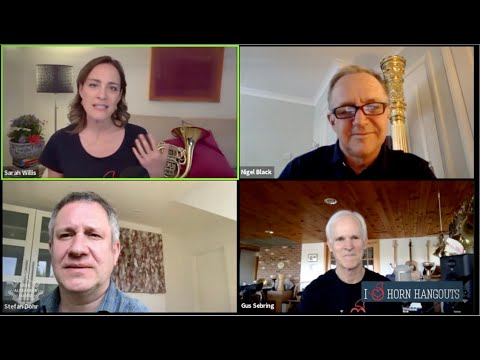
An international panel of audition veterans: Stefan Dohr (Berlin Philharmonic) Gus Sebring (Boston Symphony Orchestra), Nigel Black (Philharmonia Orchestra) and Sarah (Berlin Phil) reveal all their audition tips. Find out here how auditions differ in their countries and even what you should wear! A Horn Hangout not to be missed.
Transcript
Auto-generated from the live stream, expect the occasional robot mishearing.
Welcome back to the Horn Hangout. Good afternoon from Berlin. Good morning from Boston where we have Gus Sebring and good afternoon also from where are you Nigel? Nigel Black where exactly are you right now? Ashvale. I’m sorry in in London near London. Sorry, so it’s tea No, it’s not quite tea time, is it? No, it’s 2:00 in the afternoon. 2:00 in the afternoon. That’s way too early for tea. Stefan, nice to see you again and you’re not spinning this time. You’re on a different chair, right?
I’m on a rocking chair. On a rocking chair backwards and forwards. It’s great to see you all. Welcome to all on the chat. We’ve had some amazing questions in today is all about auditions. And um if you’re watching on Facebook, write in please and tell us where you’re watching from. We love to see that. And if you have any really juicy questions, then hop over to the website and put them in the chat here cuz I can the ones on Facebook go by too quickly. I can’t see them.
But I’ve got them all here um on my iPad from the website. And handsome Tim, it’s very late. Good evening to Melbourne. How are you doing today? I’m doing great. Australia is doing great today. It’s a nice evening in Melbourne, so all is well. But I’ve got a special request for everyone who’s watching the Hangout today. I’d love it if you could share the Hangout on Facebook so we just posted it to a couple of places, but I’ve got a feeling I know the contents of what’s coming up is going to be really really great.
I’d love everyone to get to listen to it. So please share this on your Facebooks, all your Twitters, all your Instagrams. I’d appreciate it very much. A word from our technical advisor. Thank you so much Tim. Really couldn’t do this without you. We are so grateful. Right guys? Yeah. Bringing us all together like this. And now you’re off to bed, right? No. You’re staying No, you’ll stay there and watch what’s going on. in the background. I’ll stay in the background. Have fun. Okay, let’s get started.
Today is about auditions. It’s not necessarily about playing in or like like how to practice for auditions. We we we’ve touched on that a lot. It’s about the etiquette of auditions, taking auditions. And we had the idea because a very nice horn player wrote to me from Iceland. Now you guys you were supposed to practice saying her name. Have you practiced? I’m going to give it a go. Um if you’re watching um uh let us know which one of us managed to say it uh the best.
I’m going to give it a go. Dear have it written? I don’t have it written so I don’t You have it written down. Well, it’s a well, it I think it is Thorunn Er Petursdottir. Is that right? She said no the P is like a th. The O R U and then when you say the N it has to be like an N but blow a little air out of the nose during. Okay, Thorunn. Thorunn. Thorunn. Thorunn. Yeah, but there you have to blow nose out of your out of Thorunn.
Yeah. I am No, I I’m not allowed to do that. Petursdottir. Is that right? Thorunn anyway, let us let us know because um we’re really grateful you wrote in and you inspired me to do this because you came up with some fantastic standard questions actually but you put them all together for us to make it easier. And what we thought would be good today was to have three different continents repre- represented here. Well, not continents I guess three different styles. Continents that like continents that are different from each other.
And we have Gus from America and Nigel from England. And we have me from Germany. So we’re going to talk about the different styles of auditions in these three different countries. Um because Gus in America auditions are completely different than here in Germany and Nigel in England they’re also completely different kettle of fish altogether. Yeah, yeah. So Nigel, can you start? When when someone’s we’re going to touch on two different types of auditions, auditions for music colleges um and universities and professional auditions where you’re trying to get a job in an orchestra.
Nigel, what is the biggest difference in England when you’re doing an audition to get into say the Philharmonia Orchestra, your orchestra? Biggest difference from from what? Germany or America? Yeah, but yeah, or what it just tell us what the process is. Okay, well the the beginning of it same everybody applies. Um we tend to not hear everybody. We have generally have to filter. You’re getting, you know, 150 or so for in our case for a for a section job. Um and we’re looking at CVs. We’re making a call on that to start with and then we’re looking at references and we’re looking at professional experience.
Um once we shortlist and we maybe hear people over a couple of days. Um we don’t have several rounds. I mean some people do in my orchestra we just have one event and it’s the the event goes possibly over two days with with if depending on the length duration of the auditions and number people. Um and you do the audition. And it’s not it’s not like someone wins the job there and then. We maybe we in a mind to offer say four trials. That’s so four people will will come in for extended periods and play with the orchestra.
Maybe more people. It could be less people, but that’s how it works. It’s not a a winner takes all on the day which it is in in generally in America and in and in Germany particularly. Right. So um but Nigel before we carry on, um Alan Cartnic says he misses you a lot. Um hi Alan. And and also um Matt uh Matt is watching. Matt Heisip and he says Nigel Black, the legendary high C in Bohemian Rhapsody at the end of the London Horn Sound Choir.
That’s really Nigel and that was his high C and it was legendary. Yeah, that that was a that was a very um that was that was a one take event that we ran out of time it was in Abbey Road. It was right at the end. We we moved studios and and it we’d we’d gone from a church to Abbey Road and we ran out of time and and and Bohemian Rhapsody was the last one, so it’s sort of warts and all. But it was it was good fun.
Yeah, it’s amazing CD. I love that CD. Um yeah, so when someone gets a trial in a London orchestra, um it this could go on for years. I’ve known people who’ve been on trial for like 2 years at a time. Yeah. Well, you you do end up with positions being open for a long time. I mean, Dave Pyatt left the LSO I’m reckoning 8 years ago. He’s now gone to the Royal Opera House and he’s you know, he’s been he’s had 8 years in the or however long he’s been in in the London Philharmonics between between the LSO and the Opera House.
And his job isn’t filled yet, as you know. So, that’s that’s the downside of what can happen. Um but yeah, generally, you know, there are there are people that there are committees within the orchestras, people making you know, taking a view across a cross-section of people from different instruments. Um and and that’s that’s sort of how it works. And yeah, it can take a long time because if even if you’ve got four people, if you want to hear extended periods and you need to hear them all again, you know, a couple of years is quite common.
Yeah. So, once someone gets a trial and then you decide for one person, do they have then a trial after that? Are they like or do they get like the Americans say tenure? Uh no, they don’t. We We don’t have tenure anyway. None of the London The independent orchestras and none of us are actually employed as such. So, I mean, you know, this is a different thing. Um but uh what you do have is a probation period. So, that’s that’s how it goes. And and most of the time you’ve made the right call and you get through it.
That applies to your orchestra and any orchestra. Sometimes you realize you haven’t and and it doesn’t work out. In our orchestra, it’s very rare that it doesn’t work out. Yeah. Gus, Boston Symphony Orchestra, Boston Pops. It was so amazing to play with you last summer. That was such an amazing concert with some fantastic That was really good fun. John Williams film night and Gus was on first horn and it’s just so incredible to hear those amazing horn solos like right next to you live instead of on a movie screen.
So, that was really good. No, nobody writes like John. Nobody. Literally nobody for the horn. That was And I was going to say for for horn, but really for every instrument it’s unbelievable how much he knows about every every instrument. And you remember I almost cried. I was so moved by playing John Williams film music with the Boston Symphony in Tanglewood with John conducting. It was like a holy moment. So are we every time every time I mean, you know, you think how many people like that are there on the planet?
Yeah. Yeah, he’s really amazing. Um tell us a little bit you are the Boston Symphony Orchestra, but also NEC the North England Conservatory. I’m sorry I missed the hangout with your your students the other day, but I will be there another night. I promise. I thought it was North England, but it’s actually New England. I thought not North England. Sorry. Maybe the maybe the Cotswolds or something like that. Yeah. So, yes. So, I’m associate principal in the BSO and principal horn in the Boston Pops um for a long time now.
I I joined the orchestra in 1981. And when I joined the orchestra, there were two openings third and assistant utility. And there were over 100 applicants for that. And at that time um we were required to send a tape. No, at that time they they went to tape right after that. Everything was live. And so, everyone that they accepted from resumes was was a live audition. Shortly thereafter, they went to um tape submission so that we could um pre-screen and cut down on the number of days that we had to spend auditioning.
Um So, uh out of that I think there were then you know, typically then you’re invited to a preliminary audition. And then if you make it through that round, you go on to the semi-finals. If you make it through that round, you go on to finals. Um and I’ve sat on many audition committees and it depends who the music director is at the time how how it ends up going. Um Seiji was was always the last word on everything and it didn’t matter sometimes how the committee voted.
Seiji would say, “Ah, I I go home. I I sleep on it. I think about it.” And he’d come back and he might agree with the committee or he might totally decide he wants somebody that, you know, wasn’t the committee’s top choice. So And would did he did he have veto? Could he could he do that? If you’d spent all day auditioning and said, “We want this person.” and Seiji would say, “Well, we want this he wants that one.” Yeah, that that that that that was known to happen, but um and then when when James Levine was with us for a few years, he never really attended any auditions and occasionally he came to finals some for for for some positions and and completely concurred with the committee.
He Whatever you guys think, you know. He trusted us I guess that that we knew who we wanted to work with. Um and uh and and so so yeah, that’s so that’s kind of how it how it works here. We have um a trial period. If you if you win the finals or if it comes down to two people, it can be um they each play a couple of weeks with the orchestra. And of course that has to be scheduled for when the music director’s here and with the number of guest conductors we have, that can sometimes go on for a period of time.
Um Same with us. Probably yeah. Yeah, and then and then once um there is a quote winner of the audition, they have to play the the there’s a tenure a probation period and they play I believe it’s a portion of the symphony season which is September through April and the the pop season which is May and June and the Tanglewood season which is July and August. And so once they’ve done a a portion of all of those seasons or at least, you know, they’ve started the the third bit that they need to do, then the committee will get together and decide either either um to give them tenure or to extend probation or to deny tenure.
Deny But I think that that that what you’re describing now is the way it’s mainly done in the States, right? That that that’s how you do it. But I think the most important thing for people who are not in the States or who are expecting to do an audition in the States is that everything is screened until which round? Oh, behind screen? Yeah, behind everything is screened, yeah. We screen now we screen now. You do? Okay. We don’t. At all. Ever. Oh, really? Wow. Yeah, no, we we we have a curtain that goes it bisects the stage and the committee is on one side with tables and papers and all that and there’s a chair and stand on the other side and an audition proctor from the personnel office and they show the person in and they sit them down and the music is all there or they can use their own music.
Um and as we run through the rounds, prelims are all preliminaries are all behind the screen. Uh semi-finals are behind the screen and for finals, I think it’s I believe we have the option to sit behind a screen or not and then they’ll take away half the screen. So those of us who want to sit behind the screen can move uh back what So you’re like you’re like sitting you’re sitting next to the person while they play? Yes, essentially. They’re They’re They’re right through the I mean, well, once we start doing section stuff anyway, we know who everyone is, obviously.
Yeah. Yeah. All right, that’s that’s really that’s really interesting. I think this screen thing is also worth mentioning um when we get on. Stefan, can you just tell us briefly about our audition system? Um I have just one question. Tenure, what is this tenure? What does that mean? Uh probieren bestehen a tenure After trial, you got you still got a tenure on trial time. If you get 10-year means you passed your trial. Ah, if you get 10-year you have already you know you don’t you have to think something like that.
Sorry, I didn’t get that. Nigel, a word a word that Stefan doesn’t know in English this is very unusual. And then you 10-year means that you absolutely never have to practice ever again. Well, then I’ve got 10-year right now. I’ve got Corona 10-year. Stefan, tell us. Um, now our process is usually also based on invitations to people that we either know or that we’ve heard about. So, we we are not inviting all the people that apply that would be taking up too much time because um, in our orchestra we don’t have a committee.
We just the orchestra has to listen to it. So, and we all everybody has got one vote even the principal conductor. So, it’s um, a different system. It used to be different when Colin was principal conductor. Um, there was the audition and then um, the one who did win the audition had to play for him. Like in his room personally like mhm. But, I think most of the times he then agreed with the orchestra to take that person. He just wanted to meet them and you know that they get a little sort of like Yeah.
a bit frightened of him. And then if you have like passed your your probespiel so, suddenly the audition you just go into a 2-year contract and that 2-year contract is your probia. So, your test time. Or trial. In In Germany it’s usually 1 year. Um, with our orchestra it’s two because it’s stressful. Now, it gives it give that also we we will make a pre-vote after a year and say okay, this and this. But, also you know to give them an an idea what they should uh, be aware of or trying know, And usually we do a couple of rounds, so we start like for the horns we usually start with the Mozart concerto and then have like 15 or 17 or 18 or sometimes 20 people, sometimes less.
And then then the all the so-called final will be sometimes the next day, sometimes it’s on the same day, depends on how many people will be there. And we do like Strauss or the wonderful Neuling Bagatelle. Yes. Um I already had that. I didn’t have to say that. I love the Neuling Bagatelle. I don’t care what you say. And then after that we So we like eliminate people and then we end up listening to some orchestra excerpts. Yeah. It’s It’s a different system. It’s really important I think is if your students preparing for a professional audition that you know what orchestra you’re going I mean that you you it research it a little bit what orchestra you’re going to and you know what the style and what’s expected of you because it it’s can be quite, you know, worrying if you’re expecting a screen and you go out there and there isn’t one.
That happened to me once. And that is a little bit sort of Um but um let’s get to the questions, the etiquette questions that Thorun. Is that better? Thorun. She said the O should be like hope. Thorun. Is that better? Thorun. Thorun. It’s written with a P at the beginning. So that’s why I was confused and Like this but this is a not real P. But it’s a TH like TH like thirsty. Like thirsty. They’re thirsty. That’s right. Go on Gus, you try. Okay, I was going to say because I’ve been working outside in the garden a little bit and I’ve been pulling these nasty pricklers out.
So I’m thinking thorn. I’m thinking tho- thorn. Thorn. And I don’t know why I have this romantic idea that all Nordic languages go up at the end. I don’t know. Okay. Well, let us know. Um we’re going to get to her etiquette questions. I just wanted to say hi to a lot some people that are watching cuz I love where you’re all watching from. It’s really amazing. You guys You wouldn’t believe it. Um Inal Inal is is saying good good day from Baku, and Azerbai, Azerbaijan.
I’ll add to that, too. Yeah, really. Um, good morning from Arizona, USA. Martha, Fernando from Spain. Cesar from Portugal. Uh, Alexander from New York. I mean, um, Kostas is in Athens, in Greece. My mom, of course, in Esher, in Surrey. Um, it’s really quite incredible. Nigel, I’ll send you the chat after this. You can see where everyone’s watching from. It’s incredible. Really, we love it. Um, get your questions in. We do have quite a lot of questions already, so I’m going to get to those now.
And, guys, here we go. Can we start with Who wants to take the first one? Apart from the obvious pieces, what is the proper etiquette? What should you wear in a non-screened audition? Something comfortable, or something fancy? And I think, Stefan, we touched on that in the masterclass thing the other day, and you had a very good answer for that. No, I think Wolfgang Gastner said something like really nice about that. What the dress code should be. The dress code should be in a masterclass? Yeah, right.
Not in the masterclass, but like, a dress code for audition. What was it? Something friendly? No. Something friendly. User-friendly. Affable. Affable. That was the word. That was the word. Yes, Nigel, what was that? What was that quote? Something inoffensive. No, no. I Can I Can I just give a quick view on this, anyway? Please. I would say, um, I would just say avoid denim. That may sound rather old-fashioned, but I would just avoid denim. I think it just covers a lot of things. I mean, just, you know, just If you just do that one thing, and and nothing too sort of outlandish.
Don’t Don’t Don’t draw attention Don’t let the main event be what you’re wearing. Yeah. Not allowed. Oh, we’ve had some of those, haven’t we, Stefan? We’ve had some of those. The problem is, it’s very distracting. Um, if someone’s wearing something that’s more, um, exciting than they’re playing. That That That That That’s not That’s not great. Gus, what would you say if you’re You You get You come back after a few rounds. What would you recommend to wear during a audition? mean, I I think just neutral, you know, I mean, I think if somebody wears a decent pair of trousers or something and a black shirt, you can’t go wrong with that because we wear black shirts in concert, but they’re still kind of informal.
Yeah. In a way. Yeah. I mean, comfortable. Yeah. I I must say, if I may say something also to the girls, uh don’t wear anything too tight because that’s also not great to play in and you should feel comfortable. It At the risk of sounding really nerdy, I actually practiced in the clothes I was I planned to wear for the Berlin Phil audition just to make sure that I felt I I knew what I was going to wear and I didn’t wake up in the morning think, “Oh my god, I’ve got nothing to wear.” I thought about it beforehand and I practiced in the clothes.
I did wash them before the audition. Um but I don’t know whether that sounds too nerdy, but but it Well, it seemed to work. Also, don’t don’t don’t wear noisy heels because that can be heard walking out on stage. Yeah. Noisy heels and uh yeah, which brings me to um the next question from Thorunn. I love I love Icelandic. It’s such a fantastic uh Is it allowed to play a single note or three before getting started? Stefan? Okay, we don’t have a limit, but there should be a limit.
Because sometimes I have people who come on stage and like play two or three scales and then try to play the beginning of the concerto and then sort of like go on like this. This actually mostly happens in the academy auditions, not in the in the real auditions. And then they take Some people who take like 5 minutes to close their eyes and concentrate and everybody goes like, “Ah, really? So, next.” Yeah. I don’t know. We don’t have a regimentation. I’m sure behind the screen you will have a sort of regimentation because of Otherwise, you will sort of like you could build in a code of of something.
I don’t know. Oh, there there there are some funny looks thrown around by the committee when someone takes too long. And of course you don’t want them to hurry either. But there’s a there’s a reasonable amount of time to get ready and you know, I think it maybe comes down to if you’re if you’re going between excerpts, maybe a minute is getting long. You know? It’s the ones that empty their water after every single excerpt. Is that necessary? If it’s necessary, of course you should do it, but it Usually main slide and maybe third, but not like yeah, pull out everything and and yeah.
I would say maybe put yourself in the position of the committee while you’re when when you do your audition practice and say how long would I want to sit there and wait. That’s a good tip, especially in Germany if you do an audition and your last name is Willis or Züst because it’s always alphabetical order. Nigel, what’s it like in your orchestra? Oh, Nigel’s frozen. No, let me say it’s all his that has alphabetical order. Usually they you know, you draw numbers or whatever. So it’s not always like Okay.
Oh, Nigel fell asleep or something. No, I think he is frozen. Handsome Tim, can you fetch Nigel back for us, please? Please, we need him. I hope we didn’t bore him. Okay, but yeah, that I think it’s okay to have a little tuttle just to play a couple of notes, but but not if if it goes on too long. So that’s that’s the that’s great advice from Gus. Put yourself in the position of the committee. There was a there was also a question earlier about whether it’s best to go first or last.
And That was a great um I always find it really difficult sitting on sitting on a committee and trying to judge the first person because you don’t have a standard to judge them against and so um I I still try to use my sort of absolute standard of what’s the ideal rendition of this excerpt in my head. And and I still try to judge them and on kind of I do a little scale. I’ve taken to doing a little scale thing. Um um we have these little boxes for the earlier rounds and I you know, write the candidate’s number or letter and then I actually make a little notation on each excerpt because I find if I don’t do that, I tend to go to sleep after a while.
After a few hours of auditions I tend to go to sleep. So I make myself mark something or some indication of how each excerpt was or what impression it had and and then I give them to write that down. And then I give kind of a general score along the left side um of the box and it’s like 50% is halfway and like above 50% is maybe I want to hear this person again and slightly below is I probably don’t. So just a way of making Just just a short question.
You start with excerpts of the audition. You don’t start with the Mozart concertos. It starts directly with excerpts or like the first round? The first round is is only excerpts and then as you get into semi-finals and finals you yeah, usually semi-finals is still excerpts most of the time. Uh I’m I’m talking about symphony auditions. Sure sure. Yeah. And then in the finals they’ll they’ll play with with a piano. They play solo with piano and that’s also important for people to realize practice your solos with the piano because it’s a lot different than just standing there playing it by yourself.
It really is. It’s very very distracting. You hear pitch things and all that. So it’s Yeah. If you can get on stage with that piano before even if it means you have to come an hour earlier than everybody else. It’s always a good idea. Especially if you’re coming for example, we’ve had Americans audition for us and they’re quite shocked at how sharp our pianos are. You know, there’s a there’s that pitch difference as well. So that’s really important. Um Yeah, also also like I think very important is if you’re like playing and sometimes there’s only a couple of small rooms or bigger rooms or whatever.
You know, be the bestest thing like, okay, be prepared before you go already with the ambusher so you don’t have to do a a long long warm-up or warm-down or whatever before. And look for quiet corner somewhere, put your headphones on when you have your number and you have to wait for two hours or just go outside for a walk, come back after an hour and a half. And just don’t annoy, don’t be annoying, don’t talk too much. Talking with I mean I I find not talking like on this corner notes and then playing you know it’s the most terrifying thing you can It’s very true.
It’s very true. But I was Sorry, sorry. No, no, go ahead. Stefan, you mentioned did we play did they play solos? For for Tanglewood, yes, they play they play Mozart two or four exposition to start. And there’s so much that we can tell just from that as you know. It’s Absolutely, yeah. Always. Absolutely. There’s a couple of questions. Margaret says, do we ever record auditions? Never, that’s not allowed. And we have all our digital concert hall cameras pointed to the ceiling. That that never happens. I’m sure with your orchestra it doesn’t either.
There’s actually there there was some some people fired from orchestras that did record and Yeah, and chat chat terrible auditions on Facebook and they really got fired from the orchestra by doing that. Yeah. That that’s absolutely not okay. So if you’re ever on a jury, phone phones off. Our Stefan Yildiz is watching. Hey Stefan. Nice to see you. Gail Williams is also watching. Hey Gail. Got fantastic great great great lot today. So that’s and then Louis says, can I choose the excerpts myself? No, the excerpts are usually chosen by the panel.
We I’m sure you send yours out beforehand Gus. We we sort of we send out we never have any big surprises. We always ask the same things. What about you guys? Most orchestras have them online. You know, once Once once you get to the site sometimes they make they make sure that your resume or CV is is adequate that they’re willing to give you access to them, but most orchestras I think you can go on any any website of any orchestra that has an opening and pretty much download the list.
Yeah, and for us it’s like if you have downloaded all these lists from the American Orchestra, just practice that. Gail Gail has asked a question which I think is a really good thing to to clear up. Gail says maybe this has already been asked. It hasn’t Gail, but why don’t committees allow comments to be shared with the candidate? I learned so much from these comments during CSO audition. Norman would be offended if candidates didn’t ask what he had heard what he had learned what he had heard to learn in each and every audition.
We do. The people can come to the candidates can come to us. We spend we stay afterwards. You know, sometimes it’s a lot if you’ve been through a a three or four hour audition and then we wait and we really do give the feedback. It’s the hardest is after the academy feedbacks where there’s like 65 horn players waiting to hear. Um but I I think it’s really important. I don’t know what why are the why are the candidates in America is that an American thing Gus?
Um well, they can contact our personnel office and they can get uh they’ll they’ll they’ll read them our notes. And that’s why I also think it’s important for me to notate every excerpt, write something about every excerpt every time. It’s in our If someone comes up and they say, “So can you tell me about how I played?” And I’m like, “Yeah, I was I opened my paper and there’s just a big X.” Yeah, I was I I was candidate E and then I look at E and it’s like, “No, absolutely not.” It’s like, “Oh.” I don’t know what this is.
So I need to write something why, you know? Yeah. Yeah. Um and Gail just said, “Do you encourage your students to record all auditions?” I don’t see how. I mean, I don’t I don’t think that’s that’s not something you should be thinking For me, I don’t think that’s something you should be thinking of while you’re taking taking an audition. Um I think you can record yourself before, do lots and lots of trial runs. I’m sure you guys agree. Um to play in front of as many people as possible, and um but on the on the day of your auditions, I would not take a secret iPhone in there.
Would Yeah, it would it would take time to build up the setting. I don’t know. I would I would get even more frightened if I would then check out that was and then listen to it would uh yeah, I don’t know. It would take you away or something. Yeah, I think I would I would I would just try to trust my memory and my general feeling about how I played and what I could what I did well and what I could have done better. But I think it’s really important to record yourself ahead of time and even video.
Um like Sarah, you said you you got in your audition clothes for your audition practice. And I um the the the little audition tips from Ron de Kant that I shared, I don’t know if you can share that with Yes, and um I think I don’t know if Tim’s put it up on the website yet, but um Gus has sent us a PDF with some audition tips from when when it was they’re quite they’re quite was early ancient. Yes. But they don’t get old. They don’t get old.
they it was the first time I saw anything in print that was really concise and it was from Ron de Kant who was the principal clarinet of the Vancouver Symphony. And I was studying with Chris Luba in Seattle at the time and went up and had some lessons with Marty Hackleman in Vancouver. And and somehow we got these audition tips from Ron de Kant and so they’re they’re hand typed and everything, but he says get in get into your audition clothes and practice the audition. I maintain that if you set up a video camera, all your music is ready on the stand, you’ve already selected what you’re going to play, you leave the room with the camera on, and you walk in, and you walk across, and you take your position, you play, and you give every give yourself one shot through, and then turn the camera off and go home.
Yeah. But that’s the best way to practice the actual audition. And then keep a running file of how, you know, then then you later on critique your your performance and you say keep a running file on your computer that says um you know, this is what was different, this is what was different than the ideal version in my head, then you have specificity in your practice. When you’re going to practice, you practice those things and you fix them. And then the next time you do it, a week or a half a week later or something like that, you fix those things, you’ll find other things wrong, but gradually you get closer and closer to that ideal version.
also one of the important things like how you enter the stage. I mean, not fall behind the screen, but then we are talking about the final thing like how you stand, not to move like too much, and people like, “Oh, you you can hear that they like, um, yeah, they their action on stage is sometimes a bit too much.” I’m not against moving while playing, but sometimes it’s it’s more the musical ideas are are more into the moving than into the phrasing. So, it’s like, So, this is great to control and have, yeah, have yourself recorded it also in video, not only like audio.
Sorry, I’m a bit distracted right now because I’m trying If you If you’re watching on Facebook and on the website, you you you’ll see we’re missing Nigel Black Black, and he’s just texting me. He’s trying to get back in the chat, and he can’t seem to be able to, and and handsome Tim has probably fallen asleep by now. So, um, yeah, I I don’t know how we can how we can manage that, but Nigel was here and said some very good things, and maybe he’ll be able to join us join us during If not, we’ll get him on another time because that legendary high C You’re going to call him?
I could I could have him here then. Maybe That might work. That That might work. I doubt it. No, I think you won’t be able to hear then. It’s too loud. He said that He said it doesn’t it doesn’t complete the connection. I think it’s his I think it must be his internet connection. I can’t see any other reason. Anyway, we’re happy to have Stefan and Gus with us. Um, I know a little bit about British Audition, so I can help with that if anyone has questions.
Um, so, yeah, we’re moving swiftly along. That was really should If not specified, should one assume warm-up rooms will be available? Yes, warm-up rooms really are available, but what Stefan said, they’re usually packed full of people practicing their high Cs and secret horn calls, and I avoided them like the plague. I would not Oh, plague is not a good word in these days. Um but Um I I would I just couldn’t be there. I I would rather be in a broom cupboard um than in the room where everyone was warming up.
And so, like you said, Stefan, put your headphones in, go out if you’re not on I couldn’t leave the building. I’d feel a bit weird leaving the building. Oh, yeah, but you you know, these buildings are usually immense, and you find somewhere to sit, and then I put headphones on or headphones on and listen to something, or maybe just, you know, relax, read a bit of a book, and then come in Yeah. I would But don’t about half a minute before you have to play again, and so That’s right, but don’t warm warm up too much with your practice mute.
That’s also not a good idea, right, guys? No. There are so many things that you learn at every audition that you take. It’s like another another notch in the gun, you know, another one under your belt, and um you know, they’re like I don’t know, things like um uh don’t play too much, don’t play too little, don’t drink too much coffee. If you get there at 9:00 a.m. and your draw is drawn your audition’s at 1:00 p.m., don’t sit around and socialize and drink coffee with people.
You’re probably not going to play as well as you could. That sort of thing. So, yeah, and definitely stay away from other people who are um you know, who who can steal your energy. Um I I once had somebody say, “Oh, that’s an Alex descant. Oh, may I see it?” And so, I handed it to them, and they started pushing and pulling slides all over the place, and I was like, “Oh, you know, like I I what What audition did you do on an Alex descant?
Uh my first job, Rochester Philharmonic. I used it for I forget Brandenburg and Ravel G major or something like that. Maybe one Just one short question is, uh how many auditions did you do? Me? Yeah. Not so many. So, maybe I’m not qualified to talk that much about them. You’re right, I didn’t do that many. Professional ones anyway. I I I did one for the Munich Philharmonic and I didn’t get it. I’d never done an audition in my life like that. I remember I got to the final two with with Who’s the guy?
Hubert? Hubert? Hubert? Um and there was Shelly Bidakis actually. That shows how old I am. Was sitting in the front row. Oh, are we GETTING I’M DONE. HEY, NIGEL. Nigel’s back. He’s still finding the sound back. Nigel’s back. Welcome back, Nigel. Welcome back. There Nigel. I still got the crown on. Not not really. Well done. Did handsome Tim help you or did you do it all by yourself? I did it by myself. I had I had to get rid of everything. You know, it’s get out of the out of the computer and then and reconnect the Wi-Fi and everything.
I had full signals. So, that’s weird. We’re so We’re so happy that you’re back. Uh Stefan has asked just asked asked me a question about how many auditions did I do. Uh not many and um but uh the Staatskapelle audition was the first like well, it’s the that I came after the Munich Philharmonic and uh I was just this little girl and what I learned I got the job, but I learned something very important. I had to play the entire Mozart three just because Sebastian Weigle was there first horn and he said, “We’re all just enjoying it so much.
We just let you play.” But I hadn’t practiced the third movement since I was 12 years old, you know. So So, I though I would I start and all I could think of was don digga digga digga da. Oh. So, always practice entire concertos. Right, Nigel. We’ve got a a little one a little one for you. Right? You ready for this? Nigel, Nigel, how many auditions did you do? I just I’m just asking a question on. You know the answer. No. I did one. One. I did one in 1979.
And that was for the Philharmonia Orchestra? No, La Scala. La Scala. So, you didn’t even do an audition for the Philharmonia? No, that it it it in London I mean, one thing I didn’t say I talked about section jobs when I with the you know, the applicants and what have you. Generally in London, I mean, if you’re already a a principal in an orchestra and you wanted to move sideways you’d just be invited to do a trial you wouldn’t have to audition I mean I mean generally speaking I mean some people are sort of moving the goal posts as as I say to speak but I mean as a rule that that’s it and I think the LSO sort of insists that whoever you are whatever you do and you’ve you’ve got to do an audition but I mean I’m not sure how steadfast they really are with that.
Um but yeah I just did one. And you didn’t get it did you? Of course I did. You did you were in La Scala how long were you in La Scala for? Well I was in in La Scala for a pretty short time I got a I got a I did not know that. Yeah no I did a Sorry. I did not it was it was Claudio Abbado he invited me to audition for first principal at ECYO as it was then in in in that summer course and uh Yeah European Union Youth Orchestra are the ones who are from far Yeah.
Oh. So I did that and and uh anyway I got got the job and that was I there was a big shock for me because I on the and I flew over there and all that stuff and thought it would be just you know me the accompanist a few people out in the room as it would be in a UK audition and I assumed it would be that and I walked into this place it was actually the the Verdi Conservatorio and I looked out and it was just a wall of people it was like a hundred and something people and La Scala is a double orchestra and so it was huge huge number of but a huge number of people were there voting and all of that so as that’s it.
That that’s also different between American and also British auditions and German German auditions we all go as many of us can from the orchestra go to the audition doesn’t matter what instrument you know it’s just it’s we go to all sorts of we hear everything every position as much as we can if we’re in the in the country at the time. Um I guess it’s a little different because you don’t necessarily have only horn players on the panel for horn auditions do you? No no um the entire horn section will be on on the panel for a horn audition but we’ve got string players and you know woodwind players as well, and it’s it’s really important, I think, for those people who probably aren’t as familiar as intimately familiar with the excerpts that we have to play, that you are really cognizant of what it says on the page, because they may look at that and say And so, if you have a good reason If you have a reason to deviate from that, it better be good, you know?
Um because they can find fault. And honestly, I’ve sat on committees, and I hear people make comments, and I go, “Are they listening to the same player I am?” I mean, it’s amazing how people hear things differently. Isn’t it? I totally agree, Stefan. Uh sometimes when we sit there and we hear a horn player, and we think, “That’s fantastic.” And then a string player will stand up and say, “I just thought that was awful.” And you think, “Do we We’re all We all play in the same orchestra?
We all play in the same style, but how can we hear that? Why is it?” Yeah, that’s interesting. Gus, how many auditions? I’m just keeping an eye on them. Um Well, I auditioned I was freelancing in Boston, and I auditioned for Rochester Philharmonic. I auditioned for the second horn job, and didn’t get that. Then I auditioned for the first horn job, and I got that. And in that one was much more difficult. In that season, um there were the there there were two openings in the BSO, and I auditioned and got the BSO job.
And then, um there was an audition for associate principal the following year, and that was That’s when I became associate. Stefan, and you? 10? No, really? I’m amazed. Did you have 10 jobs? Did you get them all? No, three. I did win four auditions, but I I turned down one of the offers. But, um yeah, I did 10, and I was not very successful at the beginning, so I was I might have been the one who has the most experience of all of you. Yeah, good.
All right. Well, silly me, I didn’t mention the ones that I didn’t get either. I started taking auditions. I started I started taking them when I was a sophomore in in college because Marty Hackleman said to me when I went up for an audition to escape Chris Loben, who was a six-day-a-week teacher, wonderful teacher. Um but but very intense. Uh Marty said take every audition you can possibly get to and there’s always a good reason not to go. And so I took that to heart and began taking auditions in my sophomore year and you know, miserably failed for Vancouver Symphony.
Uh came came in one of the last four for uh an another orchestra in Canada. And but every like I said, everyone was another thing. Don’t do this, do that. And then there were of course festival auditions and uh I auditioned for the San Francisco Symphony and places like that. So, yeah. I just remember that I ended up at a final together with Lars Schonsky who was the then later principal horn of Vienna Philharmonic for a long time and we both didn’t get the job. Shame on them.
Shame on them. Guys, let’s get to some questions. One that we can answer quickly from Alexander, sit or stand? Now, if you ask Stefan or me, we say I if I may speak for you Stefan, we prefer standing in auditions. I think for me, I can’t perform as well sitting down, but I know what is it like in England? Uh Okay, yeah. I mean there’s there’s there’s no fixed view on this, but my view is um I’d like people to stand for the for the solo piece and I think I’m and I’m happy for people to sit for the excerpts cuz you actually never play them standing up in an orchestra.
So, that’s my view. Same here. Yeah, we we’ve never If someone said they definitely wanted to sit, then they could sit, but Well, I’ll certainly accept that would be fine for the conductors. No, definitely not for the conductors. Not even Not even behind a screen. Oh, well. Who knows? You’ll never know. I think you I think you play differently standing for a concerto than you do sitting. It just doesn’t feel the same to me at all. Totally. You breathe also the air works much better if you’re standing, so Feel more solid.
Yeah. So, um Saul is watching, I think from a rainy M which I hope that means Melbourne and then I know which Saul it is and we’re sending you lots of love. Um he he’s asked a question. Um can you discuss how important it is for a candidate to play on the same instrument as a section when they audition? That’s very interesting. Well, what Nigel, what would you say about that? We’re not stuck in that sense in London. I mean, we have a mixed groups. I mean, in my in my section we’ve got Paxman, we’ve got Alexander.
I think that’s it mostly. Um and yeah, that’s it. But I mean, we’re not at we’re sort of one horn one type event. I mean, I know half the world thinks that Stefan plays 103s and there’s an expectation that in Germany everybody plays a 103, but we definitely don’t have that in the UK. Yes. Um yeah, so it would be impossible to all play on the same horn as our section cuz everyone plays a different horn. But but everyone plays a everyone plays a Geyer style instrument of of one kind or another.
Um what what they don’t play in our section are our silver horns, 80s, and things like that. Um they have in the past from time to time. I’ve owned silver nickel silver Krish bees and things like that. But uh But for Tanglewood, it’s really interesting because it doesn’t matter. And we’ve get we’ve we get great players on Connie 80s, we get great players on Alexanders, we get great players on every every imaginable professional quality horn. In Germany, it’s a little different, Stefan. It’s a little different, but if someone really plays well, I actually don’t care.
I mean, it’s like when Stefan auditioned, our horn section at that time was also not playing on one kind of instrument. That was like no but on the 103 those guys I was playing whatever it was that was a very small builder from somewhere in Germany. Um some Yamaha by by Mumford clear one of the first ones and so that was not really a rule and he Stefan I think auditioned on a con 80 with us so and even that worked so I’m not sure if this will work now because we have a very sort of like quite fixed mindset of how how our section should sound or what you wanted to sound.
But I think if you if you would play on a on a different model and would really play well I think we would just say okay we can try and maybe you have to change after a couple of weeks or we say yeah. Yeah. We had Marcus playing on the 1103 when he came but he was changing to 103 while he was sort of like So that that’s the same make of horn that’s the still in Alexandra so that that is sort of The ones the ones the guy shape like they’re just very different.
Yeah. Um also one thing in the audition if everyone else is playing it’s not just us horn players we sort of understand it you know if someone comes in on a different horn and play we can say oh that person plays really well although it’s a different horn. The string players and the others who are listening to the audition they like what they know you know and they like the sound that they know they like the sound of their section. Or they don’t like us. Or they don’t like us.
But it is maybe a little disadvantage then to play completely a different sound because we’re only well now we’re only five but we should be eight. We’re eight votes we have no you know we we vote with the rest of the orchestra and the strings are much a much bigger section than we are so if they don’t want someone we don’t have much say in the matter. So. How would they know how would they know most of the time you’re at the back of the orchestra they don’t see what you play they don’t know what you play.
it. I mean but just But visually they wouldn’t know but sound wise I mean a lot of people tend to sound pretty much make their sound on whatever they play. I I sort of take that view. That’s true. That’s true, but sometimes they they haven’t and I have experienced that in audition that someone’s come in with a different horn and it’s just sounded totally different. Um and people have noticed that. Of course they don’t see you know, what horn is. Often I don’t see it. No.
From the distance I can’t see it anymore with anyway. When you’re behind see the screen without wearing these glasses. When you’re behind the screen you really can’t tell. Honestly, I’ve I’ve I’ve tried to guess and I go, “Oh, it’s a heavy Connie D sound.” And then I find out that the person’s playing an Alex. There you go. Thomas from Sweden is watching. I can’t can never pronounce his name, Stefan. Could could could could I again? I can’t pronounce it. Sorry, Thomas, but it’s lovely you’re there.
David is watching. Tom Redmond is watching. Hello, Tom. Hi, Tom. Hi, Tom. Vladivostok in Russia and the name is in Russian. Krasovsky Yes, sorry. Um and Jennifer Robbins asked, “If you have a choice, is it better to audition earlier in the day or later in the day for the panel?” There’s not usually a choice, is there, guys? No. Oh, you know Jen. Oh, of course I know Jen. I think there’s not a choice. I mean but then if there’s no choice, it’s If there’s a choice, then I mean I would just go for when you feel best.
Yeah. Yeah. Yeah, that’s It’s kind of tough It’s kind of tough to be the first person because the committee is just finding their sea legs at that point. And it’s tough to be the last person because they’re pretty fatigued by then. Yeah. But that that that being said, we’ve had auditions where the last person comes in and just blows the blows the doors off. It It It is in the end, yeah. Yeah. Willis Jones Willis and Jones, yeah. Seems to be the last one is better.
What what I think audition candidates must always remember is that when you come in, we’re all hoping you’re the one, you know? You come in with an advantage, not with a disadvantage, because we want you that to be that person. You know, we really do. If I remember I I was first in my audition here. It was a letter D. We were only like seven for for that round, so and we had to play all of the Gauss concerto the first round. That was like 9:30 in the morning.
Yeah, we start at 9:30. That that’s a tough one. So, I didn’t I did get up at 7:00, no, 6:30 even, I think, just to be, you know, a bit more alive than usually at at this time of the day. Yeah. I mentioned I I mentioned Chris Lobert and he had repertoire class every morning at 8:30, except Friday morning, which was solo class. That’s sweet. Ay, ay, ay. I keep being invited I keep being invited to Andrew Bain’s warm-up class and I’ve it’s fine for me here, because that’s 5:00 in the afternoon, but they they’re up at 8:00 in the morning and they’re doing their warm-up classes on Zoom.
It’s really impressive. Um What what do you do What What are you doing with the rest of the day then? The rest of the day is really long now. It’s like and I get up at 7:00 Yeah, and and my dog hasn’t been walked as much as these times. Yeah. Lucky, lucky. Um so, are you um this is quite a funny thing. Are you allowed to speak, crack a joke? If Don’t say a word if it’s screened. Um if you smile at the at the if it’s not screened, it’s nice to smile and say good morning or guten Tag, but I wouldn’t hold the Ah, there’s one more thing I want to talk about is cadenzas.
Cadenzas. Oh, yes, you hear funny things. Um Avoid trying to play high F’s over top C. And please low pedal F’s. If they’re not going to come out, yeah. Don’t. If they won’t get out, they won’t Usually they don’t get out and they’re just joking. They’re just Yeah, it’s like basically don’t play a cadenza that is longer than the first movement where it is in. No multi-phonics. No multi-phonics. No hand stopping either. We had that. I mean if we did didn’t we? It can be good but it usually the problem is the the more difficult you choose it to be the more difficult it gets.
And Okay, what about playing someone else’s cadenza? Someone else’s cadenza? Good question. I think that Klaus wrote my cadenza. Klaus Wallendorf. I think that’s I think that’s fine playing someone else’s. Whose cadenza did you play Nigel in your one audition? I didn’t the Strauss one. The the Yeah, if if you’re going to play I mean if you if you’re in Mozart’s if you played a lot of people played a lot of you know a pretty close version of Dennis Brain’s cadenzas things like that. I mean that you surely that that’s pretty safe territory, isn’t it?
Mhm. Absolutely. Fair enough. Madeleine is watching in Australia and it’s her 19th birthday. Happy birthday Madeleine. Happy birthday. Suzanne is in Denmark, Nancy Thornton in New Hampshire, USA. I love I just I love the globality of all this. Globality, is there any word is there a word like that? Oh, um Jacqueline Rainey is watching. Hi Sarah and Gus from Kentucky. Hey Jacqueline. Good morning. Thanks for joining our class Jackie. Yesterday. Oh, was she there yesterday as well? Oh, okay. I should have come. Next time Gus, okay?
Promise. Um so we’ve got a few more questions left and then we’re almost done an hour. It’s really amazing. Nigel, can you tell me something? This this is the the the last question I’ve got from Thorunn. Is that Thorunn? We’re getting better. Um Is it better on video auditions? It’s video auditions I think it’s quite a good topic now just to say a few things about that because that’s the new future. Is it with imperfections? If you start a video audition and play it you know you you miss the first few notes but then carry on really well.
Is it better to keep this video and do the one or should you always start again if you mess up the beginning of a video? Okay, well that’s a time and stamina issue, isn’t it? Really? And how much it can I mean the the inclination for all of us recording anything is to is to get it right. I mean to send something to to upload a file that you know has errors in it is something that doesn’t lie well with any any any human. And so that’s it’s really how much time have you got?
I mean I’ve I think it having someone in the room with you having someone there with you doing it they having making a recording so someone else is hearing it if you can I don’t think that’s breaking any rules. I’ve done that a few times with students and auditions so that so that you cuz things pass you by when it’s when it’s just when you’re the only person listening to it. And so yeah, I think um I think you should be able to record something as many times as you like and in truth no one’s ever going to know.
It’s down to your time it’s down to time and stamina surely. But then it has to be in one go, doesn’t it? It has to be in one go but that’s a stamina issue. I mean it depends on yeah. Yeah, I mean if it’s like a minor error like really tiny okay fine. If it’s big one of course then most of the people will just proceed to the next one to listen to the next one. And you’re just like oh that doesn’t make sense. Doesn’t really make sense.
I mean take the time to make a good recording even if you have to play it like four times on three different days every day that is not a problem. Um when I was when when I should I at Royal College do you have a room for that or do you use your would you use like Nigel Nigel is the head of brass at the Royal College of Music that and Stefan is guest professor there so that’s the background information on that. Yeah, yeah. Um we got several record rooms where you record with the totally set up for recording even more now.
We’ve got two new rooms I haven’t even seen actually since they were they they were totally ready just before the lockdown. So, I have no one to Oh, that’s so sad because they had this massive construction going on and they just opened. Yeah. Can’t be no couple of rooms now arrived before they had to lock it down. It’s It’s yes, but it’s a huge It’s a huge It’s a huge development. It’s amazing. Um, yeah. Um, recording I don’t think any orchestra expects someone to to necessarily send something of a sort of high professional recording level in terms of the the equipment.
I mean, you know, we’ve got plenty in the Royal College we have plenty of sort of portable recording sets. You don’t have to use the rig in the room and most people just use the those sets whether it’s applying for summer schools or auditions for jobs or whatever it might be. But, um, yeah. But, that’s how said, that being said, when you listen to auditions and you get a pretty good player with a poor quality recording and then you get the same player with a much better recording, it makes a better impression.
It’s all part of your your your video resume and your resume starts as soon as you apply and contact the orchestra or or the festival. And that’s where it’s important to be, you know, have everything tidy and have it have it present your information in the best possible light. Of course. And and of course, you have to start recording these things early so that you have as many goes through it as you as you possibly as you need to get something that’s representative of how well you can play.
Yeah, absolutely. So, it’s important to listen to it as well. It’s amazing the number of things that we get that you go, “Did they even listen to this before they shipped it off?” So, Gus, what would you say? I mean, all of us have had experience of of watching video auditions and I it’s going to carry on like this for a long time. But, Gus, your Tanglewood auditions, your NEC auditions, Nigel, you’ve had to see what what what who applies a video? People from the Royal College?
Yeah, yeah, a video or at Far East mostly. Yeah. And and Stefan for Lubeck for your for your professor Yeah, they have already decided not to to do. I think the people who applied were get notified soon, but they have decided not to risk anybody to travel now in June or May end of May beginning of June because they you can’t foresee. You can’t book airline tickets. So it’s like, okay. Um so they’re doing like a mix of they everybody sends a tape and you look at them.
Yeah. But then you just pick the best ones and you do with the other brass teachers you do a zoom meeting with them like an interview and ask them to play some notes that that you know, some maybe people send tapes that they play back on. Oh dear. No, no, no, not having that. I I had to look I watch a lot of videos for Pacific Music Festival and that is really impressive. I must say that that often the Americans and the Europeans they do the best tapes.
Not necessarily always the best playing, but their videos are really good quality and then the sometimes they from South America or that people just are not able to send good quality video and I find that quite hard sometimes if you’ve got a terrible audio, but you can tell that the student is really talented. You know, that that’s quite hard. Gus, what would you say is the most important thing when setting up a video audition for yourself or audition tape? Well, I think I think one thing that I’ve noticed is that if if it’s really artificially doctored, we can tell.
I mean, musicians’ ears are so so finely tuned. And we’ve gotten auditions where I go that’s a pretty good Brahms too, but then I realize, wait a minute, the tone changed after that breath. What what’s going on? And then I look really carefully and I see that the second valve or something isn’t going down absolutely in time. So I know that they’ve messed with it. Don’t mess with it. We’d rather have We want you to do well and we want we want an honest representation of of what you do.
How many times do you need to play through the Brahms 2 to get it without one one cac, you know? Yeah. Yeah. One what? One cac. Nigel, what do you think? What what what do you like to see when when you get open a video video and someone comes on the stage or is standing there already? Okay. I mean, look look it’s it’s for starters just the video is sort of so detached anyway. I I think we do see it in a different light to being in in in a room.
It’s It’s a It’s a different environment. It’s a different view from the person assessing it. Um I think we just know as Guy said, you know, you know you know when you’re hearing a good player and if the sound and you said if the sound’s not so great or the sound even if the video’s not so great. But nowadays, you know, with technology as it is, you pretty much anything it’s easy to do something that’s good. But um I think we’re all real all able to make an an informed judgment even if it’s compromised in terms of the quality of the sound and the vision.
Yeah. We can hear a good player in there. I mean Definitely. Yeah, it’s just yeah it’s sometimes, you know, I’m just saying I’m not judging it I with a specific music I’m just saying it’s quite impressive to see the difference, you know, if someone comes from a a school that has a very good technology department, you can really tell. Um I must I must say maybe I’m old-fashioned, but especially as you said Nigel that this it’s a detached thing anyway, these videos auditions. I’m happy if someone looks at the camera and says, “Hello, I’m and you know, you feel a little bit.” Sometimes people say “Sarah Willis, Berlin.” And then they play, you know, and and it makes me think, “Oh, okay.
All right, you know.” Yeah, no, that’s that’s a you good point. I think that’s a good point. Engage your audience just with an introduction. Just Don’t go on though. Yeah. Don’t say too much. Don’t say too much and then and don’t That’s another thing we talked about way earlier on on a video tape. Don’t spend hours getting the water out of your horn. Get the water out of your horn before. But if half the tape and I have had this in in our Pacific Music Festivals, I Exactly.
You have hours of that going on. Yeah. Yeah, I’ve also I’d also I’d also say Oh, INTERESTING. OH, YEAH. OH, GROSS. THAT WAS TODAY’S COLLECTION. Now now I have to dump my water. Here’s one. Don’t You make your introduction. Make sure you’ve tuned before you turn on the camera with the pianist. Make sure you’ve done You’ve done all that stuff. You don’t want to make spoken introduction and then go back and start tuning up. Yeah. That’s a big point. Yeah. No, absolutely not. Um And also play in tune, play in tune, and play in time.
It’s really important. Those things we can absolutely tell on any video. If you if your rhythm is poor and you you know, then then you’re impossible to play with. And if your intonation is not if you’re not in tune with yourself, then it’s you know, those those things are very Play Play in tune and in time. The best advice, I think, of the day. Very good guess. That’s the most important thing. Really. Um And also play in tune. And hello hello heart to Hawaii to Marie from all of us.
Hi Marie. We love Hawaii. I’ve never been there, actually. You’ve been there? I have. Oh, you’ve been there? I’d love to go there. And the Philippine Horn Player Society are watching, too. So we’re really rather rather global today. Um Cristobal Jaimes, Cristobal Pastrana. I It’s The names are quite hard, you know, but uh So I think So we There’s been so many fantastic tips. I think we’ve got to finish up today. Um There’s one last question that came in from Fred from Florida. What’s the most Well, just each one of you, maybe just quickly.
What’s the most common mistake you’ve seen auditioners make to stop them advancing? Stefan, the most common mistake? From from stop them In an audition will make you think, okay, sorry, not into the second round. Um, a lot of things is intonation. Yeah. Okay. Intonation is a really huge thing. I would actually intonation and rhythm. Nigel? Okay, yeah, obviously intonation and rhythm, um, but context. You know, just make sure that you know, just when you’re when you’re um when you’re up against people who have held the job you’re auditioning for before.
If you’re a student, so it’s the first attempt, you’ve got to play this stuff as though you really know it. You have to play it correctly in context. That’s that’s really important. You have to make it sound so you played it before many times cuz you’re up against people who have invariably. They know what it feels like to sit on the stage and play third horn in Brahms’ first piano concerto. You done. Yeah, yeah. Gus, thank you for wearing your horn hangout t-shirt, by the way.
Oh, yeah. Thank you for that. What would you say? Um, well, I guess you both you both stole what it you stole my my fire, I guess. Um, yeah, so I think people don’t do enough listening to to the entire piece and just know the piece. As as Nigel said, if if you don’t have that under your skin, the committee can tell that right away. If you’re playing it this way because some teacher told you to play it that way or if you’re playing it um you know, correctly or something like that.
You have to get into the mood of each piece quickly in an audition. In 20 seconds, you’ve got to change from Ravel to Strauss, you know, and and you’ve got to totally flip that switch and become that that character. Yeah, I was I was like when I was teaching America first time for a long time, um, last summer in Canada and then in Aspen later, I was I was very, you know, I was astonished by the by the um obsession with orchestra repertoire like snippets of snippets of it.
And and not like taking the advantage of me being there and just go for oh, we do some musical work on Mozart’s or whatever. No, it was like I want to do today the fourth horn part of Freischütz Overture and then the second horn part of the Overture of Fidelio. So, okay, if you’re a limited person, then so like you can work on everything, but not you know, I don’t want to work on three excerpts for the next hour. Um that’s going to be a bit like yeah, maybe if you can play everything, then just listen to it on different recordings, make your own opinion of it and technical things are not you know, are not very different to that what you usually play in concertos.
Yeah, remember that the excerpts are actually pieces of music. So, often they turn into etudes for horn alone, don’t you think? Yeah, yeah, good point. You guys, you’ve been absolutely amazing. Thank you so much and thank you for joining us on on the website and on Facebook. It’s fantastic seeing you all chatting amongst each other as well. I’m going to go back Oh, I always go back and read both chats and and see where you you all watching from. So, thanks for that. The Horn Hangout is actually taking a little break.
We’re having a little holiday, handsome Tim and myself and we’ll be back on May the 4th, which is Monday, May the 4th. So, Stefan and I will think up some really juicy things for that. Stefan, did you did did you have a think about what what you’d like to do about the videos seeing as we’re talking about videos? Yeah, I was you you know, you you were saying that people could like maybe send you some and we would like have a life. A little competition maybe.
We thought because we’ve been talking about videos today. I’m not quite sure how it work. Maybe on an unlisted YouTube link or or send us I think we just you know, we just say now we will start something next week and then decide over the weekend what we are going to do. Okay, and we’ll post it. We don’t have a party on Friday, but maybe next week Friday we can do a cooking and I would send send a cooking list like a shopping list and we can Stefan, we already have Stefan, we already have from thanks to Alex.
I think Alex to you who he said he was bored so he came up with this. Are we ready for it? Oh, wait a second. Leave it on for 7 minutes have to make it special. No, perfect. Let’s do that. Absolutely. I would absolutely wear that that apron. Perfect. We need the apron. I have to get the apron made for you before we start. This is absolutely perfect. You’re actually you’re actually grilling a Yamaha. The reason for that? Yamaha, yeah, it looks like. I haven’t had another belly button like that for I don’t know how long.
Me, too. Do you like my coconuts? I like your coconuts. Where are they? Are they on your hands? Okay, sorry. Thank you Alex for this. This is absolutely fantastic. We are so happy to have this and it means that Stefan Dor cannot get out of the cooking horn hangout. I’m not exactly sure of the day but we will get back to you on that. So maybe Friday next week like for for or later a week later. I’ll make a list and we can I prepare something easy and we can all It will be a Friday night and Nigel and Gus you are invited of course and I think we’re we’ll just hang out and have a drink while Stefan cooks for us in the kitchen.
No, no, no, you will have to cook at the same time. Or maybe everybody suggest one course and we we send up the the shopping list before and then we do one cooks the main thing, one cooks the starter, one cooks the I get the cheese. I can I can think about very difficult cheese things. Okay, I was just going to buy it not cook it. I have a good recipe with a coolant. Very easy, you can do that. Okay, well, you have been warned everybody.
We will be back with a another horn hangout. We have a wonderful horn hangout about lungs coming up for you. We have an intermediate horn hangout coming up. Annie Annie Bosler and Heidi Vessel be back cuz they did such an amazing job the other day about intermediate horn playing and what they would recommend for that. We have a cooking class. Gus and Nigel, if you come up with other stuff, let us have it. This Today’s horn hangout was thanks to the inspiration from Thorn. Thorn? Thorn.
We’re getting there. We’re getting it. So, thank you for that. And did we do a selfie yet? We didn’t do a selfie yet. Selfie. Nigel, this is your first hangout. We always end it with some sort of selfie as you can see. think you can put you can put the crown put the crown on your on your head. in the room outside. I’ve got my crown. I’ll put my crown on. Put the crown on. That’s great. Okay, ready? Nigel, the king the You’re like the king of England.
Ready? 1 2 3 horn hangout. Yes. You guys got that? Will you send them to me? Thank you. That was lovely, Nigel. That’s much better than a than a horn. There’s a big blue bit sticking out. There’s a bit of a bit of cover there, but it doesn’t matter. Thank you for joining us, everybody. Have a lovely week. Stay safe. Wash your hands. Don’t go outside too much if you don’t have to. Things are sort of getting back to normal over here, but everyone’s being very We have We have to wear masks and when we go out.
And yeah, so everybody stay careful. We’ll miss you, but we’ll be back. So, take care. Thanks for joining us. Nigel, Stefan, and Gus, thanks so much, you guys. You’re the best. Bye. Bye.
Horn Hangouts are created by Sarah Willis of the Berlin Philharmonic. Brassbanned is a proud long-time collaborator and streaming partner.