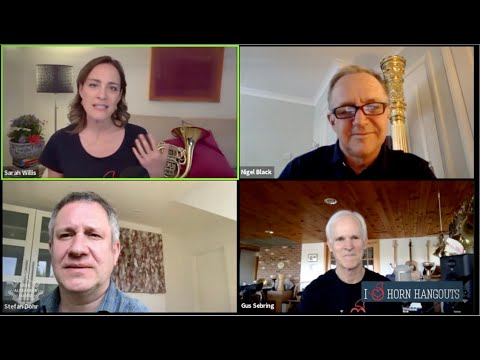
Horn superstars Gail Williams, Radovan Vlatković and Stefan Dohr join Sarah Willis on the Horn Hangouts and bring their favourite etudes. A unique opportunity to listen to these four demonstrate and talk about etudes, why to play them, what to play and why they are so important as a part of your horn practice. A Horn Hangout not to be missed!

Transcript
Auto-generated from the live stream, expect the occasional robot mishearing.
Hi everybody good afternoon from Berlin good evening from Melbourne and good morning from Evanston in Chicago hi hi Gail and Stefan and Tim morning who’s the sleepiest me always 24 hours a day yeah it’s 7:30 but when we when we met you just now to test it out with 7:30 in the morning how is that for a get up time for you oh it’s fine
I’m usually up I’m just not usually verbal did you say horrible or verbal purple you are definitely not horrible right yeah Tim how are you doing I’m great I love these 11:00 p.m. hangouts is my prime hour you know remote with Tim had to get up at 4:30 in the morning on Fry I’m Safi money because he he cure he look at looked after the trombone and horn hangout um and they was like herding cats a little bit but we got there they were great and the zoom link broke just before the we went live so you were you were so calm it was amazing
We got there we got there the best because about the trombones was that we finished after an hour so that was 10 p.m. Berlin time the party went on in the zoom room until 3:30 in the morning at which case Christian Lindbergh either fell asleep or passed out we’re not quite sure which fell asleep of course and they left him they left him in this room so
Tim if when you opened your browser you could see him that’s quite would have just been sleeping luckily I didn’t really that it was a closed thing and the others were all pointing to him it was it was great it was a great hangout wasn’t it spectacular one of my favorites one of my favorites so where’s Radovan
I’m not sure I’m not go and find him find him see you later - so I’m what - say hello to everyone watching of course on the horn hangout page on Facebook it’s great to see you all how was your weekend and let us know where you’re watching from and on the website where there’s some very exciting things going on so you want to get over to the website
I’m sure climb on can posts a link right now on to the Facebook page because there’s some special links there for you to click and download about our favorite issues which we’re going to be talking about today and there’s a present for you there as well so get on over there click to download I hope the whole thing doesn’t crash now but guys
I thought guys and gal guy and gal I thought we talked a little bit about Ed’s today what do you think that’s how you learn the heart you really think so do is that is that is that something that is just really it just has to be there’s no way around it but you know I didn’t study horn until
I went I got into college I just I played the horn in the high school band and mr. covert who was my teacher at Ithaca he made you eat and drink and sleep etudes and solos we never ever I never played an eighth excerpt until I was a senior and because he said these are much more difficult and you need to build your technique and your endurance and all your musicality ideas in these etudes and practice before you have to put everything in the 8 bars and
I and I do feel that very strongly I feel this is not an etude and I know I’ve got to share it but this book has been my handbook for well hold it up again hold up a bit longer it’s the it’s the shunt gentle gentle book for valve horn you gave me my copy when I was visiting you
I still have it it’s not etudes but that’s your go-to book right I know that yeah it really is because if you take a week or two or month off or whatever that is the best way to get back in shape one 1/2 1/2 a key a day or a whole key or or play all your force and see if you don’t play with a drone so that is a book that
I used in in my plane since I was a freshman in college till and I still do everyday and when I teach five students when I’m at school not now when I teach five students today I get to fight please shout to five times a day hi deorro says good morning Gail and Chantal is the thing good morning
Heidi and foreign Patrick says hi from Canada cop Russia’s love cop rush is life good what do you think Stefan I was actually when I was studying I was very bad in practicing those things my teacher took the book of Rendell’s away and said are you not practicing this anyway so and I came I came to do the exercises and it’s a bit later
I have to say and no I I do played a lot and we will find out what they are because they really keep me in shape and I can’t play the coach after so many times because you know it’s it’s a waste of yet musical ideas and you can’t after me after if you played many times in the life it’s a bit like you want to focus if you really have to play it so
I do a lot of just exercises and edges just to keep in shape at the moment I mean we were just talking I haven’t had a break it’s not six weeks I think since my last concerts and in Brisbane so I think that is like the longest break I had since I was 14 performing breaking me not horn break you’ve been practicing
I know you have no no but just yeah performing they shoot it shoots in in these days of lockdown and isolation I mean thank goodness we have issues because as Jeff Vaughn said I wouldn’t want to practice orchestral excerpts this whole time and to play all the concertos is great but it does you know how many we haven’t got that many but
I’m discovering so many great attitudes also from you guys from from the last the last week’s of we’ve made a little list we haven’t posted that one yet but any of you watching on the Facebook page go over to the website we have some downloads for you of some of the issues we are going to be talking about today we’re waiting for
Radovan rather than had a few technical problems but handsome if anyone can solve them handsome Tim well so what have we got on though what do we got on the website first have Gayle do you want to take us take us through some of yours we have we have three which I’ve learned how to separate PDFs I’m very proud you’ve got
Maxine Alphonse knowing for lo horn and Barbato went when when I was in the Chicago Symphony I had a lot of free time in the after and the second half of concerts so I always had my etudes in my locker and that would keep me in shape because maybe one week I would be playing only a Mozart piano concerto the next week mr.
Clevenger would be off and I’d have the whole holes no so you have to stay in shape for what’s coming up not what you’re just doing and and and especially when we were going on a month-long tour I had a book of a 2s and in that time you know you would go and Xerox not copy Xerox a piece of paper and
I had a book of etudes and these two of these were in that book and the one that I don’t have it in front of me because it’s on my my prop box the maximum Alphonse five that’s the articulated one because you have to do articulation in your orchestra job this is number 17 this is the one that starts that’s not the one no sorry thank you
Tim so whoever whoever comes late to warn hangout has to pay for the coffee’s for everybody else okay happy to do I like I like that just sort of like have cleaned up behind you so all all we like books with the etudes I’m fond of you so you’re going to play them all for us now enough
America order yes and rather than welcome how are you doing today you’re in thank you as well I’m sorry for the glitch with that thing I’ve changed it the device and the Roman that’s why I’m sorry absolutely no problem we are thrilled to have you and I can’t imagine three more wonderful people to spend the afternoon with so thank you thank you to all three of you we were just talking about etudes and why we think they’re so important and
Gayle has started with one we’ve we’ve downloaded we’ve scan and definitely forget there’s obviously the wrong one but but it’s similar I mean the one that I had in more lyrical than me just an exercise of articulation this is you said number 17 this is when my fat doesn’t matter this one’s also good if you haven’t got the
Magnum Alphonse book now should have funds left what’s going on today okay while we wait for stuff on you two haven’t seen my new shoes yet oh very nice okay horrible excellent I got my birthday and my birthday was in February and they arrived three days ago right what’s going on is the one that Gil means which number well
I see not seventeen not maybe the next one over or something it’s on the right-hand side of the page okay so while chef I was looking for let me just tell you if you go over to the right we have scanned and uploaded PDFs of all the edge foods were gonna be talking about today and there’s also a purl there just this one of gears is not the one she was talking about it’s a different one but the one we’ve scanned is good anyway here we go and now mr.
Stefan Dora’s going to play it for us I’m just I’m just trying to find it eighteen or nineteen okay [Music] and then you take it the octave lore and then you can put it in C or any other key that you might be playing in that week so you have a variety of ranges and keep the same kind of articulation how do you encourage students to do that because when
I say play it in C and in DNA they sort of look at me as if I’m asking them to drink cat’s blood transpose it to transpose it choose any further than a flat seems to be something well that people just don’t want to do when you see something in D flat horn section stops and writes in all the notes before but also
I mean I remember all that help when teaching these sort of attitudes but he also you know asked his students to transpose them but then transpose them but play everything on their home yeah he really did these poor students they had to play everything on the F form but it’s good why do we love playing on the
F horn it’s where we’re from I like it because it gives us that much more resistance and you have to support more yeah at control you have to be really careful with this otherwise you just bleed around all the time yeah so if you make the airport sound really beautiful and articulate and clean it’s gonna be easier and more facility on the
B flat side yeah yeah Gayle you’ve also included the bar but oh now I’m not playing that one because it’s too hard and I ever played it before but it’s the first likely well I always play it it’s two pages I love these because they’re two pages and you play it down the octave and then you go back to the left-hand corner and play it where it’s written so you get that’s sort of like not as
Musical as a Bach cello suite but you’re covering that full range of a good three octaves and and facility and and stretch ability because I really feel as you mature you need to stretch more as we do in our regular bodies so that’s part of the stretch those those are beautiful I’m going to be playing those you you think it’s better that way around to play low first and then the written written or can you do the other way around or what it was harder for me to play low so
I did it first also I will middle C so it just kind of scrubs that over and over and over so why not do it first and then you go into the area where maybe it’s a little more natural for me it’s the other Peter way around for other people yeah I feel like you get you I feel like you really get your air going better in the low range and then you just apply that air to the upper range so is this why you’ve included knowing for low horn as another one of your favorites attitudes yeah they said these are the ones these are
Three that I would take on a tour and if I had to go to I had to go to two books you know now that we can carry everything on one iPad or something I would take my Shanta book and I would take by that classique book because I feel like there’s a lot of articulation a lot of slurs it looks like this oh yeah yeah it just has a variety of music that you can play
I mean I I go through a lot of different agents because I don’t have as many concerts as people in orchestras anymore so I create my own now you only have to give yourself a lesson every time you play so absolutely absolutely and so the NOI ling one that you’ve included is this one [Music] written on a dotted quarter equals 48 oh okay that’s the way
I like to do it because then you really see if you can really explore between the notes okay so there’s no there’s no metronome marking on here apart from an Dante so everyone who’s just downloaded it from the horn hang I hope we’re not gonna get in trouble for copywriting or whatever but we’re really just trying to help everybody so
I I hope that’s okay we we have our favorite issued scanned and on the on the on the website right under the video box so you could find them there so you would suggest dotted dotted crotchet what do you call that a dotted what equals 48 right it makes it and then if you can get that means every time you take your breath you have to really expand otherwise
I’m not gonna make it to the end of the phrase correct yeah good um so good questions just come in from ID uh what do you practice here choose just playing through or breaking it up what would you say to yours Gayle depends on what part of the week I’m on if I’m learning it and being a student
I stop and fix it it’s like in the Daniel Carr look stop and fix it don’t let your mistakes continue but at some point you have to perform at the end of the week you turn on your recorder and you perform it then you go back and listen so on Fridays it’s more fun than it is on
Monday now your mindset is yeah that’s true that is a very very good advice thank you for those three so Barbuto knowing the that’s from the first book isn’t it yes and the Maxime Alphonse book 5 did he write in total do you guys know six-six-six until you know much more than me Radovan yes what’s yours I chose these not because
I practiced them particularly myself but because there are examples of different things there’s you know stylish and and and different we have Fran Strauss who wrote these a chose I believe for him to self because he was very keen on practicing and because they performed the Beethoven symphony she included [Music] exactly exactly yeah yeah and then here are talking about playing it in fragments
I do strongly recommend playing it in fragments first I’ve come across maybe typical mistakes that one does and I just wanted to maybe as general advice say that one you know when I talk to my students or for myself as well just try to plan in advance as much as possible that means including temp or not taking too of an optimistic tent or run into trouble just by throwing ourselves into that and then when as
Gail mentioned when we are in performance mode as you mentioned towards the end of the week never going back I think just just not allowing yourself to go back but planning other things as dynamics especially breathing also like your string player would use boeing’s and so on so what they’re planning and you can use colors if you want to paint your your page and that
I think it’s easier to like conductors use and you get a lot of information from different colors I do recommend who arrests and slower tempo and I also recommend trying to learn either difficult passages or the whole edge it by memory because if you can do it by memory and you know you have it down and then you’re not overwhelmed with the visual information so really tough because
I mean you all three of you are a big-time soloists and you play a lot from memory but I sort of mere mortals that play in the orchestra I literally almost never have to play from memory can you train that course I mean there are books not that I’ve read them but as a child it’s not difficult to do and then it’s just like training your memory these people who can you know tell you remembered party how many digits it’s a matter of training and well
I learned this from a clarinetist colleague of mine and he said you know if you have a passage that you can play on memory then you know you have it down so whether it’s solo repertoire and or oriented I was also thinking why edges are maybe not necessarily popular and I think you know they have a reputation for being boring and dry it is true that some edges are not well written but for instance
I prefer I don’t know how Coleman’s low horn issues there to nailing nail oiling his hard work and it’s it’s good and it it’s rewarding but it’s hard work and again Bach Suites that were mentioned I prefer for a low arranged but trying to played as musically and as stylish Li as possible so that we don’t separate you know the hard work of the etudes and then we have fun with the pieces that probably explains my students prefer playing repertoire other than choose yeah so you you were your other choices was the with the copperish which would be more of a sort of more of
An attitude attitude and then and then the the the Caprice the caprices I find more like pieces yes well you know copperish I was thinking of USERRA for a moment because he was a colleague from he played in the Opera in the early 19th century was second horn in unter den Linden so he would do breed assessment he’s a colleague of yours so you should start writing etches of your own as well and and he did it for the needs because he knew this man the gentleman who invented the vowel foreigner also and
I think because they were used to hands stopping this was a new thing so they had to cover in the knee and that’s where the cooperative’s got written although ii also called low horn are more popular he wrote them for high horn as well but i think they were doing that or as in vogner playing with all the fast transpositions i think they just changed their valve positions in continued hands and stopping in the transition period you you’ve chosen the number 59 the the lyrical one yes yes [Music] the variations and the rest of it that’s oh don’t start it too fast the
French capris we choose because that’s something that we learned with our teacher in back in zagreb in my hometown he studied in paris in in the 1960s and indeed he used this ascending system familiar with the third ascending system the horn is you know basically in in GE and then it goes up it becomes horn mg so it’s something very specially
French system which unfortunately didn’t did move on and I wasn’t familiar with it I plan will be sending but we were going to do through this repertory I think it’s French tradition that he and I enjoyed practicing fast would you do because the number four is quite it’s quite a big relief that your audio is a little bit quiet this one is in one more or less okay [Music] because you know
I love the way the galleys finishes they’re always they’re always really sort of you know diva operas mala but why do they put why doesn’t he put the high note of course you can I’m worried about Stefan now I told him off and now he’s disappeared they’re fun handsome Tim um can you sort Stefan out it’s been look what’s happening there no but thank you for those those are really great we have them on for those of you watching we have all these downloaded on the website the
PDFs are the ones we’re talking about today and we also have a surprise for you there on which we will tell you about at the end yeah so practicing these it was so we should learn them by heart yeah we should sort them slow at the beginning of the week we should record ourselves we should move the tempo up can you summarize that you two again [Music] and success was the second player
I think so using your fantasy and and pushing the limits but also knowing what is doable and not having too high expectations you know allowing yourself on the first performance to do 30 40 percent less and then maybe in the gradual process improving your score as you go on but I think we need to be a little more realistic about our expectations and not be disappointed now in the times of corona we
I have both individual lessons and group lessons and when we get together and we have a laugh and we talk and sort of mutual support but also when we go into performing and then I asked them to come and specially with positive things realize what you did well and what you want to improve on then I see that that this performance mode yeah asks for different things so it’s good to hang out together performing
I never thought I would miss it so much you know you don’t realize how much we need it until it’s not there anymore yeah yeah but that it’s good therefore it’s good to just do it in for each other or in small groups and I think that keeps keeps you going I was also thinking maybe in the context of this
French Caprice by golly he’s a player from the beginning of the 19th century he was successor to Dora his teacher and he influenced French more playing in a big way by playing and teaching of course this is the time of the hand horn and to understand a little bit about the historical background also I think it’s interesting we talked about cooperation how he met the needs of the new valve instrument this is pure hand horn playing so understanding a little bit about the covers about the world was possible what was not possible if you play
Cherubini Sonata their articulations in the autograph which are undoable and maybe their beating didn’t do it this is the horn playing so he knows overall though you know details over specific requirements so going into that a little bit or modern agent from the 20th or 21st century which knows exactly what they want with all the you know extended techniques and everything so it’s good to understand a little bit that and do research so listening to a lot of music listening to different schools of playing not necessarily national but you know how do you play differently in different orchestras in the
States why are things so centralized in in in France because of its core why is Germany so rich with musical culture because it was never one country until the 19th century so you had all these wonderful you know different centers of culture and people play differently and that’s still the case in Germany if there’s not one style to it or in
London for that matter schools I love that we can all be here we’ve lost Stefan Stefan trying to rejoin he’s not quite sure what happened he dropped his iPad so I’m Stefan if you’re watching us I hope you can join us soon because well I wasn’t gonna play any of his EDS because actually they’re too hard if he’s chosen really really difficult ones eyes coming back but he’s sideways remember reminding me of
Tim Jones yeah we were talking about Ron Ron was just reminding us about the difference in the cultures of all the attitude composers you know the French concept pieces and the German melodic ones and that’s what’s so wonderful that we have all these things then the modern composers who also really knew how to write for one of yours wait a second
I’m really sorry I see you twice now I’m sorry Tim has saved the day no I think when I plugged in my iPad because it run out of battery I pulled the chords out of it in the whole the whole rule to fell down and everybody was like sorry do you feel like telling us about Vernon Reynolds
Vern Reynolds yes I’m not burn ya know you know we’re not starting in front but in the Opera at the same time I was playing a lot with the ensemble down this time actually this sort of it’s very good help to find rhythmical things like this is why I’ve picked number five because you know you develop a sense dissolve when anything in drive eight or seven eight comes
I don’t know why you develop a feeling and then they come like to price and between and suck ah it’s a bit more tricky so there’s a lot of these things in in the book but also there’s a lot of like intervals that you really have to hear before you play them and so this is yeah one of my not favorite books but the thing is
I have to practice it because it’s not my favorite so the things not to practice are the ones that you have to practice Gail do your students like to play Vernon Williams Williams I choose which students would be successful I use I use different roles quite a lot but not until like their third year I want some of the other development to go first but then again you know my teacher study with
Vern Reynolds so yes you all do and I was very upset when I realized you know my all my burn rentals or or my studio and one of my students said oh I asked and him for you so now I have him again but I think I I’ve also taken a lot of those suggestions in the front of the book and use those for solos you know the ones he has written had the preface page because he exploited the whole range of the instrument and
I think they’re really very fantastic and and especially if you finally make the student sit down and realize oh this is a whole tone this is a you know minor third major third and then they get the idea of how he actually wrote these who was the horn player that came to our oh no that was that was the that was the guy that
I was thinking I got when I was with you in in Evanston at I’d been in there it was a little sure that turned up wasn’t it was a long shot but he had gone what’s interesting and I never had the opportunity to ask him over and over you know he was at Northwestern for two different degrees he studied with max
Pontic way back when and then he had to go into the service and then he came back and study with Phil Farkas so he overlapped you know a great different generation Chicago has had a lot of good horn players over the years you know it’s very interesting as Radovan said about you know the different colors of the horns and the different styles throughout
Europe sort of that was that way in the United States for many years and why because it was the the instrument that they played in Boston and National Symphony we all played Alexes so at Baltimore Symphony Lawson before he started making cards he played second horn in the Baltimore Symphony played and Alex so many different schools am
I gonna say what and why do we play Geyer type horns cuz guy are settled in Chicago those are the reasons it’s nothing magical and it’s sort of then you had more Czech and bohemian people moved into Chicago area and that’s that’s a stop that’s nothing it’s really great PO tag wrote some Tony smiles just reminded us pot tag wrote some great attitudes as well he wrote
I must dig out that book I have that book somewhere go to the Han room yes Chris oh we do in one of the I think sir horn room gets buried for years [Music] but if you look at that max part a preparatory melody book yeah Shanta lead there Shantou melodies the shaman is from my part of the world from
Deana so that comes closer to here those of you just joined gales go to book is Chantal and that if you got it there Gale show it to us again those of you that just just just don’t have the cover anymore oh yeah yeah all the best issued books don’t but we’re dinosaurs we still have the books books anymore no but books
I mean it’s good to you know if you like pick one or two of their choose two to show them that’s fine but people should buy the books I mean they’re not very expensive and and it’s good to have like that let me paper because then you Soph like you look you can’t easily skip them on the iPad you just go look next that’s too difficult next but here
Chris gone goose is watching hi Chris lovely to see you we’ve had someone someone else a Stephanie Fritz asked how many days should you stay on one attitude and when do you know how to move on to the next one when the one you’re playing sounds good right guys I would also maybe add that you know Philip
Farkas book he talks about planning your day and I would agree that it’s important to planning even if you don’t have a hundred percent efficiency that but deciding how much you want time you want to dedicate on one issued and then moving on so it’s not like I have the whole afternoon or the next month to learn this thing it’s gonna be thirty minutes every day or forty minutes every day and then you stop just as you start it’s difficult to start it is difficult to stop but you must stop and move on or have a rest of whatever and then
I think also it’s with myself that when I was playing repertoire that was maybe too difficult when I was younger it would build in said I was getting tense without being aware and at that time my teacher didn’t didn’t actually talk about those things that I notice it more and more with my own students so reminding you’re constantly yourself constantly to relax and play in a relaxed sort of body you know mode and then
I think the things that are difficult also also work in in performance mode so I think that’s an important to remember well if I look at one of the ones Stefan has the other one the other two one is okay the belly belly is the maximum out I would be very tense if I played that one yeah but this is this is a typical example for it has so many different parts in it this is which one now to the website all these attitudes were talking about are scanned and waiting for you to download them so that you know what we’re talking about and give
You something oh yeah yeah looks a bit frightening of them at the beginning but also it makes you know you have to think about rhythms you have to think about the ins of odds but you can also just like he also suggests like play this ten times yeah it says like defo you can replace it with one and two so that’s if you if you see something like this just do one or two work on the details of it first you don’t really have to play it in one’s eye you know of course you can after a while but there’s enough work on that for
A couple of days there’s a very good question just coming from Matthew Haislip you’re such a loyal horn hangout viewer thank you for always joining us he says do you each have students work through entire books one off to the other or do you have them study you choose from a wide variety of books at the same time not missus really not necessarily going from beginning to talk no it’s nice to do some and if they are working at a good pace we can go through the whole book but it’s good to cut them with different different books so we just don’t get into just
One way of playing yes yeah I wanted to say both the maximal falls I find them quite difficult I think as a student myself I got stuck somewhere on book four and five and every time there is something little bit old-fashioned in this repeat 10 times yeah if you don’t do it well you are about to be repeating your mistakes you know so
I believe always too I mean there are two ways you can approach either you facilitate things by making it easier putting it like Yael said an octave down playing a super slow tempo or you make it more difficult by making a transposition which which sends you up into the stratosphere so there’s always you know at two ways to approach that but the
Tempe are also very optimistic here in this book and I tell my students usually not to always obey these super fast tempos because I see them just just doing too too much damage on the way so yeah that’s a lot of times they’re really cool yeah as far as the the choice of a choose I think you know there’s this good little video how to practice efficiently on
YouTube and it’s very good because the explain explains what happens in the brain as we learn and then so pushing the limits and going to your limits on the one hand but I think also like whether we do it while we’re warming up or in like exercises that we talked about Sarah I think repeating certain things which are easy and relaxing is also good and
I think the reason I like to do that and I think it’s not a waste of time is that we keep the connection between that the head and the fingers and the lips going and I don’t want to get into the tricky subject of focal dystonia but I think when problems started somewhere on that connection and that’s why we need to kind of oil that and keep it going in a relaxed manner because when we it starts it’s hell to get out of it so
I think there is a sense to you know repeat in a relaxed way not spending your whole day on easy stuff but not on too difficult either you can be over ambitious and get in trouble just by always being on the edge the whole day and that’s that’s exaggerated to know it’s very good just to take parts and bits of these especially this book number six is like yeah but also also the
Byrne Reynolds if you just take a group of like you know four or five lines even the straight lines or just one line and just really that every note is focused and where it should be this is the way to work and then you can like even if you don’t need two bars for two bars in a row and have a little breaks and then put them together later just sometimes these being the
Reynolds or the the Maxima for slate once they are really hard to play through there’s no not this risk you don’t have the skills yeah and you try to play let’s just say tennis and in the Daniel Cole Cole book he talks about going to Russian tennis academy and this woman has taken your backswing into every single section and you don’t hit a ball for two years no well that would never happen here you know your elementary man has to play
Mahler or something instead of going very very very slow and that’s like being a farmer having to watch his corn grow and because of the technology that we all have nowadays you have to do this exactly I always think this reminds me of my life during my teens or so when things were slower and you actually have time to dedicate and you didn’t expect every solution with a quick click on your computer and this one this is on the bernoulli they are very nice they’re like six ones of them only six but they have like three or four pages each and they’re nice melodies and
Nice they’re not too difficult you can transpose idiot they’re too hard you transpose them - he fled first they are really nice to play some just like melodies lucky’ can you use that Paula kerger food howling outside she can’t stand which transposition a flat okay you can do it in G okay good okay well you’ve got all of those all of the ones we talked about up on the up on the website
I just go through mine really quickly because of course I love playing lower Jude’s bar I don’t know what is all that noise is that you stuck on sorry water water sounds very loud water i I can’t only practice low horn I choose because otherwise I wouldn’t be able to play the high note so I actually practice more more like stefan’s but if there are a few you really you really would like there’s this one which
I know you all know from the cling book [Music] you know that one it’s lovely and you have to play it like like an opera singer otherwise it’s just boring so don’t play and talk at the same time it’s it’s not good for playing but you know what I mean sorry about the splits but you can do this one with all the all the the cadenza bits like an opera so imagine yourself being an opera singer otherwise it just gets um just a lot of notes but if you couldn’t run bump um but you can really make a lot out of it so that that’s
When I love that and I also find it relaxes cuz it’s got so many so many nice jumps but I don’t know do you guys practice that one too octave jumps relaxing I’m not sure yeah that’s relaxing you know you wouldn’t believe how useful these low notes are in an orchestra to just be able to go I’m winning tenure is all about notes like that and not about all the stuff in between you know
I’d like you have to come in on on pedal notes and even you know it’s all it’s all in these studies studies are just great talking about the pace how we want to study and move on to the next thing you can decide as a teacher or as a student with yourself to be either terribly strict and polish an etchant for months and months and months until you really want to record it for you can just move on when it’s time to move on
I think one of our aims is to prepare the students for professional life and there they won’t have so much time maybe in Venezuela when they have the Youth Orchestra they learn a program that everybody plays by memory for three months but in normal in life you have to move on and you have to while you’re performing one program prepare the next one and
I think to get into the rhythm of things you have to understand that we actually mean next week that a chude and I want I don’t want any wrong notes because that will be your part in the orchestra so not developing that kind of a and and and you know just seeing that they play more precisely with more all of the qualities that we need but so there is somehow related to practical life and the expectations because we all know that that that leap between students and professional life is a tricky time so you want we want to prepare them as best as we can
What that’s the same it’s the same most of that if if you really find out it’s too difficult just put it away and get back to it a couple of month or weeks later so that you soon are then you find out I’ve you know I’ve developed a strength is I have developed this on other issues and now
I’m ready for it it’s not always that you can get out don’t start with it yeah as most students don’t know how to cite read anymore and finding finding an etude book that maybe not as difficult but you could assign yourself to some read something every day do you have a friend that’s going to be doing that right yes
I do late you tell us about that my friend James Stevenson is a wonderful composer here in Chicago area he used to be a trumpet player in the Naples Philharmonic in Florida and he has written two different months worth of trumpet etudes and we can play trumpet etudes you can take them down the octave or whatever and so it was really great to get a new a to it every day for a whole month and he approached me the other day about hey how about doing some horny to assess it
I’m there and especially now so he we haven’t finalized it but I think he is getting ready to put out a subscription you pay X number a few dollars and you get a new piece every single morning in the in the mail then it’s it’s really fun and it’s nice to go back to them and polish them up but to read
I mean that’s something you know I don’t know if you have sight reading and orchestra auditions in Europe but that’s something that research say oh we have to have sight-reading and I’m like why because you’re in the orchestra you would go to the library and get that music out and practice it before you come in for every concert so we have usually you would have three maybe four yeah and but it’s it’s still you maybe maybe
Stefan get sick and you have to slide over and play principal horn it’s a skill that’s very nice I mean look at all the London players it’s I treat all those you know movie scores and it has to be right and it’s a skill that you have to learn and with torchy library you just can go and find so many pieces it doesn’t have to be a two you can play all sorts of weird concerts and solo pieces and sonatas and things there’s such a lot of thing what
I’d like from you deerhorn hangout viewers we would like lists a list of you which favorite issues which are your favourite issue books and I’ll try and put them all together we’ve been promising to do that since we started this three weeks I don’t know where the time goes we’ve been here at home for weeks but it’s time seems to go quite fast to let us know which ones are your favorites if you want the attitudes we were talking about today they are on the website for you along with one beginner attitude which
Clemmy in for now and Berlin chose for me they’re from the uragan rumor books is that is that right you probably don’t know them I didn’t know them they’re for beginners it’s a German a German guy and these apparently are really really nice to play well if you’re a beginner he’s not a beginner anymore what we’re doing on
Wednesday is I have to begin a beginner and school horn teachers coming in because I don’t feel qualified to talk about the very beginning stages Stefan you don’t you said you don’t feel the same you know we we you know it’s this is something that we’ve promised we’ll do and we’re going to be doing that on Wednesday because to start off someone well on the horn that’s a huge responsibility and
I would like to know Heidi vessel will be coming and I’m working on the second guests I hope it’ll be who I’m working on but it means she has to get up at 6 o’clock in the morning to do it but this is such an important moment you know in you can make or break a horn player not only chopped wise but also inspiration wise
I just would like a few tips but we’ll be bringing you many more a tooths on Wednesday of a let you know of a not so difficult category ones that can inspire but a very interesting question just came in um other instruments our attitudes from other instruments you would steal Gail box I guess I don’t have an
AIDS Lee thanks Jonathan for that question I think the trombone players have stolen from the vocal literature all the Volk Elise that we all play in and if you take any of those vocalist that the trombone players still we can actually expand it because we can play it in bass clef in C we can play it in old notation and new notation so you get three or three different ranges immediately yeah
Radovan do you steal any flu yes I mean our burn method we talked about those are not issues or not only issues but exercises and there I worked a lot it wasn’t my idea it was given to me through I for James and he learned it through Aubry brain and so it was a bit of a tradition of using trumpet or methods but also with warm-ups and their ideas and buzzing and so many aspects of playing
I’m still practicing my viola attitudes on the viola we want you to play those large ever viola at home no you do oh here we go you know the joke was a gentleman yes we had that on the trombone hang out they can say that about any instrument it’s not about the board talking about trippity to if you look at the
Schlossberg book it gives you an idea of slurs and so make up your own horn yeah I’m scared about what’s about to happen I’m not playing it’s not even my viola my violist omana with our second violin he plays it when we play the mozart quintet he always plays you know because usually plays in the octet in play second violin and he plays on my old wheel on the second jewel and there what’s a quintet back well if
I challenge you to play the viola on the horn hangouts one day so there we go um I actually stole my best friend’s book of flute tango etudes by Piazzolla hmm it’s mainly too high but you know you can put it down and it’s really great it’s quite feisty stuff to play but I just think you can steal all sorts of stuff we
I have a list of Klaus voluntour suggested the versed oboe toots and you played them in e-flat otherwise they’re quite painful painful in e-flat yeah you guys have been amazing really I mean I think we have to think about this word that yeah but I get again it’s in Daniel Cole books Picasso said a great artist doesn’t steal you know borrow it they steal it and they keep it that’s your a new idea to add to yourself so go ahead
Steve yeah don’t publish it i I’ve got something for you all it’s a present and you three I’ve got Gail I sent it to you yesterday you practiced it because send it to around abandon stuff on it’s a very Britta brand-new at you’d called a friend of mine Mike berry in LA has written me four or five cinematic
Hornet oods because obviously he writes for Hollywood so he he like loves the horn and it’s always so heroic and and I’ve we’ve given you the first one here as a present it’s on the on the website to download and I want you all to practice it rather than want you to practice it to you’re gonna like it and it the first one is leaps and bounds and it’s it’s really cool actually it’s not quite you know it’s it’s a little bit modern but it’s quite it’s really how did you find it girl when you play the cop is a really good blow yeah you
Practice your sevenths or whatever interval and arpeggios it kind of starts to feel like it it flows a little bit more yeah it’s hard to sight-read but I want you to download it and if any of you feel like making a video of it and letting me see it somehow we might have a little competition and the winner might get a lesson and we might live stream it how about that we’ll see you know we’re looking for ways just to keep motivated all of us in this time you know and what you were saying rather than about you know the edges and the orchestra and
The and you know needing to keep this concentration up and and what you need for playing a certain line in an orchestra and getting that through your edge in fact it’s harder to do that at home right now it’s a great this is a great book this is called a choose from the repertoire repertoire by Steve Beck now he’s principal
Horne in the LA opera and they are so cool um they are you can order it from him online they are Beethoven six bizzy’s Carmen Dvorak nights she answered he’s made it shoots out of all these well-known excerpts and there are a lot of fun to play I’m glad you’ve got it because it’s really it’s it’s a good book and
I just that’s really one I can remake him in but I want you all to play this because it’s cool and if you like it then we might have another couple for you but it’s it’s about motivation and if you have any suggestions how we can help with that then let us know but you three it’s it’s cool it’s quite a blow by the time you get to the end with the
Ritardando and the forte but Mike really knows thank you very much Mike for that I wanted to pay him and he said no he’s donating it to the horn hangout so very nice if I may just add Sarah I was gonna say you know we have to see this this time which is very unusual in perspective and maybe in one year time in five years time or in ten years time we want look on this and say well that gave me a chance you know an opportunity to do something different whatever it is that you choose whatever your project is to practice to do some
Other things that you never had time enough for and sauce and we want to this will be over and it’s not about it’s not gonna stay like this forever so let’s make good use of time and then maybe maybe make more sense I think also like we meet together in person and we like decide on which the best recipe of these eight weeks everybody brings we can write it
I’ve managed soups so far I’ve managed now to ferment blueberries that sounds exciting it’s very exciting you know I cut onion and garlic and you guys need a lot of garlic we’re the master chef yes second week of trying sourdough bread amazing [Music] yeah so to play your a tooth and do some cooking and let us know how it all goes if any of you want to record the cinematic issued
I want to hear them and I will be picking out my favorites and not just the notes guys it’s how there’s not so much information there how it shoots are great to bring out your moves musical personality as well you know make make a piece of music make a cinematic issued out of it so I’d really love to hear that
Stefan in Radovan are gonna be practicing it too you can you can join in as well you might get a prize but thank you you three you are so inspiring we need a selfie moment everybody likes to take the selfie oh yeah we got Ana tuna okay one two three there we go how many animals do we have today which - oh that’s the cinematic attitude yeah oh
I didn’t put the title in yeah I got it got it got it thank you so much for joining in you’re so inspiring you three I could talk to you for hours you are thank you sir and I will get out some new etudes great I’m gonna go and practice a cheese now are you guys gonna practice a cheese
I hope so and for the beginners and the people that have been playing so long or getting back to horn on Wednesday will have etudes which are a little bit less challenging there Maxime Alphonse book six bye thank you go to bed Oh like this
Horn Hangouts are created by Sarah Willis of the Berlin Philharmonic. Brassbanned is a proud long-time collaborator and streaming partner.