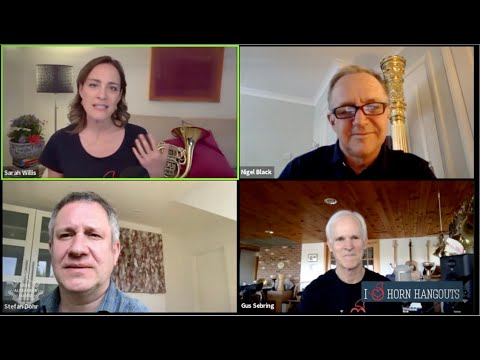
Stefan Dohr, Stefan Jezierski and Sarah Willis guide the Horn Hangout global viewers through some of their favourite warm up exercises. Grab your horns and join in!

Transcript
Auto-generated from the live stream, expect the occasional robot mishearing.
Hello everybody good afternoon from Berlin and yes we’re back we’ve gotten with three incredibly handsome gentlemen today first of course but not at first but not at all last no least but not indoors first Tim Kelly handsome Tim from Melbourne hi everyone thank you for staying up late again one door you’ve had a Shea Eve yes Stefan j2 but somewhere else beautiful you have the shave - yeah great maybe we will stop that conversation right now
I don’t want it to go any further um hey you guys I got a present in the mail today can I show you your socks no not new socks shoes oh goodness they have a horn on them Wow my brother dear Alastair who’s the conductor in the South Bend Symphony in Indiana he sent me these for my birthday in
February and they just arrived today so what do you guys the wrong mama well that’s fine yeah that’s not is that what horn is that it’s a French horn okay French what is good your motto six six seven okay we’re gonna warm up today have you all got your horns I think you have Lina’s got brownies she wrote
Hanna from Bavaria is very sad that your beard has gone Stefan Davis and Sonny Della Devin Brenda and Sebastian in Alabama Simon in yorkshare Clinton a New York Alexandra Cape Town Annika Slovenia as if you’ve got you’ve got Devon’s watching Thank You Devon for being there and for all your help great are we ready to warm up if you’re watching on
Facebook get your horns out and if you’ve got any questions for us which we probably won’t have a lot of time for today because we’re going to be playing yeah get over to the chat on the website and put your questions in otherwise I would say time to warm up guys I think leave you guys to it so what we thought we’d do today is that we thought we’d start off
I get the easiest job the buzzing and the getting ready to warm up Stefan J is going to start with some more easier warm-ups that that are good for beginners but also good for all of us and then Stefan doors going to warm up on high seas and pedal F’s right yes good everybody ready okay so mouthpieces at the ready get your mouthpieces you can put your horn on your lap or whatever but our bodies are part of our horn playing
I I think I think we all agree that that’s very important so how often do we do this this is one sports therapist told me this is one of the best things horn players can do Circle your shoulders to the back like that I can hear your joints cracking you guys and then circle them the other way how does that feel up and down up and down okay exactly and then like that good stretch your arms out back
Oh keep that for a minute yeah all the stretching is a minimum of 25 seconds so yeah shake him out I usually do this because I’ve had a lot of problems with my wrists my right wrist so I just sort of warm it up like this just I’ve seen this Agreement I’m just just I’ve put my hands together and
I’m just sort of sneaking around just to get the the wrist a little bit bit more on there good good good so now you’re gonna take a really big breath a really dark low air breath and what you can do if you want to make it really dark your throat you can take your finger and you can suck against your finger like this try this and out and 3/4 again and breathe out and now throw a bucket of cold water over you and
I want you to breathe in very quickly as if you’ve got a bucket of cold water like this okay okay ready and you know and again and now good how do you feel guys cold cold cold cold so we got our mouthpieces and Schieffelin e and I have done this in the previous hangout about I don’t know hang out number two three four a couple of weeks ago important is you don’t press your mouthpiece onto your face yeah hold it right at the end or if you guys have better other tips how you could do that just to make sure but it doesn’t go oh
Yeah exactly so we’re ready for the first note take a good dark breath okay so what do you want to to be is holding a troop I’ll go one two take breath okay and um don’t use your tongue yet just go with the buzz okay three four okay and you with Stefan you contact and your conduct okay [Music] and now a little goose and
Oh without pressing on your lips I can feel all that spit coming through the airways so it’s just a little bit okay so it’s basically just for me and for I know Stefan D Stefan J I’m not quite sure about your philosophy on buzzing Stefan D and I don’t do a lot of buzzing on the mouthpiece sometimes just to see how it feels like but it’s basically you’ll feel your lips vibrating a little bit just to get the the air going
Stefan J what’s your philosophy on buzzing on the mouthpiece well I don’t usually buzz as part of my daily routine but sometimes I use it as a tool when I’m teaching when a student has some issues with a certain note sometimes to really fix find out what the embouchure is doing and what the air is doing it helps to eliminate variables and one way is to take the horn away so the
Horner’s other factors with just a matter you’re down to your lips and your mouthpiece so there’s also a way which I will start with this warm-up exercise that that Sarah started by getting the hair going the body warmed up the lips vibrating so we’re going to just take where Sarah left off here and and elaborate this a little bit and add the horn so we have is the body just just one one very sad thing when when
I do buzz I actually tried to cover 3/4 or two-thirds of my of the outlet of the mouthpiece so that the feeling is a bit closer tongue to to the harm with the resistance otherwise it feels like falling off of it so if you like to if you have it like in two fingers and you take take the other thing and just put it like at the end say 15 years ago this is very - it’s a bit closer to the feeling that you have on the horn let’s try that once let’s try it once if you do it for us and then we’ll do
It we will do it together [Music] I think that’s really good dangerous that I would want to press more on my lips I think it for me is the opposite because you have a resistance of the air coming back and you can feel it more like in the home so that’s that’s what I’m sorry if I go no maybe totally with bundi with this matter that’s all
I’d forgot to mention but I’ve always been doing this for years to stimulate the resistance of the horn it has a little bit more resistance pay into the mouthpiece exactly what Stefan was talking about I agree with this 100% and so we have the when we just pick up the mouthpiece and play a certain though the easiest most natural note usually in the middle register and so
I like to take this take the horn and play this note let’s see how it was closed when if it was actually more close to an e but as a starting note I’d like to take this F and this is a very easy pattern we’re playing a half note rest for a half note play another half note rest for another half
NoHo then play a whole note with a thermometer okay this dust doesn’t really need the tongue to get the air the note should actually respond without using the top you play it for us and then just a fondue chef on you’ll conduct us I’m going to put myself on mute while I play it so that you’ve muted yourself okay then okay then
I’ll play okay got it okay well start demonstrate when you think of a pulse going of a quarter note 60 beats per minute so that’s each second one B so just talking with one two three [Music] could you hear that I have a bit of a problem hearing you but it’s basically just 4x in a row yeah yeah three to two beats two bits break to beat stupid breaks that’s all be things to concentrate on is okay okay let’s do that all together
Sarah Stefan Stefan you’re not you’re unmuted so I know I just play very soft okay you’re Kovac Hey three four [Music] mm okay and then how many notes do we do this with okay we go up half step so the next note would be our F sharp we keep going until the G so we don’t want to uh this is an easy okay okay so can we do that on the higher now okay we take this even we continue and from the we will play with you we’ll play with you you started maybe maybe state maybe stay we now go because we’ve done the
C let’s go an octave lower to take the octave lower just the sea lower the aim of this is just getting the air going keeping the throat open stuff on it’s a little hard to hear you on the third one I don’t know why you’re the microphones a little bit maybe I have to get a better microphone for this but that’s that’s gonna be happening till now until then
I will just play louder and talk louder oh good okay go for it where we’re playing with you okay one three four I keep stopping before the last one is over oh she founds other is and then how about a low one like what would you say a low G remember though is to breathe out so it’s breathing like
Sarah described well quickly like the bucket of water thing that was very good then we use a breath like that instance we’re gonna have too much air we’re not gonna use up all the air in one half note this dynamics we breathe out again [Music] I keep forgetting to hold up okay next now maybe maybe moving on to another exercise because this is one to maintain just the evenness register
G in the C major scale and then we take the next one and go up [Music] okay okay that’s a soup maybe only with one repeat so because otherwise you run all of the time by the way Gil Williams’s and you horn classes watching hello gale there’s masses of people from Brazil on the chat I will see you very soon there’s a lot of people oh my goodness it’s so fantastic so thank you for for watching this it’s a little bit weird this is the first time we’ve done this the three of us so bear with us we’re we’re doing more beginner exercises now we’re
Getting on to a little bit more advanced ones in a minute okay so starting on a G here we go okay can play if only one of us can play cause it’s just too distorted okay Stephan Jay you show us we’re gonna do it we’re gonna listen to the rest the rest of the world is gonna be with you yeah the things the reason one is doing this to maintain evenness of sound and absolute perfect legato between the notes no bumps really smooth okay [Music] okay this one can expand this up to the hi-c and then one can start again at the
G and work one’s way down work on the beauty of sound okay thank you that’s really great we’re gonna sort you out with a microphone I think cuz we want I want to hear you you’re beautiful sound even better okay right Stefan D let’s move on to some tonguing maybe or something like I mean okay one of my favorites is bit of like mascara but first of all you repeat the note then you play to scale up repeat the no space go down and repeat the note
I just play one time and you anyone you go and then I’ll play it back to you so C major you know one time a bit slower is not the speed this week okay the speed is bit faster okay maybe we’ll try something in the middle because I know we have a lot of [Music] look at your fingers are still on the mouse good
I’m just one second we’re getting out of advice about microphones thank you so much I know it’s not the greatest to hear where we’re all just sort of swimming around here we’re not not technicians yeah we’re we’re trying to do that but I know zoom will have some things we’re working on it this is the first time we tried this so excuse us for any sort of delay but you guys know what we’re doing so that lets thank you for all the advice any advice more than welcome especially because all of us are teaching online online now
Stephan signed up with a play with the pro stuff on Jay probably will do something very soon and as soon as I have time and no horn hangouts I won’t say teach more online as well but yeah any any recommendations thank you where were we should have fun after all I was hoping you’d forgotten that okay F sharp one to do [Music] well done just keep the fingers on the box that’s kitty keep your fingers on the vows it’s very important because when you get old like me you can’t change it anymore for one or two days um what other one
I’m finding the tongue gets slower it really we’ve got to practice the tongue anymore because my tongues doing little flow yeah another one for tonguing one times low so you set the speed or they’d legato so write stuff on your turn let’s see what that sounds like [Music] okay everyone on the c1 again oh yeah the first time is always legato so okay [Music]
I thought the beginners anymore the good figures oh I can’t play this one okay [Music] why are you trying to play the F sharp on the F on now okay and now we add another difficulty everyone’s playing it can’t you hear them okay what about earlier what about a little bit of flexibility Oh Sarah please show us
I want to keep it really simple I don’t think my mind has to move on that’s the open B flat side okay [Music] Stephan Jay do you have any tips for these ones getting around the break when you’re warming up yes when you’re talking about the break and I agree with how Stephan his philosophy of the break is to have a range of notes where one can play either with the upper or the lower embouchure and one has to pragmatically find one’s way depending on the passage one is playing for example if
I was complained I would stay on the lower embouchure for the D I would play this so I have a range where I can be flexible to find a pragmatic position that sounds good the ear has to be the judge but I do different setting for the low notes than for them that’s a really good point that’s very interesting go back to a couple of the hangouts before or last week
I don’t know what number it was but Stefan talked about that a lot about the the upper and the lower on eight a flat on the B horn [Music] horn are you tonguing them now Stefan oh I know okay [Music] and so on so you can go down to 1/3 Qantas one two three four one three iPhones
Leopard I’m so glad you are showing us that you do these because it’s so important the middle range is such a muddy range for certain and it’s quite wobbly wash your hands first so yeah that’s really good on that yeah this is one step one but step two would be not for now can you give us an easier version of that we can try now a little bit slower so that we can speak just add one this jump wand on it oh yeah [Music] good okay next one he’s got this one [Music] second mouth and all the
Gaza no tagging great rooster just got up in LA hi Greg [Music] also you have to pay attention that your eyebrows are still why are you back at least mine still move a lot of women now they don’t know they’re done they’re done yeah done yes done okay good that’s a bit of flexibility um what else is important to include it’s a really important to make the difference between warm-up and practice yeah because warming up is for me just getting everything a little bit loosened which is what we’re trying to do today we have five more minutes we haven’t done that much it’s stranger because
We can’t we can’t get that some questions do we have some questions we have we actually most people are playing to be honest so so so I have a question those people like there’s some chats going on it’s great to hear where you’re all watching from thank you for writing it it’s great to see you tomorrow night by the way please tell all your trombone friends we have the global trombone
Orton hangout Stefan stop shaking your head it’s gonna be fun don’t please join us we need you because the trombones don’t know how to how to work the chat so it’s 9 p.m. Berlin which is 3 p.m. the usual party time on a Friday night tomorrow global trombone horn hangout so please tell all your friends I need your help on that one okay a favorite of favorite
Stefan J what would you say is the most important thing for you while warming up in the morning can you start usually with this warm-up it’s like this good and then you up in half steps I would like to do this one I agree I really like the Farkas exercise I do warm up a lot on the f4 and
I think that’s really important to play a lot on the f1 in the mornings for the resistance for the air so after all you know noodling around getting all our things open I would like to do this maybe I’ll do it and just have fun you play it back with everybody else starting on an a-flat on the
F horn three great to talk and play three or can play great [Music] big sound [Music] [Applause] [Music] so I I really think for me it’s important to warm up slowly you know and then get all the flexibility and everything going on Stefan you what what would you say would be your favorite and then we’re gonna have to call it a day for today because
I’ve got another date at 4 o’clock and exact I think already last time I was saying that my I was always trying with these two octaves [Music] just to have a nice freeze open side not too large just you know letting go step step by step up and then maybe start bit higher so not not all the beginners might have a very low
G so let’s serve on b-flat okay all together [Music] big breath [Music] yeah that’s a good but I would be I would start from GE and go high and high say yeah yeah I really I really think that’s a good one thank you everybody if you like these warm-ups let us and we are looking for things to do we’ve had some pretty bad news over here that people think they’re not going to be any live concerts for quite a while and we haven’t had anything but we really we’re really worried that we might be like this for quite a while and why we love to
See you every day we’re gonna have to think of some sort of format because yeah all of us have to have to live and do stuff and teach and if you have any ideas of what you would like on the horn hangouts please let us know Stefan is already teaching on play with a pro so sign up for it yeah maybe maybe we can have one time also where where people can tell us what their best internet connection what the best platform for them is like oh that’s let’s compare because we need some you know some input is always good time to see how it
Works play the protest I mean teaching zoom is a bit difficult because the sound always gets like regulated so much thank you thank you for all the suggestions we’ll go back and read them in the chat and then try out stuff with Tim handsome Tim are you still there no I think he’s gone to bed so I’m gonna end the stream today because
I’m I’m allowed to I’ve got this I know I’m the admin today Tim’s going to buy one more new thing it’s a new new a new practice mood Oh show us I looks like is very small and actually it fits quite well here thank you no song get your gummy bears now actually where do we buy them everything sold out every year yum yum stefan and gummy bears that isn’t the story you know any other things we did disappear that my whole rooms are peanutbutter
M&Ms so that’s you know terrible hey guys thanks so much for joining this was really great thanks for your input thanks for being here and we’ll plan something next week we’ll see what we’re gonna do but first of all tomorrow night trombone party all the info will be on the website tell all your trombone playing friends the guess was amazing you’re gonna be blown away
I’ll tell you when we go offline now guys okay you get you get a but thank you and see you tomorrow and actually see your Stefan we’ll see you in singles no 15 minutes I don’t know how to say 15 in Spanish otherwise I’d say it compresses bye everybody see you next time bye okay and we’re never not
I don’t know 400 [Music]
Horn Hangouts are created by Sarah Willis of the Berlin Philharmonic. Brassbanned is a proud long-time collaborator and streaming partner.