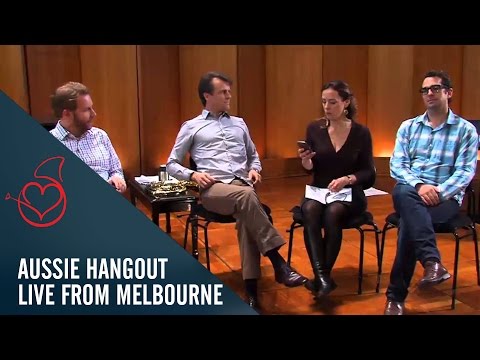
A Horn Hangout especially for our spanish speaking friends- live from the Brass Academy Alicante on March 1st, 2013 with Sarah Willis, Nury Guarnaschelli and Hans Herrmann in Alicante and Paulo Muñoz-Toledo in Zürich. And Brandy the dog asleep on the sofa…
Una Horn Hangout dedicada en exclusiva a nuestros amigos de habla hispana en directo desde la Brass Academy de Alicante celebrada el 1 de marzo de 2013 con Sarah Willis, Nury Guarnaschelli y Hans Herrmann en Alicante, y Paulo Muñoz Toledo en Zürich… Y Brandy, el perro que duerme en el sofá…

Transcript
Auto-generated from the live stream, expect the occasional robot mishearing.
Hello everyone, welcome to Spanish first, first Spanish hangout [Applause] Hello everyone, hello Latin America. Thank you too. I’m coming from a concert and that’s why I’m arriving here. My colleagues are playing. I’m here with you. [Music] Live from the orchestra, live from the Kelly Melbourne orchestra. KY from Melbourne is doing all the electronic magic so that people around the world can see this hangout, this video stream.
Brandy Sleeping Brand, okay, let me explain. Well, we’re at my house, we’re broadcasting from Alicante where Sara Willis is doing a course at the Braas Academy Alicante. It’s the fourth time Sara has been with us. And well, at my house there are dogs and they’re here in the interview too. [Laughter] My dog just said goodbye. Hello Brandy, okay, let’s go.
Okay, she just asked me how I got here, and very simple, I arrived in Berlin and came here, just like that. No, no, first, like Nuri, I was also at the Car Academy in ‘97 and after spending almost 10 years in Berlin, I did the Enon Hall competition. And now I’ve been here for 11 years, exactly 11 years, and time flies.
And although I’d been in Berlin before, I started at the 977 academy, but I went to the JK, the Berlin University of Music, sorry. And I met Sarah Willis in ‘93, ‘94 when she was playing at the opera house. And I have to say that I also played at the opera house as a substitute, basically a student who goes to work at the opera house.
And I’ve been friends with her for many, many, many years, and the best memory I have of Sarah was that one day I got lost at the opera house and she went looking for me in her Mini, and that stuck with me so much that when I see a Mini, it’s synonymous with Sarah, exactly. [Laughs] Sarah says
I speak like a ger when I speak English, but it’s not like that. You pick up on the street, almost in the background. But what happens is that I’m coming from a concert. My colleagues are playing a concert called [unclear] that starts at 10, and the first part was with [unclear] Fisher with [unclear], and then my colleagues played the fourth [unclear].
I don’t play, so it depends. It does n’t depend. It depends on when you learn to play the instrument well and when you have good teachers and good musicians like Sara and Nuri, who are always around. You always listen, listen, listen, because of that. Thanks, okay. Well, we’re live from Alicante, where Sara, as I said before, is doing a
Masterclass at the Plaza Academia Alicante. It’s the fourth time Sara has visited us, luckily, because we always have a lot to learn from her. She’s an excellent French horn player, and everyone is always waiting for her advice and to see how she does things to learn a lot. Yes, and the truth is, it’s always a pleasure. Welcome.
Thank you. Change of air. Very cool. Can I do ape tonight? Excuse me for your Spanish, but there’s no problem because many people understand English, and your English is very elegant. The purpose of tonight is that there are many questions coming in the chat, many in Spanish and also in English. It must be said that there are many
English speakers who speak Spanish, which is very interesting. Well, first we’re going to ask Sara questions, Nuri questions, and questions for me. Then there’s Mr. Hans Herman from the Alexander firm, who will also answer your questions, of which we’ve already… They’re arriving quite a bit, I see in the chat here on Hangout [Laughter] Well, even though you guys are ahead,
I’m in and Imagine what that means, very diversified. It’s my mother’s birthday today, so happy birthday! She had enough. Happy birthday already on Facebook. Thank you. No, no, hold on. If I have a solution here [Music] [Applause] [Laughter] Poor dog, sleeping with… Here you… There are several questions in the chat, some that are very interesting and we haven’t answered them by typing because we think it’s more important to talk about it.
For example, they’ve asked us if it’s very difficult to navigate the professional world as women, and they’ve also asked specifically why they chose to be a French horn player. Good question, a good question. When we start playing the French horn, we do it because we like the sound that the horn produces. Nobody thinks, “I want to play with a alto cone, a low cone.”
That comes much later. Different points of view regarding the alto cone and the low cone. In German it’s very defined. No one wants to play the alto cone or the low cone. In America or Latin America it’s more general. It’s a bit of a combination of the two; it’s not as sarcastically divided as in Germany. My personal opinion is that a horn player should have the possibility of playing both alto and bass horns, and generally those who play alto have excellent low notes, and vice versa; those who play bass horn are the ones who have spectacularly good high notes.
I did n’t become a horn player on purpose; it happened almost by coincidence, since the first job I had was an open competition for bass horn at the Berlin State University, and that’s why I dedicated myself to studying bass horn. And you know, I also discovered that I really liked it when I was in the Philharmonic, becoming more of a bass horn player, since
I could play even louder than in the opera, not in the pit. It wasn’t something planned, but it just happened. I’m trying to create a new kind of art in playing the bass horn. Normally, the one who played bass was the one who couldn’t play from the middle register upwards, not for colleagues who were already of retirement age, and to make their lives a little easier,
I started playing second and fourth horn. Looking back, there isn’t much literature for the bass horn, and I’m trying to change that a bit. My colleague, Manfred Clear, who sadly passed away, was one of those who was very interested in bass horn literature and wrote a lot of things, arranging many things with the aim of enabling bass horn players to also play their parts.
I’m trying to answer the questions in a very general way, but I’ll tell you in advance that it’s really cool to play with a bass horn. Well, it’s surprising that a woman can lead such an important orchestra as the one… but I don’t know who’s going to direct the question. A woman can do it, and I think
I’ll answer a question. The first woman in Celín set a milestone. It’s a milestone, isn’t it? And I think that for a woman in a very patriarchal world, it’s more difficult to make a career than for men, as is common, because of patriarchal issues. But I think it’s becoming more and more normal for women today to have leading positions, not only in music but also in all aspects, that is to say…
The in banks, in jobs, women who drive taxis or buses, pilots, etc. Yes, yes, okay, well, Sara is asking me how my experience was in Berlin, in Vienna, in Vienna. She’s asking me, well, I was in the Vienna Radio and Television Orchestra for 16 years, and really, for the first two years I had a bassoonist colleague. And then for 14 years
I was alone as a woman in the entire wind section, both woodwinds and brass. I think that in Vienna the tradition of men occupying the positions is still much stronger than in Germany, and well, little by little it will change, but the truth is that in the winds it’s still quite difficult to introduce women into orchestras. As far as
I’m concerned, it’s never been a problem for me, that’s why some things are more difficult, like taking a little more air, but really, that doesn’t worry me. Today in music schools there are many women horn players. Here’s a very interesting question: the horn, but you know that only the feminine name in Portugal and Spain, in all of
Latin America it’s masculine. Why did I leave Chile? Well, a very interesting question. I’ve always been very curious. And in Chile, despite the very good education, we always had our sights set on Europe or North America. In my time, there was a great lack of cultural exchange among instrumentalists. Nowadays, it’s different with the internet and everything else; that gap no longer exists.
But it was a bit of a coincidence, a bit of destiny, and also because many, many people helped me. I mean, I can’t deny that there were people like Ignacio García, who is principal horn at the Berlin Opera. Hello Ignacio, if you’re watching, he was kind of like me. Deep down, he always told me, “You should come and audition in
Europe; it will be good for you, and try your luck.” It was a bit of a destiny thing. Well, everyone has questions. I’m not here trying to fight with the chat because it arrives a little late, but there are many interesting questions. Mus Oscar and0 B technic ton is more. I’m a little tired; I’ve been working for hours giving classes, and
I’d like to talk about simpler, more normal things. Exp moreir more. In your book, playing the French horn is like driving a car; the analogy would be that the lips or the embouchure would be the Steering wheel and the rest, what is the air, which I would call the brakes, the speed, the turbo, etc. That is, the more air we put in, the more we have to steer with our lips.
Luis: Oh good, a very interesting question. I think at that moment it would be Berlin because that’s where my school is most influenced. In Chicago I learned especially the breathing techniques, the technique that masters like Clevinger Char used or continue to use, and which, by the way, many Latinos know. And in London was my training, or rather, my basic education, since the
English have the characteristic of being very correct when playing, they have a very efficient sight-reading, and they also have a very large orchestral culture. Hello Paulo, I’m David V from Chile. I have a question: what is the best way to deal with stage fright when you have to play solo? Hello David, how are you? Look, David, it’s very simple.
I have two theories or two things that I’ve learned in these times. One is to believe in what I’m doing, and the second is to keep believing in what I’m doing, and it doesn’t matter what. My cynical experience is very complicated, but there are several methods to overcome that fear. Look, we’re not the only ones; everyone has stage fright.
There are certain levels of stage fright. Some people have stage fright and can control it. Some people need to drink tea. Some people who are less panicked need coffee. For example, Fergus McWilliam drinks two coffees before a concert because he’s half asleep. But stage fright is something you can work on; it’s long-term work, and you can do it with meditation.
Some people are very religious, and that also helps. It’s possible… maybe in the chat I can explain later what I use for stage fright, which is a combination of meditation and religiosity. Let me be clear, it’s not religiosity directed at a creed; it’s something more internal. But that’s a long topic to discuss. Yes, English, English, Spanish. There is a wonderful hangout.
There’s a hangout on the website sar.willis.com, which is Rovan’s wife’s. vlov and in that hangout she talks about stage fright in English of course, but as I said before, I think many of our colleagues in Latin America understand English quite well, and if there’s a problem, I could do a written translation for colleagues who want it. I can put it on
Facebook or in the envelope. She talked about stage fright, and I feel very fortunate. Sara feels very fortunate that she learned a lot from her concepts about stage fright. [Music] There’s a question from Luis. He says, " What advice can you give to the three of you when auditioning for a professional orchestra?" Thank you. Well, we can answer it together.
Of course, the best way to face orchestra auditions, which both Paulo and I have done quite a few times, is to prepare absolutely seriously. When we’re in audition season, we have to study orchestral solos for six or six hours a day. Besides, it’s very important to know the context. I’ve seen many times solos played without knowing the actual context of the piece.
So, listen to the pieces a lot, be aware of what musical moment the solo is in, and then prepare technically, of course, very well because it’s also The only way to go calmly to do tests I’m laughing Because it’s suddenly very very Uh cramped on this couch the problem is is telling everyone about seros and Being very professional about know and you guys are laughing sing
Next To Me good um I I just Sit Back and and Maybe we somebody says we need a big Okay let’s see well the relationship between the Alexander firm and the Braz Academy Alicante is very simple. It’s that the relationship between Alexandra and myself is 26 years old, yes and more actually because I’ve been playing since I was 15,
I’ve been playing Alexander horns, eh. Since I was a child my biggest dream was to be able to play an Alexander horn. As I was telling Hans today at lunch, and well, the relationship comes from there when I started here with the Braz Academy Alicante. Of course, I always advise my students to also play Alexander horns and right away when we started doing the masterclasses that we organize here at the academy, the idea arose for the
Alexander firm to approach our students and in general the horn students here in Spain with its instruments, its accessories, and also with technical support. Yes, because for the exhibitions, two technicians, Hans or Raymond, always come and fix instruments, give advice to the students on how to grease their instrument, how to oil it, how to keep it in shape, and everything else that’s necessary.
Okay, first, let’s talk about a young man who made music as a hobby, and he was looking for a job opportunity with music that wasn’t directly playing an instrument, and that’s how he came across this opportunity to be a technician, to repair and build instruments. Yes, because that’s the training. What’s the best new series of Alexander horns?
The philharmonic is currently playing with Alexander horns, whose bell is handmade, hand- forged, sorry, hand-forged, no pun intended, but the horns are made by German hands. Hans is explaining to me that there isn’t a series that starts and ends, but that they are always evolving. When the different models evolve, if they come up with an idea that they think is very interesting, they simply put it into practice.
Ah, what should we keep in mind when buying a New horn. Well, I have to say that, by the way, prun habid about this question, we have to take into account buying, but you, do you das istent zu kom das W zu dasit mit moment mon und dann komm Die spo wiren und instrument pass, well, explaining this in a few minutes is very difficult.
Yes, but it says that to buy a horn, for example, from Alexander, the first thing is to place the order, then wait more or less 10 months, yes, and then go to the Alexandra firm in minds and try different instruments and see where the decision falls. [Laughter] It’s the coolest one I’ve had. Cabos, asad has horses at his house, right?
That about the horses. A question, please, Victor, I have my Alexander 103, but it’s very hard from the queum a vi. [Music] We place an order, then when those 10 months pass, we wait, we go to the Alexander company, and they always have more or less some. There are horns to choose from, and for them it’s usually quite entertaining and interesting to see how people try instruments and decide on them.
No, no, start again. Okay, so V [Music] Well, I’ve never had the dog. I’ve just been trying out different horns with detachable bells. Because detachable ones are easier to carry, there’s something… There’s something… My original horn was with a fixed bell too, but when I put the ring on it, when I tried horns with rings, there was a little resistance that
I really liked because I could give more when I played in the orchestra, for example, and I had the feeling that the instrument was more compact, not when it had the solid bell. My impression was that a little of that sound ray of the instrument was lost, a little, but it’s something very ambiguous, it’s relative. There are people who play with a fixed bell and it sounds wonderful, like with a fixed bell.
I think you have one with a detachable bell, if I’m not mistaken. It’s something very personal. She’s always played, I mean, sorry, she’s always played with a fixed bell, hasn’t she? And she’s tried them, but for her it’s like that. The only problem is that for traveling… It’s a problem, it’s very difficult Question for h now we ask of course answer
Alo and now we ask the technician alander opinion on the differences mecht 12 [Music] buo exp point deico that well in principle there are 125 more than the instrument has serm yce instrument which is quite critical and sensitive to sound and that the detachable bell is actually giving a lot of stability to this part of the instrument then of course this is no longer a technical point it is the same as what
Paulo said and which I agree with is a great convenience when traveling especially we in für Die of course also we have the possibility with the detachable bell to change bells from time to time try different bells that we may like more or that are better for one situation or another [Music] there is a prun there is a prun there is a very interesting question from a boy it got deleted here
I don’t know which boy it is But why do I have black spots on my bell it is a very common question and many musicians especially in Latin America have a problem with the lacquer skipa enamérica und Die temperaturen deropa und diese eine Von kannal sein tú yo okay tro yo el problema está el problema Está es que en
Latinoamérica por general y es cierto la temperatura es más más que en Europa y de esto losos alexand son diseño para un temperatura muy Mediterráneo eh cuando los temperatura y la y humedad que es lo más que es que a poco a esas manchas negras e en fondo es un microclima que formas entre el metal y lacquer y puede también son restos de de eh polos que para limpiar el instrumento cuando se es polisho o hay rese de un gota de la lacquer y eso que causa que en fondo de metal e se se se se a colorear oscuro no significa que se está de
Rotar que c un sol eo una ist zuen instrument nicht wir ist also keine oxidation wie Die dazu das loch bekommt oder Sas s Man kann das bremsen indem Man an dieser stelle kinen schn macht mit dem skalp und imip diech kann das ausen und The important thing is that they realize in time that it is not oxidation when it is so e you can remove a piece of lacquer with the scalpel eh you can polish that piece of metal that is without lacquer and you can treat it in time that is very important to realize when there is oxidation
H what can be done to consider an alexand in [Music [Ica] South America, the first step is to contact the Alexander firm by email or phone and first order the instrument [Music]. After the order, the instrument begins to be manufactured, and the easiest thing would be for someone to travel to Frankfurt, which is very close to Frankfurt, to pick up the instrument.
Although I have to say that sending an instrument from Germany to any Alexander Latin America… we… listening… because there isn’t an Alexander Latin America store. The problem lies partly in the fact that there isn’t qualified personnel who can repair Alexander instruments, including spare parts, and secondly, it’s also a matter of capital. An investment in Latin America is very high, and that makes it difficult to have an exclusive
Alexander store in Latin America, whether it be in Argentina, Chile, or Peru. In Argentina, they are very… you don’t like the Spanish horn players you ’ve met, I mean their way of playing, something that… [ Music] Okay, Pao, maybe you can translate this. I’ve spent quite a bit of time here with Spaniards; there are also many Spanish horn players in
Germany. It’s very difficult to generalize what is good or what is bad; that’s a very… Live [Music] the problem lies generally with many students worldwide who should listen more and don’t really listen to what they’re doing. What we started with is that many students, not only in Spain but also elsewhere, worry a lot about embouchure, breath control, eye position, and so on, and they forget about what they’re playing, the sound, and the reason they’re playing the
French horn is for its sound, because that’s what attracts the most attention. Amen. Okay, Jesus, Jesus, important question: rest in the studio. How many hours are enough to be satisfied? Okay, technical breaks. The most important thing is to know, I’m going to expand a bit on the answer, the most important thing is to expand your physical capabilities a bit, to know when you need a break and not go beyond your physical capacity.
Yes, you have to be careful when practicing a lot with cones, guys and girls. Now, guys and girls, gentlemen, it’s quite late here in Alicante, it’s almost midnight, and there’s already a lot of interest in the Spanish-speaking world regarding the French horn. What we’re trying to do… Here in this hang, giving opportunities and ideas that I dreamed of having when
I was a student [Music]. We do n’t have the most direct information regarding the academy. Go ahead with it. It’s something very fascinating. All day long, Spanish-speaking kids, and of course, come on, come on, come on. One second, thank you very much, Pao. We met in December playing the Eighth Pruckner at the meeting for the 40th anniversary of the academy, where we were both students.
I was a little before you, Pablo. A little before, quite a bit before me. How much before me for the Philharmonic Academy? It will be Paulo. Well, no comment, no comment, but I wanted to say for a second that on April 21st we have entrance exams at the academy. So, cheer up! Finish. Now, are you still there,
Melb? Come back and good to us. There for me. Do. I am very, very grateful for what you are doing for the chronicle world, Melb. Mel, when I went to do a Master’s, I asked you, “But what would you really like to do? Interview people, people who…” Well… Let’s do it! I’m so happy to know that this is working and thanks to the effort of everyone working on this.
Maybe someday there will be an automatic simultaneous translation system in Spanish, I’m sure there will be. Good night, lots of [Music] luck, delighted and thank you for this, and let’s do it once I’m working [Music]
Horn Hangouts are created by Sarah Willis of the Berlin Philharmonic. Brassbanned is a proud long-time collaborator and streaming partner.